Nuclear Clocks: How Thorium-229 Could Transform Timekeeping
Nuclear Clocks: How Thorium-229 Could Transform Timekeeping
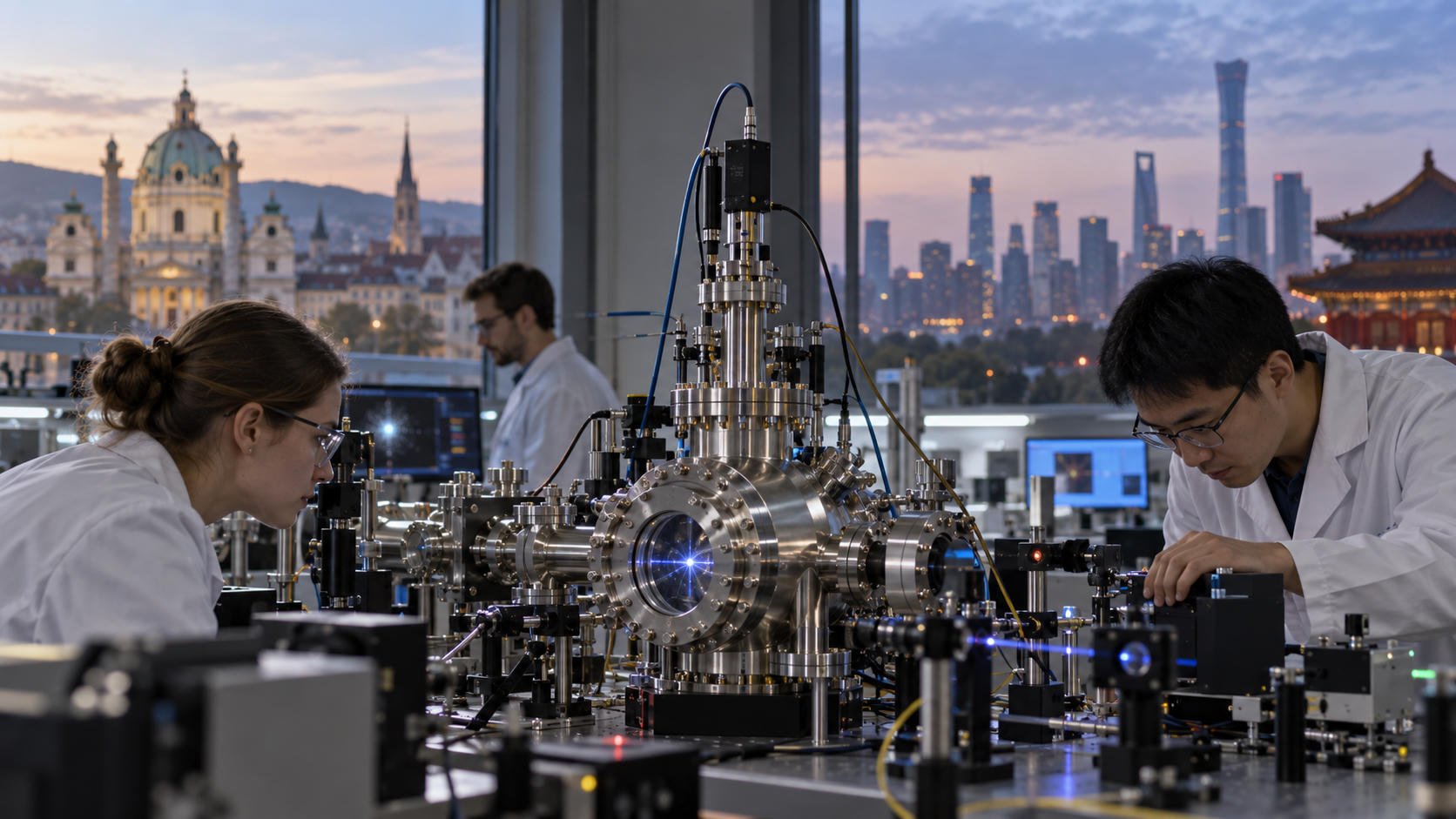
Scientists in Vienna and Beijing have reportedly demonstrated working nuclear-clock systems, marking a potential milestone in precision timekeeping. The technology could eventually improve tests of fundamental physics, navigation, geodesy, telecommunications, and advanced measurement systems. Source 3
This achievement does not mean nuclear clocks are ready to replace the atomic clocks used in global navigation and telecommunications. It represents an experimental milestone: researchers are learning to use a transition inside an atomic nucleus as a highly stable frequency reference.
What Is a Nuclear Clock?
A clock measures a repeatable physical process. Mechanical clocks use pendulums, electronic clocks use quartz oscillations, and atomic and nuclear clocks use quantum transitions.
Conventional atomic clocks measure transitions involving electrons surrounding an atom’s nucleus. A nuclear clock measures a transition between energy states inside the nucleus itself. Because the nucleus is tightly bound and less exposed to some external disturbances, nuclear clocks could eventually enable even more precise time and frequency measurements.
A nuclear clock does not produce nuclear power, operate like a reactor, or use radioactive decay as its ordinary timing mechanism. It measures a controlled quantum transition between nuclear energy states.
How Atomic Clocks Keep Time
Atomic clocks use the frequency of radiation associated with a transition between energy levels. Cesium atomic clocks underpin the international definition of the second, which is based on a specific microwave transition in cesium-133. Source 1
Modern atomic clocks control temperature, magnetic fields, laser frequency, atomic motion, collisions, and other environmental effects. Optical atomic clocks use higher-frequency transitions than traditional microwave clocks and rank among the most precise instruments ever built.
Recent advances have raised the possibility of redefining the second in the future. Such a change would require extensive international comparisons and agreement among metrology organizations. Source 7
Why Thorium-229 Matters
Thorium-229 is central to nuclear-clock research because it has an unusually low-energy nuclear transition. Most nuclear transitions require extremely energetic radiation that is difficult to control with laboratory lasers. The thorium-229 transition may be accessible through laser-based excitation and precision spectroscopy.
A simplified experiment involves four stages:
- Researchers prepare thorium-229 nuclei in a controlled environment.
- They direct precisely tuned laser light at the nuclei.
- They detect the transition between nuclear energy states.
- They use the resulting frequency as a reference for time and measurement.
The experiment remains difficult. Scientists must locate the correct resonance, stabilize the laser, control the nuclei, and distinguish the desired signal from environmental effects.
How the First Nuclear Clocks Were Built
Reports identify researchers in Vienna and Beijing as contributors to the development of early nuclear-clock systems. The work combines nuclear physics, optical spectroscopy, laser stabilization, materials science, and metrology. Source 3
The phrase “first nuclear clock” can refer to observing the nuclear transition, measuring its frequency, or demonstrating a complete clock architecture. Performance criteria also matter. The reported milestone should therefore be interpreted carefully: it shows that nuclear-clock technology is moving toward a working measurement system, not that nuclear clocks already outperform every atomic clock.
Crystal-Based Systems
One approach places thorium-229 nuclei inside a crystal. The crystal holds the nuclei in fixed positions and allows researchers to study many nuclei at once. A solid-state system may eventually be easier to operate than a system based on a single isolated ion.
However, the crystal also introduces sources of error. Crystal symmetry, electric fields, defects, temperature, and strain can affect each nucleus’s local environment. Researchers have reported identifying an optimal crystal site for an ultra-accurate nuclear clock. Source 9
The material that enables the clock can therefore become a source of error. Scientists must understand the crystal at the atomic scale before treating it as a reliable frequency reference.
Accuracy, Stability, and Precision
A nuclear clock must account for temperature changes, magnetic and electric fields, vibrations, laser-frequency noise, crystal defects, and interactions between the nuclei and host material.
- Accuracy describes how closely the measured frequency matches the ideal reference.
- Stability describes how consistently the frequency remains constant over time.
- Precision describes how finely the experiment can resolve a measurement.
A clock can be stable but inaccurate if it maintains a constant incorrect frequency. It can also be precise in the short term but unstable over longer periods. A practical nuclear clock must perform well in all three categories.
Why Nuclear Clocks Could Be More Accurate
Lower Sensitivity to Some Disturbances
Electrons respond directly to external electromagnetic fields, creating systematic shifts that researchers must measure and correct. A nuclear transition may be less sensitive to some of these influences because the nucleus is tightly bound. This is a potential advantage, not a guarantee: nuclear clocks still interact with their surroundings, and crystal hosts introduce additional material effects.
Higher-Frequency Operation
A higher-frequency reference provides more oscillation cycles over a given interval, potentially improving the detection of small frequency changes. The benefit depends on the entire system. A high-frequency transition does not create a better clock if the laser is unstable, the signal is weak, or environmental effects are poorly understood.
A Possible Redefinition of the Second
The reported developments do not redefine the second. Any future redefinition would require independent replication, long-term stability, comparisons with leading optical atomic clocks, international measurements, reliable operation in different environments, and a demonstrated advantage over existing standards.
Potential Applications
Fundamental Physics
Highly accurate clocks can detect tiny frequency changes caused by motion, gravity, fields, or possible variations in physical constants. Nuclear clocks could help investigate relativistic effects, dark-matter signatures, interactions between gravity and quantum systems, and deviations from the Standard Model.
The technology does not constitute a discovery of new physics by itself. It provides a more sensitive instrument for testing established theories.
Navigation and Positioning
Navigation systems depend on precise timing. Better clocks could support more accurate satellite navigation, improved network synchronization, positioning with limited external signals, and advanced scientific or military timing systems.
Practical benefits would require compact, robust, and low-power devices. A laboratory clock cannot immediately serve as a navigation component.
Geodesy and Gravity Mapping
General relativity predicts that clocks run at slightly different rates in different gravitational potentials. Networks of highly accurate clocks could measure these differences and map changes in Earth’s gravitational field. Potential uses include monitoring groundwater, studying ice loss and sea-level change, detecting geological movement, and improving models of Earth’s interior.
Telecommunications and Scientific Instruments
Accurate frequency references support optical communications, distributed scientific instruments, radio astronomy, quantum technologies, and secure timing networks. Nuclear clocks could eventually synchronize instruments over large distances and provide stable optical references.
Nuclear Clocks vs. Atomic Clocks
| Feature | Atomic clock | Nuclear clock |
|---|---|---|
| Reference transition | Electron energy levels | Nuclear energy levels |
| Typical control method | Microwave or optical radiation | Highly tuned optical radiation |
| Research status | Mature and widely deployed | Emerging and experimental |
| Potential advantage | Established reliability | Possible lower sensitivity to some disturbances |
| Main challenge | Managing environmental shifts | Accessing and controlling the nuclear transition |
Atomic clocks remain the practical standard for international timekeeping, navigation, telecommunications, and scientific measurement. Nuclear clocks are a possible next-generation technology, not immediate replacements.
Challenges Ahead
Researchers must reproduce the results independently, confirm the transition frequency, characterize systematic shifts, and compare results across laboratories. They must also understand crystal defects, local electric fields, temperature dependence, nuclear interactions, material stability, and variations between crystal sites. Source 9
Field-ready systems will also need compact lasers, low-power electronics, thermal stability, vibration resistance, automated calibration, long-term reliability, and affordable manufacturing. A transition demonstrated in a controlled laboratory is only the first step toward a practical instrument.
Conclusion
Scientists have reported early nuclear-clock demonstrations and identified promising methods for improving their accuracy. The essential advance is the shift from measuring electron transitions to measuring a controlled transition inside an atomic nucleus.
Thorium-229 is important because its unusually low-energy nuclear transition may be accessible with laser-based techniques. Crystal-based systems could allow researchers to control many nuclei at once, although the crystal environment must be characterized carefully.
Nuclear clocks could improve fundamental-physics tests, navigation, geodesy, telecommunications, and precision measurement. Their practical value remains unproven until researchers demonstrate stable, reproducible, independently verified performance.
Frequently Asked Questions
What is a nuclear clock?
A nuclear clock is a precision timekeeping device based on a transition between energy states inside an atomic nucleus. An atomic clock generally uses transitions involving electrons.
Are nuclear clocks more accurate than atomic clocks?
They have the potential to become more accurate, but the technology remains experimental. Existing atomic clocks are mature and provide exceptional accuracy.
Why is thorium-229 important?
Thorium-229 has an unusually low-energy nuclear transition that may be accessible through laser-based techniques. Most nuclear transitions require much higher-energy radiation.
Will nuclear clocks replace atomic clocks?
Not immediately. Atomic clocks remain the foundation of international timekeeping, navigation, telecommunications, and scientific measurement. Nuclear clocks could eventually complement or outperform some systems if they prove reliable and practical.
Could nuclear clocks improve GPS and navigation?
They could improve the timing and synchronization systems used in satellite navigation and advanced positioning. The impact depends on reducing device size, cost, power consumption, and environmental sensitivity.
When will nuclear clocks be used commercially?
No firm commercial timeline has been established. Researchers must first demonstrate long-term stability, reproducibility, independent verification, and practical engineering.