IceCube and Francis Halzen: The 2026 Nobel Claim
IceCube and Francis Halzen: The 2026 Nobel Claim
Reports state that the IceCube Neutrino Observatory’s high-energy neutrino research and physicist Francis Halzen received the 2026 Nobel Prize in Physics. However, the supplied reports do not include an official announcement from the Nobel Foundation. Verify the award, citation, and laureate list through the official Nobel Prize website before publishing this as confirmed news.
Why IceCube’s Neutrino Research Matters
IceCube offers a new way to study the universe. Instead of relying only on light, scientists detect high-energy neutrinos: electrically neutral subatomic particles that can travel through space and matter with little interference.
The observatory lies deep beneath the South Pole. Its sensors monitor flashes of light produced when rare neutrino interactions occur in Antarctic ice. Most neutrinos pass through Earth undetected, but IceCube’s enormous detection volume makes it possible to capture some of these events.
Neutrinos are valuable cosmic messengers. Unlike charged cosmic rays, they are not deflected by magnetic fields. Unlike photons, they are far less likely to be absorbed or scattered by gas, dust, and radiation. They can therefore provide clues about violent environments such as active galaxies, black-hole systems, supernova remnants, and other potential particle accelerators.
A single neutrino event does not automatically identify its source. Researchers analyze its energy, direction, timing, and relationship to observations from other telescopes. Repeated detections and independent observations strengthen the evidence.
What Are High-Energy Neutrinos?
Neutrinos have extremely small masses and do not respond to electromagnetic forces. Their weak interaction with matter makes them difficult to detect, but it also allows them to preserve information about their origins across enormous cosmic distances.
Low-energy neutrinos are produced by sources such as the Sun and Earth’s atmosphere. IceCube focuses heavily on higher-energy events associated with extreme astrophysical processes. These events may help scientists understand how cosmic rays are accelerated and where the universe’s most energetic particles originate.
How IceCube Works
IceCube contains thousands of optical sensors embedded deep in Antarctic ice. Its detection process generally follows these steps:
- A neutrino reaches the ice.
- It rarely collides with an atomic particle.
- The collision creates charged secondary particles.
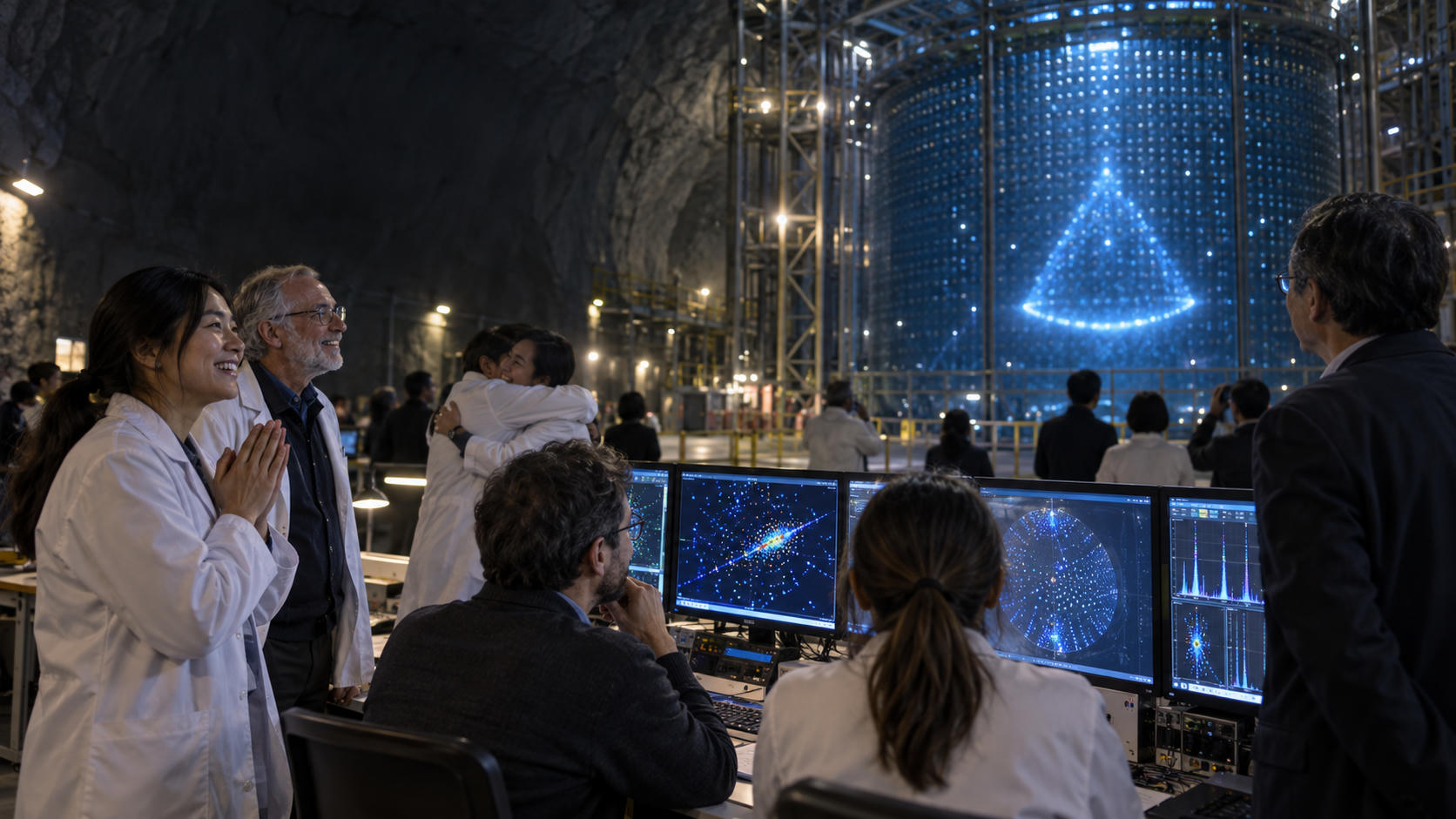
- Those particles produce blue Cherenkov light as they move through the ice.
- Optical sensors record the light’s timing and intensity.
Researchers use the resulting pattern to estimate the event’s direction, energy, and type. Track-like events can provide useful directional information, while contained light bursts offer other clues.
The South Pole provides a large, naturally occurring volume of transparent material. The depth also helps reduce some backgrounds, although IceCube must still distinguish cosmic events from atmospheric neutrinos, cosmic-ray products, sensor noise, and other interference.
Constructing and operating the observatory required particle physics, astronomy, engineering, glaciology, software development, data analysis, and logistics. The remote Antarctic environment limits construction and maintenance opportunities, making long-term reliability essential.
Francis Halzen’s Role
Francis Halzen is associated with the scientific vision behind IceCube and the development of high-energy neutrino astronomy. He helped build the case for a kilometer-scale detector capable of recording enough rare interactions to study cosmic neutrinos systematically.
A detector of this size required more than a theoretical proposal. Researchers had to secure funding, design and deploy the sensor array, establish an international collaboration, and develop methods for analyzing faint signals against substantial backgrounds.
Recognition for Halzen would reflect scientific leadership and institution building, not the work of one person alone. IceCube depends on engineers, technicians, operators, software specialists, data analysts, and researchers across many countries.
What IceCube Has Revealed
IceCube is part of multi-messenger astronomy, which combines information from different types of observatories. Researchers can compare neutrino detections with:
- Optical and infrared observations.
- Radio measurements.
- X-ray and gamma-ray data.
- Cosmic-ray detections.
- Gravitational-wave signals.
Each messenger reveals different properties of an astrophysical event. Neutrinos can indicate high-energy particle interactions, while electromagnetic observations may identify a source’s location and changing brightness. Gravitational waves can reveal the motion or collision of massive compact objects.
Associating a neutrino with a source requires statistical analysis. Scientists compare an event’s location and timing with possible cosmic objects and assess whether the relationship is unlikely to have occurred by chance. Directional uncertainty, limited event numbers, and background signals can make this process difficult.
Why Detection Is Difficult
Neutrinos’ scientific value comes from the same property that makes them challenging to detect: they interact weakly with matter. Most neutrinos pass through IceCube without leaving a trace.
A successful observatory therefore needs a large detection volume, sensitive optical sensors, precise timing, advanced reconstruction software, effective background reduction, and years of continuous operation.
Scientists distinguish possible cosmic events using energy, arrival direction, event topology, timing, sensor response, and expected background rates. No single measurement is sufficient in every case. Strong conclusions require careful analysis, peer review, and, where possible, confirmation from other observatories.
What the Reported Nobel Recognition Would Mean
If officially confirmed, the reported Nobel Prize would recognize neutrino astronomy as a major method for studying the universe. IceCube extends astronomy beyond visible light, radio waves, X-rays, and gamma rays by using particles that can cross matter with little interference.
It would also recognize the importance of large-scale scientific collaboration. IceCube required decades of planning, construction, calibration, operation, and analysis. Its results depend on international funding, specialized engineering, technical maintenance, and coordinated research.
The recognition would not mean that scientists have identified every cosmic neutrino source or fully explained how the universe accelerates its highest-energy particles. Neutrino detection remains technically demanding, and many events require further observations before their origins can be established.
The Future of Neutrino Astronomy
Future observatories may use larger detection volumes, more sensitive sensors, improved calibration, and more precise reconstruction methods. These advances could increase event rates and improve estimates of direction and energy.
A stronger multi-messenger network will also be important. Coordinated observations by neutrino detectors, optical telescopes, X-ray and gamma-ray instruments, cosmic-ray facilities, and gravitational-wave observatories could provide a more complete picture of cosmic explosions and active galaxies.
Conclusion
IceCube transformed Antarctic ice into an astronomical instrument. By detecting rare flashes from neutrino interactions, it gave scientists a new way to investigate the universe’s most energetic environments.
Francis Halzen helped develop the scientific case for a large neutrino detector and connect particle physics with astrophysical questions. The achievement also reflects the work of the international community that designed, built, operated, and analyzed IceCube.
The supplied reports describe a 2026 Nobel Prize in Physics recognition for IceCube’s high-energy neutrino research and Francis Halzen. Confirm the award through the official Nobel Prize website before presenting the claim as established news.
FAQ
What is IceCube?
IceCube is a neutrino observatory installed deep in the Antarctic ice near the South Pole. It detects light produced when neutrinos interact with the ice.
Why are neutrinos called ghost particles?
Neutrinos interact very weakly with matter, so most pass through Earth and human bodies without being detected.
How does IceCube detect neutrinos?
A rare neutrino collision creates charged particles that emit Cherenkov light. IceCube’s optical sensors record that light and help researchers estimate the event’s energy and direction.
Who is Francis Halzen?
Francis Halzen is a physicist associated with IceCube and the development of high-energy neutrino astronomy.
What can high-energy neutrinos reveal?
They can provide evidence about extreme cosmic environments and possible particle accelerators. Researchers compare neutrino events with observations from other kinds of observatories.
Has the 2026 Nobel Prize claim been confirmed?
The supplied reports make this claim but do not include an official Nobel announcement. Verify the laureates, citation, and award details through the official Nobel Prize website.