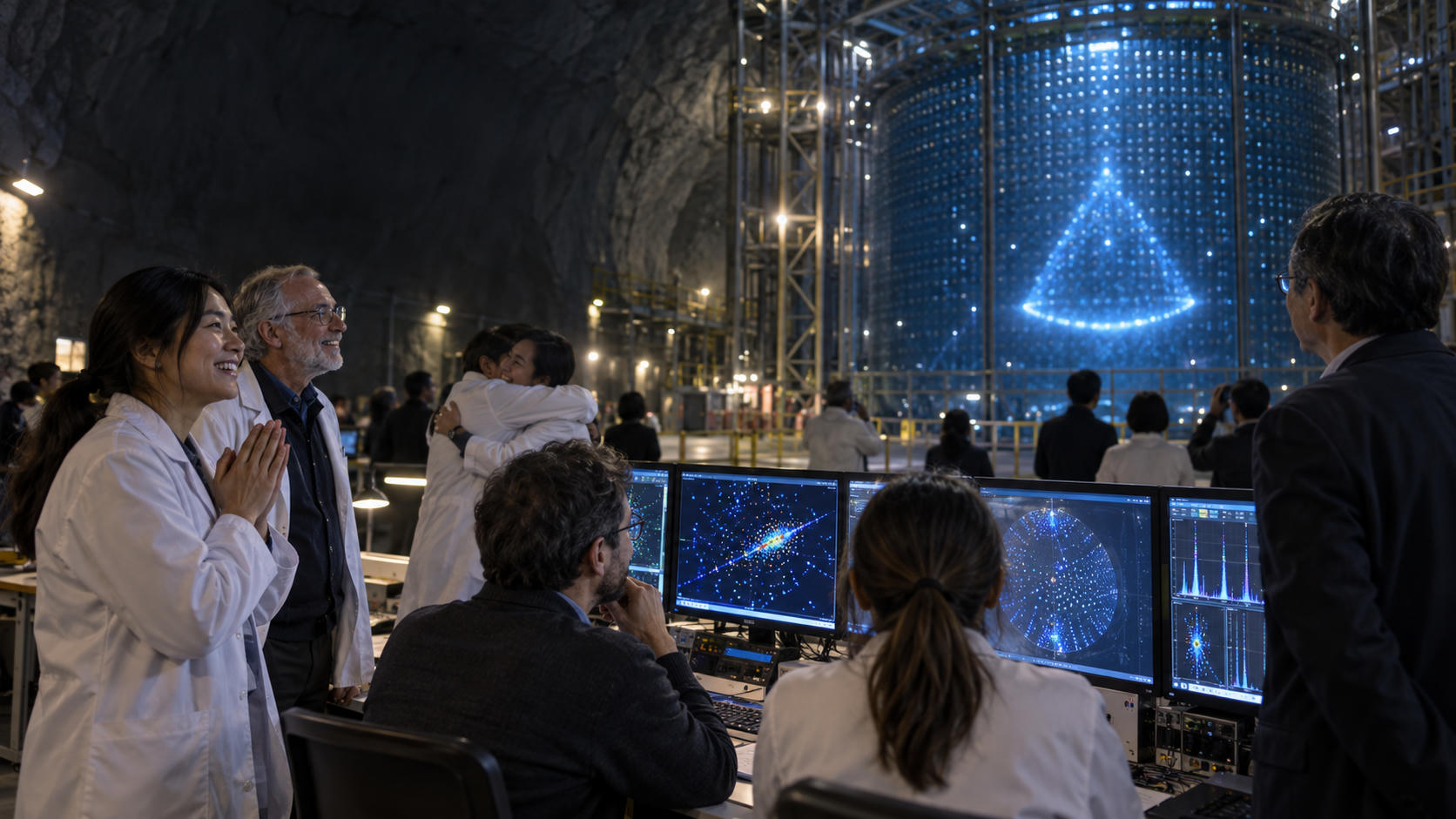
Nuclear Clocks Begin Ticking in Vienna and Beijing
Nuclear Clocks Begin Ticking in Vienna and Beijing
Researchers in Vienna and Beijing have begun operating working nuclear clocks, marking a major development in precision timekeeping. Unlike conventional atomic clocks, which measure transitions involving electrons, nuclear clocks measure a transition inside an atomic nucleus.
The reported systems use thorium-229, an isotope with an unusually low-energy nuclear transition. Ultraviolet light can reach this transition, giving researchers a practical way to control the nuclear state with lasers. After decades of research, nuclear timekeeping has moved from a theoretical possibility to a functioning laboratory technology. Source 5
The achievement does not mean nuclear clocks have surpassed the best atomic clocks. Current systems are reportedly about 1,000 times less accurate than leading atomic clocks. Their importance lies in demonstrating continuous nuclear timekeeping and establishing a platform for future improvements. Source 7
What Is a Nuclear Clock?
How Atomic Clocks Work
An atomic clock uses a stable frequency associated with an energy transition in an atom. In modern optical clocks, lasers stimulate transitions between energy levels associated with electrons.
The process is precise but straightforward:
- A laser or microwave signal interacts with atoms.
- Researchers compare the signal frequency with the atomic transition.
- A feedback system corrects oscillator drift.
- The locked frequency becomes the clock’s reference.
Atomic clocks support satellite navigation, telecommunications, financial networks, scientific experiments, and international time standards. Even a small timing error can produce a significant positioning error in navigation systems.
How Nuclear Clocks Differ
A nuclear clock uses a transition inside the nucleus rather than one involving electrons. The nucleus is compact and more tightly bound than the surrounding electron cloud. Electrons can be affected by electric and magnetic fields, temperature, collisions, and other environmental factors. A nuclear transition may be less sensitive to some of these disturbances.
That potential resistance gives nuclear clocks their appeal. However, a complete clock also depends on its laser, detector, trap, feedback electronics, vacuum system, materials, and measurement procedures. A stable nuclear transition can still be difficult to operate in practice.
Why Thorium-229 Matters
Most nuclear transitions are unsuitable for clock technology because they involve very high-energy photons, often in the gamma-ray range. Thorium-229 is different: its nucleus has an unusually low-energy excited state that can be reached with ultraviolet light.
This makes laser-based control possible. Researchers can excite the thorium-229 nucleus, observe its response, and compare the laser frequency with the nuclear transition.
Developing the technology required decades of work. Researchers had to identify and characterize the transition, determine its energy and wavelength, build suitable ultraviolet sources, and create systems capable of isolating and observing thorium-229.
A working nuclear clock must do more than detect a single transition. It must repeatedly excite, measure, correct, and control the frequency over time. The reported results from Austria and China show that researchers can now operate systems based on this cycle. Source 1
Vienna and Beijing Reach the Milestone
The Vienna-based effort is one of the first successful attempts to turn the thorium-229 transition into a continuously operating clock. Its significance lies in demonstrating that nuclear timekeeping can function as an experimental platform that researchers can test, modify, and compare with other designs.
A Beijing-based research effort has also produced a working thorium-229 nuclear clock. Reports indicate that the Chinese system may be more stable than the Vienna system. Source 3
Stability and accuracy are different. Stability describes how consistently a clock’s frequency behaves over time. Accuracy describes how closely its measurement agrees with the accepted value of the second. A clock can be more stable over a particular interval without being more accurate under every condition.
A meaningful comparison requires equivalent test conditions, repeated measurements, and complete uncertainty estimates. Parallel demonstrations in Vienna and Beijing can help researchers identify performance limits, compare ultraviolet laser designs, test thorium-229 environments, improve detectors, and establish shared measurement standards.
Current Limitations
The first nuclear clocks remain experimental. Reports place their accuracy at roughly 1,000 times below that of leading atomic clocks. Source 5
Potential limitations include:
- Ultraviolet laser noise.
- Weak nuclear-transition signals.
- Difficulty maintaining thorium-229 in the required state.
- Environmental disturbances.
- Detector noise.
- Systematic frequency shifts.
- Complex calibration requirements.
- Limited uninterrupted operating time.
A “working nuclear clock” therefore describes a functional breakthrough, not a finished time standard. The technology remains far from replacing atomic clocks in navigation, telecommunications, or national timing systems.
Potential Applications
Navigation
More accurate clocks could improve synchronization among satellites, ground stations, and receivers. Possible long-term benefits include improved positioning, stronger satellite synchronization, and more resilient navigation infrastructure. Major improvements in accuracy, size, reliability, power consumption, and environmental resistance are still required.
Fundamental Physics
Clocks can test gravity and search for variations in fundamental constants. Comparing nuclear and electronic transitions may reveal effects that remain hidden when researchers use only one clock type.
Geodesy
Relativity causes clocks at different gravitational potentials to run at slightly different rates. More accurate clocks could eventually measure height differences through these frequency shifts, supporting groundwater monitoring, ice-loss studies, geological research, and measurements of Earth’s mass distribution.
Communications and Scientific Measurement
Nuclear clocks may contribute to high-precision spectroscopy, distributed scientific instruments, deep-space communications, laboratory frequency standards, and synchronized networks. These applications require smaller, lower-power, more reliable systems than current laboratory prototypes.
Nuclear Clocks Versus Atomic Clocks
Leading optical atomic clocks remain the benchmark for precision timekeeping because they benefit from mature lasers, extensive calibration experience, established comparison methods, and decades of engineering development.
Nuclear clocks may eventually offer a more protected frequency reference because the nucleus is less exposed to certain environmental effects. The likely development path is gradual:
- Demonstrate reliable operation.
- Improve short-term stability.
- Reduce systematic errors.
- Validate results across laboratories.
- Build compact, deployable systems.
- Integrate them with existing timing networks.
Nuclear clocks may complement atomic clocks rather than replace them. Using different clock technologies together could improve international time standards and enable new tests of physics.
What Happens Next?
Researchers will need stronger and more repeatable thorium-229 measurements, more stable ultraviolet lasers, improved ion trapping, lower-noise detectors, longer operating times, and better feedback and calibration systems.
Comparisons among laboratories in Vienna, Beijing, and elsewhere will be essential. Standardized test conditions, independent replication, and transparent uncertainty budgets can establish whether reported stability advantages persist under equivalent conditions.
A practical nuclear clock must also be smaller, more reliable, easier to operate, and less sensitive to vibration and temperature. Moving from controlled laboratory systems to navigation, communications, or geodesy will require years of additional research.
A Milestone, Not the End of the Race
Vienna and Beijing have demonstrated working nuclear-clock systems based on thorium-229. Their results show that a transition inside an atomic nucleus can support continuous timekeeping rather than merely a brief experimental observation.
Current systems remain about 1,000 times less accurate than leading atomic clocks. The Beijing system has been reported as more stable than its Vienna counterpart, but that result requires careful interpretation because stability and accuracy describe different aspects of performance.
The central achievement is proving that nuclear timekeeping can operate in practice. Researchers now have a platform for improving lasers, traps, detectors, materials, and control systems. If those improvements succeed, nuclear clocks could contribute to navigation, fundamental physics, gravity mapping, spectroscopy, communications, and future timing networks.
For now, the first nuclear clocks are not replacements for atomic clocks. They are prototypes at the beginning of a new race in precision timekeeping.
FAQ
What is a nuclear clock?
A nuclear clock measures time using a stable transition inside an atomic nucleus. The reported systems use thorium-229, whose low-energy transition can be controlled with ultraviolet light.
How is a nuclear clock different from an atomic clock?
An atomic clock measures transitions involving an atom’s electrons. A nuclear clock measures a transition inside the nucleus, which may be less sensitive to some external disturbances.
Where were the first nuclear clocks developed?
The first reported working systems were developed by research groups in Vienna, Austria, and Beijing, China. Both efforts focus on controlling the thorium-229 nuclear transition. Source 1
Are nuclear clocks more accurate than atomic clocks?
Not yet. The reported nuclear clocks are about 1,000 times less accurate than leading atomic clocks. Their importance lies in their potential for improvement.
Why is thorium-229 used?
Thorium-229 has an unusually low-energy nuclear transition that can be accessed with ultraviolet light, making laser-based control possible.
What could nuclear clocks be used for?
Potential applications include navigation, gravity and height measurements, fundamental-physics tests, spectroscopy, communications synchronization, and future precision timing networks.