Thorium-229 Optical Nuclear Clock Explained
Thorium-229 Optical Nuclear Clock With a Feedback Loop
Why Nuclear Clocks Matter
The most precise clocks use optical transitions in atoms. They measure the frequency of electrons moving between sharply defined energy levels. A nuclear clock takes a different approach: it uses a transition between energy states inside an atomic nucleus.
Thorium-229 is the leading candidate because it has an unusually low-energy nuclear transition. Unlike most nuclear transitions, which require high-energy radiation, the thorium-229 transition can potentially be addressed with ultraviolet laser light. This makes laser spectroscopy, frequency control, and clock operation possible.
Researchers have reported observing the thorium-229 nuclear “tick,” marking a major step toward a new generation of precision instruments Source 7. Other work has focused on synchronizing a clock to the thorium-229 nuclear transition Source 5.
The feedback loop is central to making this transition useful. It detects whether the laser is slightly above or below resonance, corrects the laser frequency, and keeps the system locked to the nuclear reference. This process converts a delicate spectroscopic signal into a continuous timekeeping output.
What Is a Thorium-229 Optical Nuclear Clock?
From Atomic Clocks to Nuclear Clocks
An optical clock measures an optical-frequency transition with exceptional precision. In a conventional atomic clock, the transition occurs when an electron moves between discrete energy levels around the nucleus.
A nuclear clock instead uses two energy states within the nucleus itself. The nucleus contains protons and neutrons bound by the strong nuclear force. Under suitable conditions, it can occupy a ground state or an excited state. The frequency separating those states becomes the clock reference.
Nuclear transitions may offer an important advantage. Electron clouds extend into the surrounding environment and can respond to electric and magnetic fields, collisions, temperature, and external radiation. A compact nucleus is generally less exposed to these disturbances. Lower sensitivity could reduce certain frequency shifts and support improved long-term accuracy.
This advantage is not automatic. A nuclear clock still requires precise spectroscopy, stable lasers, environmental shielding, sensitive detection, and systematic-error correction. The complete clock is an engineered system, not merely a favorable energy level.
Why Thorium-229 Is Promising
Thorium-229 contains a long-lived excited nuclear state called an isomer. The energy gap between the nuclear ground state and this isomer is unusually small for a nuclear transition. That low energy is the key technological feature.
Because the transition lies in the ultraviolet region, researchers can use laser-based methods to probe it. A laser can be tuned across the expected resonance while detectors monitor fluorescence, electron emission, or another change associated with nuclear excitation.
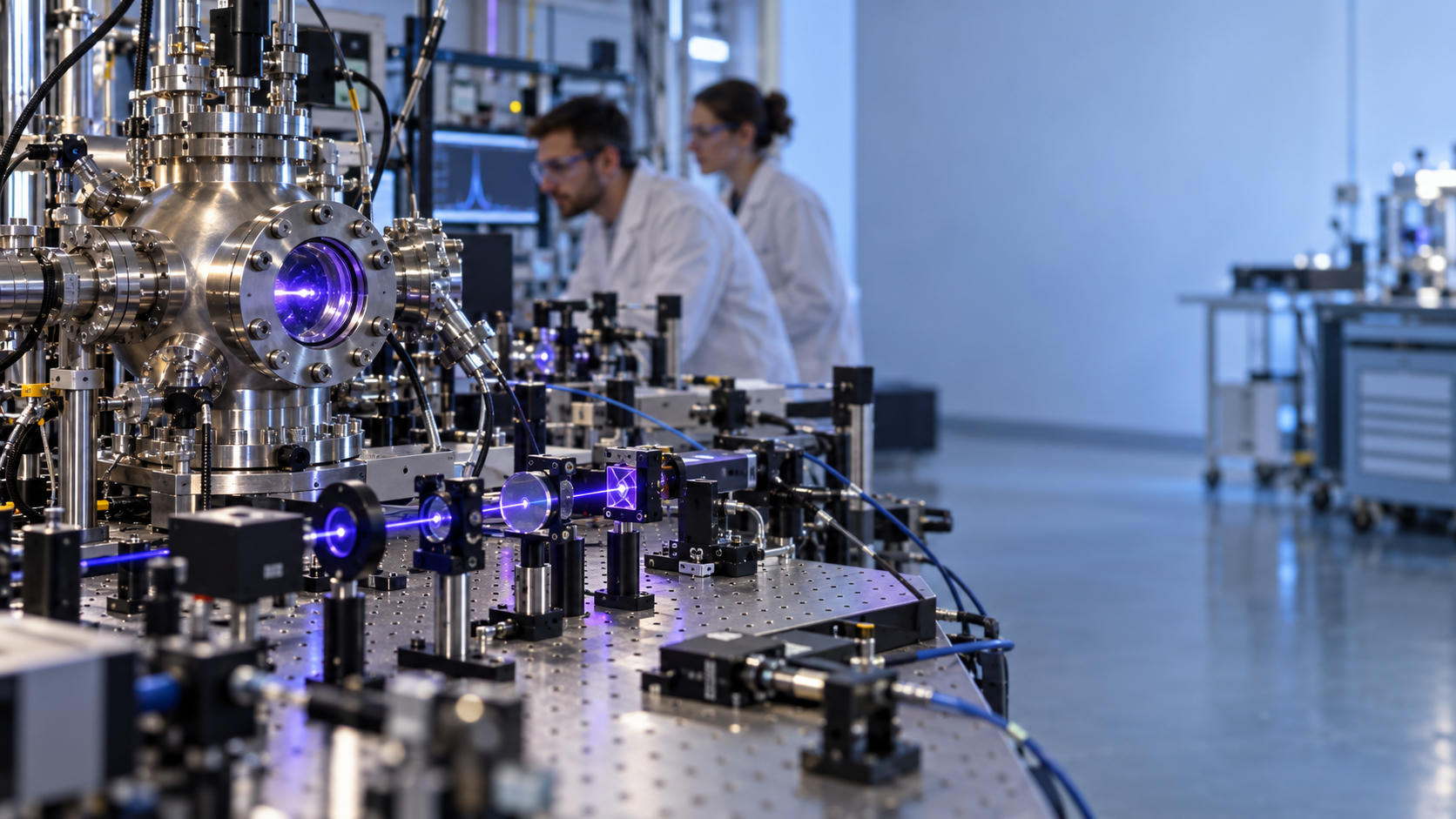
A basic system may contain thorium-229 ions, thorium embedded in a crystal, or another thorium-containing sample. It also needs an ultraviolet excitation laser, a detector, frequency-control electronics, and environmental stabilization.
The technology remains developmental. Observing the transition and building a controlled frequency reference are major milestones, but they do not yet make every thorium-229 experiment a finished commercial clock.
How the Nuclear Transition Produces a Clock Signal
Energy Levels and Resonance
The thorium-229 nucleus has a ground state and a long-lived excited isomeric state. The energy difference between them corresponds to a particular optical frequency.
Researchers tune an ultraviolet laser near that frequency. When the laser matches the nuclear transition, the thorium-229 nuclei respond more strongly. The resulting resonance identifies the frequency that the clock should follow.
The “tick” is not a mechanical movement. It is the repeated electromagnetic oscillation associated with the transition frequency. A higher frequency provides more cycles per second, while a narrow and stable resonance allows those cycles to be counted with greater precision.
In practice, the clock does not simply count visible pulses from the nucleus. It uses the nuclear resonance to stabilize the laser. The stabilized optical frequency then becomes the clock’s reference signal. Electronics can measure, divide, transmit, or compare that signal with other frequency standards.
Detecting the Nuclear Tick
A nuclear transition must produce a measurable experimental signature. Possible signals include ultraviolet fluorescence, internal-conversion electrons, changes in an ion’s state, or decay products from the excited nucleus.
The signal may be weak. Researchers often need repeated interrogations, background subtraction, and statistical analysis to distinguish nuclear excitation from detector noise or unrelated events.
Three elements must be separated:
- The nuclear transition is the physical frequency reference.
- The detection signal is the evidence that excitation occurred.
- The clock output is the stabilized laser or electronic frequency derived from that transition.
The first observation of the thorium-229 nuclear “tick” therefore represents detection of a physical resonance, not necessarily the completion of a mature time standard. It establishes that the transition can be observed and used as the foundation for further frequency control Source 7.
How the Feedback Loop Keeps the Clock Locked
Why Open-Loop Control Is Not Enough
A free-running laser changes frequency over time. Temperature shifts alter optical components. Mechanical vibration changes cavity dimensions. Acoustic noise, electrical fluctuations, beam-pointing changes, and component aging also contribute to drift.
A one-time calibration cannot compensate for these effects. Even a highly stable laser eventually moves away from the thorium-229 resonance. Once that happens, the nuclear response weakens and the clock loses its reference.
A closed feedback loop solves this problem by measuring the frequency error and applying a correction. The loop repeatedly determines whether the laser is centered on the transition and adjusts the laser to reduce the error.
Main Components
A thorium-229 frequency-control loop can be represented as a sequence of linked functions:
- Ultraviolet laser: Produces light near the thorium-229 transition.
- Frequency actuator: Changes the laser frequency through current tuning, a piezoelectric element, an acousto-optic modulator, or an electro-optic modulator.
- Thorium-229 sample: Receives the laser light.
- Detector: Measures fluorescence, electrons, ion-state changes, or another nuclear response.
- Frequency discriminator: Converts the measured response into information about the laser’s position relative to resonance.
- Servo controller: Calculates the required correction.
- Actuator: Applies that correction to the laser.
- Clock output: Uses the stabilized optical frequency as the time reference.
The detector signal contains both useful information and noise. The controller must identify the part caused by frequency error without responding excessively to random fluctuations.
The loop also operates across different timescales. Fast control suppresses rapid laser noise and vibration. Slower control compensates for thermal drift, component aging, and environmental changes. A high-bandwidth actuator may handle rapid corrections, while a slower tuning mechanism manages larger long-term changes.
How the Loop Finds Resonance
The system must determine whether the laser is above or below the nuclear resonance. One method probes the transition at two nearby frequencies. The laser is moved slightly to one side of the expected resonance and then to the other. The detector responses are compared.
If the response is stronger on one side, the difference indicates the direction of the frequency error. The controller applies a correction in the opposite direction. Repeating this process keeps the laser near the center of the resonance.
Related techniques include frequency-modulation spectroscopy, two-point sampling, lock-in detection, and Ramsey-style interrogation. The chosen method depends on the thorium-229 platform, signal strength, transition linewidth, and required stability.
The feedback loop does not create the nuclear transition. It tracks the transition and prevents the laser from drifting away from it.
Building the Optical Nuclear Clock
Preparing and Controlling Thorium-229
The thorium-229 sample must be controlled well enough to produce a repeatable signal. Researchers can study trapped thorium-229 ions, thorium-doped crystals, thin films, or other solid-state configurations.
A trapped-ion platform provides control over individual particles and allows careful management of electric and magnetic fields. It can offer a clean environment, but it may produce a relatively weak signal because only a small number of nuclei are interrogated.
A solid-state host can contain many more thorium nuclei and produce a stronger collective signal. That advantage comes with additional complications. The host material can introduce lattice strain, electric fields, crystal-field shifts, defects, and a distribution of local environments. These effects may broaden the transition or shift its frequency.
Sample preparation therefore affects both detection and accuracy. A strong signal is useful for feedback, but the signal must also represent a well-characterized and reproducible nuclear frequency.
Stabilizing the Ultraviolet Laser
Ultraviolet laser systems can be difficult to stabilize. Frequency-conversion stages may add noise, optical components can degrade under intense ultraviolet exposure, and beam alignment can affect the interaction with the sample.
A practical stabilization hierarchy may begin by locking the laser to a highly stable optical cavity or another auxiliary reference. This first stage suppresses rapid frequency noise and provides a controllable operating point. A second stage locks the laser to the thorium-229 nuclear transition.
Environmental sensors can support feed-forward correction. If the system measures a predictable temperature or vibration effect, it can apply a compensating adjustment before that disturbance appears fully in the nuclear signal.
The nuclear transition remains the ultimate reference. Auxiliary cavities and electronic systems improve short-term control and help the loop acquire or maintain lock.
Measuring Systematic Shifts
Clock accuracy depends on identifying frequency shifts caused by the environment. Relevant effects may include electric and magnetic fields, temperature, blackbody radiation, trapped-ion motion, laser intensity, laser polarization, collisions, and interactions with nearby particles.
Solid-state samples add crystal-field effects, lattice strain, defects, and local chemical environments. These effects may vary from one host material to another.
Researchers can characterize a shift by changing one environmental parameter, measuring the resulting frequency change, and extrapolating to a defined operating condition. They may then shield the system, stabilize the parameter, correct the measured frequency, or redesign the sample environment.
Stability measures how consistently the clock maintains its frequency over time. Accuracy measures how closely the realized frequency matches the intended reference. A clock can be highly stable but inaccurate if it maintains a shifted frequency. It can also be accurate on average but unstable if noise causes large short-term fluctuations.
Potential Benefits
Reduced Sensitivity to Disturbances
The nucleus is extremely compact compared with the surrounding electron cloud. External electric and magnetic fields may therefore affect some nuclear properties less strongly than they affect electronic transitions.
If the thorium-229 transition is sufficiently narrow and environmental shifts are well controlled, the clock could support high precision. However, the practical result depends on the platform. A trapped ion and a thorium-doped crystal experience different perturbations, and a host material may introduce shifts that do not occur in an isolated ion.
A Test of Fundamental Physics
An exceptionally stable nuclear frequency could provide a sensitive probe of changes in fundamental constants. Researchers can compare a thorium-229 clock with optical atomic clocks based on different electronic transitions.
If a fundamental parameter changed over time, different clocks might respond by different amounts. Comparisons could test possible variation in the fine-structure constant, electromagnetic interactions, nuclear forces, or related parameters.
No new physics has been established by the thorium-229 clock. The opportunity depends on future improvements in stability, accuracy, and comparison methods Source 1.
Navigation, Geodesy, and Networks
Future nuclear clocks could support navigation when satellite signals are unavailable. A local high-performance clock would provide a reliable time base for inertial navigation and distributed sensing.
In relativistic geodesy, clock frequency reveals differences in gravitational potential. Two clocks at different heights experience slightly different rates. More precise clocks could measure smaller changes in elevation or gravitational field.
Other possible applications include:
- Synchronizing distributed scientific instruments.
- Testing general relativity.
- Improving precision frequency networks.
- Calibrating telecommunications and sensing systems.
- Supporting advanced navigation infrastructure.
These applications require more than a highly accurate laboratory transition. The system must become smaller, more robust, less power-intensive, and easier to operate. Reliable frequency transfer and automatic fault recovery will also be essential.
Main Technical Challenges
Weak Signals and Limited Transition Access
The low energy of the thorium-229 transition makes laser access possible, but excitation and detection remain difficult. The system must generate enough signal for the feedback loop without disturbing the transition or introducing excessive background.
Measurement time, detector efficiency, sample quality, and the number of interrogated nuclei all affect stability. Researchers must distinguish true nuclear events from background radiation, electronic noise, and instrumental artifacts.
Environmental Control and Reproducibility
A high-performance system may require vacuum equipment, magnetic shielding, temperature control, vibration isolation, and stable laser power.
A frequency reference is useful only if separate instruments can reproduce the same frequency. Solid-state systems may provide stronger signals, but host-material effects must be measured and controlled. Trapped-ion systems may offer cleaner conditions but require precise confinement and control.
Reproducibility across samples and laboratories will be an important test of whether thorium-229 can become a practical clock standard.
Engineering the Feedback System
The servo must react quickly enough to suppress laser noise without overcorrecting. Poor loop design can create oscillation, add noise, or cause the system to lose lock when the nuclear signal becomes weak.
A usable clock may require low-noise electronics, reliable lock acquisition, automatic relocking, independent diagnostics, and redundant frequency references. It must also distinguish a genuine loss of resonance from a temporary detector fluctuation.
Clock performance depends on the complete control system. A promising nuclear transition cannot compensate for unstable optics, poor sample preparation, inadequate detection, or an improperly tuned servo.
What the First Milestones Mean
Development progresses through several stages:
- Predicting and locating the thorium-229 transition.
- Detecting the transition experimentally.
- Measuring its frequency with increasing precision.
- Stabilizing a laser to the transition.
- Comparing the nuclear reference with established atomic clocks.
- Demonstrating long-term accuracy and reproducibility.
Reports describing the first observed nuclear “tick” establish a critical experimental foundation Source 7. Work on a clock synchronized to the thorium-229 transition represents progress toward using that resonance as an operational frequency reference Source 5.
Observing a nuclear response is not identical to delivering a mature time standard. The clock must still demonstrate precision, stability, accuracy, reproducibility, and reliable operation over long periods. A broader report that the nuclear clock has begun ticking provides useful milestone context, although the available summary contains limited technical detail Source 3.
Conclusion
Thorium-229 provides a promising nuclear frequency reference because its low-energy transition can be addressed with ultraviolet light. The laser probes the transition, the detector measures the nuclear response, and the feedback loop keeps the laser centered on resonance.
That loop transforms a delicate nuclear signal into a continuous clock output. It compensates for laser drift, suppresses noise, and preserves the connection between the optical frequency and the nuclear transition.
The potential benefits include more precise timekeeping, new tests of fundamental physics, improved geodesy, advanced navigation, and better synchronization of precision networks. The first observed nuclear ticks mark the beginning of clock development, not its final stage. The next challenge is to prove that thorium-229 can support a stable, accurate, reproducible, and practical time standard.
Frequently Asked Questions
What is a thorium-229 optical nuclear clock?
It is a clock that uses the low-energy nuclear transition of thorium-229 as its frequency reference. An ultraviolet laser probes the transition, while detectors and control electronics measure the response and stabilize the laser.
How does the feedback loop work?
The laser probes the thorium-229 transition at nearby frequencies. A detector measures the nuclear response, and a servo controller determines whether the laser is above or below resonance. The controller then adjusts the laser frequency, keeping it locked to the nuclear transition.
Why is thorium-229 used instead of another isotope?
Thorium-229 has an unusually low-energy nuclear transition, making it accessible with ultraviolet laser technology. Other nuclear transitions may require much higher-energy radiation or may be more difficult to excite, detect, and control.
Is a nuclear clock more accurate than an atomic clock?
A nuclear clock has the potential to outperform some atomic clocks, but that performance must be demonstrated. Laser noise, environmental shifts, sample quality, detection efficiency, systematic uncertainty, and feedback-loop design all affect the result.
What could thorium-229 nuclear clocks be used for?
Potential uses include fundamental-physics tests, relativistic geodesy, navigation, precision frequency networks, scientific instrument synchronization, and advanced time-transfer systems. Most applications remain developmental because current devices are laboratory instruments.
Has the thorium-229 nuclear transition been observed?
Yes. Researchers have reported observing the thorium-229 nuclear “tick,” an important milestone for nuclear timekeeping Source 7. Further work must improve frequency precision, stability, accuracy, and reproducibility before thorium-229 becomes a mature clock standard.