Quantum Spins Move a Centimeter-Scale Diamond
Quantum Spins Move a Centimeter-Scale Diamond
Researchers reportedly observed measurable movement in a centimeter-scale diamond while controlling quantum spin states inside it. The reported result could connect microscopic quantum behavior with visible mechanical motion.
The claim requires careful interpretation. It does not show that one isolated spin visibly pushed a diamond across a laboratory, nor that the entire diamond entered a large quantum superposition. Instead, the reported experiment concerns a controlled interaction among quantum spins, electromagnetic fields, and the mechanical response of a suspended object.
The supplied material does not include the original research paper, exact displacement, force measurements, uncertainty values, or complete experimental methods. These details must be confirmed before the result can be treated as a fully documented scientific finding.
What the Experiment Reportedly Demonstrated
According to the available summaries, researchers observed a measurable shift or movement in a centimeter-scale diamond while controlling spin states in nitrogen-vacancy centers Source 1.
The reported sequence is likely:
- Researchers prepare and manipulate spin states in defects within the diamond.
- The spin states change the diamond’s interaction with magnetic or electromagnetic fields.
- A spin-dependent force, torque, or energy change affects the diamond’s mechanical equilibrium.
- Optical and mechanical measurements record the response.
The phrase “quantum spins moved a diamond” summarizes this process but simplifies the mechanism. The macroscopic motion would likely reflect the combined response of many quantum defects and the diamond’s mechanical properties.
Why the Scale Matters
A nitrogen-vacancy center is an atomic-scale defect, whereas a centimeter-scale diamond contains an enormous number of atoms. Connecting these scales is difficult because larger systems interact more strongly with their surroundings.
Heat, vibration, airflow, electromagnetic interference, and mechanical friction can obscure a small quantum-generated signal. A large object also has multiple mechanical modes, allowing it to vibrate, rotate, or shift for reasons unrelated to the intended experiment.
The reported result is therefore significant as a quantum-to-mechanical interface. It suggests that controlled microscopic states can influence an extended object strongly enough for its motion to be measured directly. The diamond’s overall motion may still be accurately described by classical mechanics even when the interaction driving it originates in quantum spin states.
Quantum Spins in Plain Language
Spin is an intrinsic quantum property, not literal rotation in the same sense as a spinning ball. It determines how a particle or quantum defect responds to magnetic fields and interacts with other systems.
A useful, though incomplete, analogy is a tiny magnetic compass. A spin can occupy distinguishable states that respond differently to an external field. Researchers can prepare a state, change it with electromagnetic radiation, and detect it through optical or electrical signals.
Changing a spin state changes the system’s energy in an applied magnetic field. If the field is nonuniform, that energy change can produce a force. If the interaction depends on orientation, it can also produce torque. In a suspended diamond, even a small force may create a measurable displacement when the support has low stiffness or the system is driven near resonance.
The spin does not act as a miniature mechanical engine. Its state changes the diamond’s electromagnetic energy, and that energy difference can influence the object’s mechanical equilibrium.
Nitrogen-Vacancy Centers and Diamond
A nitrogen-vacancy center forms when a nitrogen atom replaces a carbon atom beside an empty lattice site. The nitrogen atom and vacancy create an electronic defect with useful spin states.
Researchers can initialize these states with laser light, manipulate them with microwave or radio-frequency signals, and detect them through changes in fluorescence. Nitrogen-vacancy centers can also sense magnetic fields, temperature, strain, and motion.
Diamond is suitable for this work because it combines a rigid crystal lattice, mechanical stability, optical transparency, thermal and chemical resistance, and compatibility with nitrogen-vacancy centers. The defects provide the quantum degrees of freedom, while the surrounding crystal provides the mechanical structure that can shift, vibrate, or rotate.
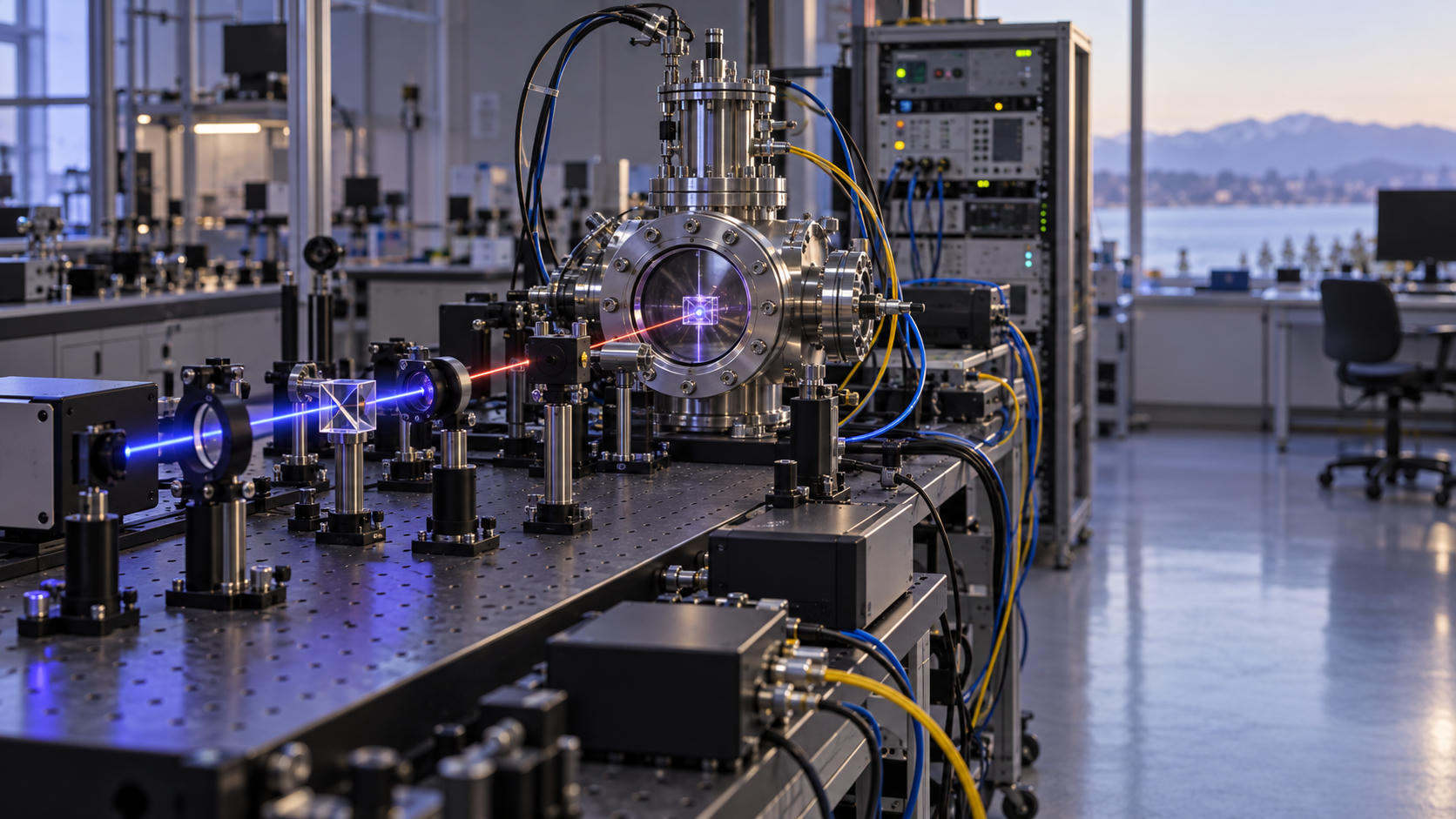
The supplied descriptions refer to a suspended diamond containing nitrogen-vacancy centers and illuminated by green laser light Source 5. Suspension reduces contact with surrounding materials and can make small forces easier to measure. The available summaries do not identify the exact hardware.
How Movement Could Be Detected
Green laser light commonly excites nitrogen-vacancy centers. The resulting fluorescence can depend on the spin state, creating an optical readout channel.
The laser alone does not prove that the diamond moved. Optical excitation can heat the material, create radiation pressure, or affect nearby equipment. These effects must be separated from the spin-dependent response.
A credible experiment would use independent measurement channels:
- Fluorescence would reveal spin behavior.
- Position-sensitive detection would record mechanical movement.
- Timing analysis would test whether the motion followed the spin-control sequence.
Researchers would also compare conditions with spin control enabled and disabled, reverse the magnetic-field direction, vary field strength and drive frequency, and change laser power independently of spin control. These controls help distinguish the intended response from heating, optical pressure, electromagnetic leakage, acoustic vibration, airflow, and instrument drift.
A schematic associated with the report was listed by EurekAlert! with an October 7, 2026 date Source 7. The supplied entry provides no scientific caption, trajectory, force value, or experimental explanation. Claims about direction, amplitude, or timing should therefore wait for the original figure and paper.
Why the Result Is Difficult
Quantum states lose coherence through interactions with heat, vibration, electromagnetic noise, and surrounding particles. This challenge becomes greater when a quantum system is embedded in a larger mechanical object.
The diamond must preserve a usable spin signal while remaining mechanically isolated. The laser must provide enough fluorescence without excessive heating, and magnetic and microwave controls must manipulate the spins without creating unrelated mechanical forces.
A rigorous report should state the displacement magnitude, force or torque estimate, measurement uncertainty, averaging time, mechanical resonance frequency, statistical significance, and calibration method. Those values are not included in the supplied summaries.
What the Result Does and Does Not Mean
The reported observation may represent a controlled connection between quantum information and mechanical motion. The diamond acts as an interface: spin states provide microscopic control, the crystal transmits the interaction, and the larger object responds.
It does not automatically show that:
- The entire diamond entered a large quantum superposition.
- The diamond became macroscopically entangled.
- One isolated spin generated a large displacement.
- Classical mechanics failed at the scale of the diamond.
- The experiment demonstrated telekinesis or force-free movement.
The most precise interpretation is that quantum-controlled internal states were associated with a measurable mechanical response from a larger object. Quantum control of an internal spin and quantum behavior of the diamond’s center of mass are different achievements.
Potential Applications
Spin-mechanical coupling could support sensitive measurements of magnetic fields, acceleration, force, position, and temperature. Hybrid systems may also connect spin-based quantum processors, photons, and mechanical resonators.
The reported experiment could contribute to this research direction by showing how a quantum spin system interacts with a mechanically mobile object. It is not, by itself, evidence of a working quantum memory or communication device.
Larger quantum-controlled systems may also help researchers study decoherence, weak forces, measurement back-action, and the boundary between quantum and classical physics.
Remaining Questions
The supplied reports leave several details unresolved:
- Exact diamond dimensions.
- Number and type of nitrogen-vacancy centers.
- Suspension method.
- Measured displacement.
- Force or torque value.
- Magnetic-field configuration.
- Laser wavelength and power.
- Environmental pressure and temperature.
- Position-measurement technique.
- Error bars and statistical analysis.
- Control experiments.
The central question is whether spin manipulation directly caused the motion. A convincing answer requires evidence that rules out thermal expansion, optical pressure, magnetic-field gradients, electrical forces, and mechanical cross-talk.
Conclusion
Researchers reportedly linked controlled nitrogen-vacancy spin behavior with measurable movement in a centimeter-scale diamond. The result highlights how microscopic quantum states can influence the mechanical response of a much larger object Source 1.
The correct interpretation is controlled quantum-to-mechanical coupling, not everyday-scale quantum superposition or telekinesis. Optical and electromagnetic controls manipulate spin states, spin-dependent interactions affect the suspended diamond, and sensitive instruments record the resulting motion.
The next challenge is to preserve stronger quantum coherence while controlling heavier, more isolated mechanical objects and determining whether their motion retains unmistakably nonclassical features.
FAQ
What did researchers observe?
The supplied reports describe measurable movement in a centimeter-scale diamond associated with controlled quantum spin states.
What are nitrogen-vacancy centers?
They are atomic-scale defects in diamond formed when a nitrogen atom replaces a carbon atom beside an empty lattice site. Their spin states can be controlled with light and electromagnetic fields.
Did one quantum spin move the entire diamond?
The supplied summaries do not establish that. The experiment may have used an ensemble of nitrogen-vacancy centers. The original paper must confirm the number of active centers and the measured force or displacement.
Was the diamond in a quantum superposition?
Not necessarily. A quantum-controlled internal spin can produce classical mechanical motion without placing the diamond’s center of mass in a large quantum superposition.
How was the movement measured?
The available summaries do not identify the exact instrument. The setup appears to combine optical readout of nitrogen-vacancy centers with mechanical or positional measurement of the suspended diamond.
Why is the result important?
It may demonstrate a measurable connection between microscopic quantum spin behavior and the motion of a much larger object, with possible applications in quantum sensing, hybrid quantum systems, and precision measurement.
Artikel Terkait
-
 NASA SpaceX Crew-12 Landing: Latest Verified Updates
-
 Why a 1,000-Mile Cloud Forms on Mars Every Day
-
 Jonathan the Giant Tortoise and the Secrets of Longevity
-
 Jupiter Occultation: Stunning October Moon Photos
-
 Geoffrey Hinton’s Nobel Prize and AI’s Foundations
-
 Thorium-229 Optical Nuclear Clock Explained