Perseverance Sets Mars Driving Distance Record
Perseverance Sets Mars Driving Distance Record
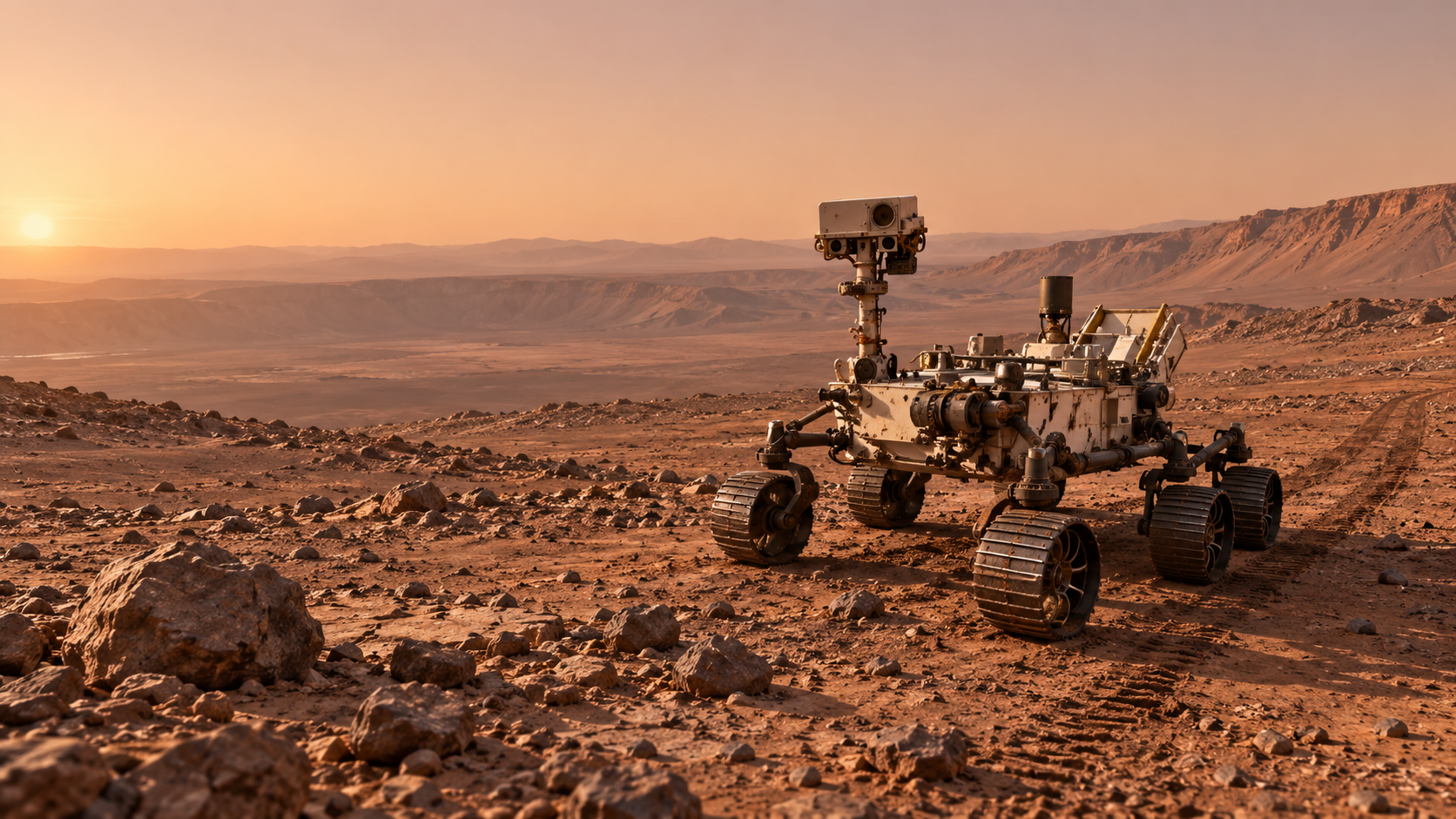
NASA’s Perseverance Mars rover has reportedly driven farther on another world than any vehicle before it, setting a new cumulative surface-driving record during its ongoing mission in Jezero Crater.
The milestone measures the distance covered by the rover’s wheels on Mars. It does not describe the rover’s speed, a single-day journey, its distance from Earth, or the much greater distances traveled by spacecraft through space.
Reports place the achievement after approximately five and a half years of surface operations. Because Perseverance remains active, its total distance may continue to increase. The available reports confirm the broad milestone but do not provide a verified current mileage or kilometer total. An exact figure should be confirmed through a current NASA mission update or official log.
What Record Did Perseverance Break?
Perseverance’s record concerns the greatest cumulative distance driven by a vehicle on the surface of another planetary body. It reflects the distance traveled by the rover’s wheels during its Mars mission.
This is distinct from several other spaceflight records. The milestone does not mean Perseverance is the fastest rover, has traveled farthest from Earth, or completed the longest uninterrupted drive. It also does not include the distance traveled by a spacecraft in orbit or through interplanetary space.
The achievement is a long-term surface-mobility record. It reflects reliable navigation, wheel and suspension performance, energy management, terrain assessment, communication planning, and years of sustained operations.
Perseverance’s Mission in Context
Five and a Half Years of Surface Operations
Maintaining mobility on Mars for approximately five and a half years is a major engineering achievement. The rover must operate in dust, extreme cold, low atmospheric pressure, and unfamiliar terrain while managing limited energy and communication opportunities.
Long-term operations require regular health assessments, conservative route planning, software updates, and decisions that balance immediate scientific opportunities with future reliability.
Exploring Jezero Crater
Perseverance explores Jezero Crater, a region selected because its geology records an ancient Martian environment shaped by water. The crater contains sedimentary deposits, exposed rock, varied surface textures, and geological boundaries that can help scientists reconstruct Mars’ past.
The rover’s mobility allows it to move among locations that differ in age, composition, and formation history. It can examine rocks in place, photograph landscapes, analyze materials, and select promising samples.
Its driving supports several central objectives:
- Studying Martian geology.
- Investigating ancient environmental conditions.
- Searching for possible signs of ancient microbial life.
- Characterizing rocks and soil.
- Collecting and caching samples.
- Testing technologies for future exploration.
The record itself does not prove a particular scientific discovery. Its importance lies in expanding the area Perseverance can reach.
Why Driving on Mars Is Difficult
Uneven and Unpredictable Terrain
Mars has no prepared road network. Perseverance must cross loose soil, rocks, slopes, ridges, crater surfaces, and sharp geological features. Ground that appears passable in an image may still threaten the rover’s wheels or suspension.
The shortest route is often not the safest. A scientific target may require a detour around a steep slope, a rock field, or terrain that could trap a wheel. Mission teams use images and terrain data to identify hazards before approving a drive.
Communication Delays
Operators cannot control Perseverance like a remote vehicle on Earth. Commands must be prepared, transmitted, and executed across interplanetary distances, so communication delays prevent continuous manual steering.
The rover therefore carries out planned instructions with a degree of autonomy. Onboard systems help evaluate nearby terrain, identify hazards, and select a navigable path. Earth-based teams remain responsible for destinations, scientific objectives, and operating limits.
Dust, Cold, and Energy Constraints
Dust can affect power generation and settle on equipment. Mars’ cold conditions place additional demands on electronics, batteries, and mechanical systems.
Energy availability influences driving, scientific instrument use, imaging, communication sessions, battery charging, and system checks. A record-breaking drive therefore reflects more than wheel durability; it shows that the rover has maintained useful operations within strict environmental and power constraints.
Wheel and Mobility-System Wear
Perseverance’s wheels repeatedly contact rocks and abrasive ground. Its mobility system must tolerate impacts, friction, slopes, and changes in surface stability.
Engineers monitor wheel condition, motor performance, steering, suspension components, and other mobility data. Continued driving after years on Mars demonstrates the value of conservative operations and detailed engineering oversight.
How Perseverance Navigates Mars
Perseverance combines human planning with onboard navigation. Scientists identify high-value locations, engineers evaluate terrain and vehicle health, mission planners design routes, and operators transmit commands. During a drive, the rover uses onboard systems to help avoid hazards and navigate between communication sessions.
This autonomy does not make Perseverance independent of Earth. Teams continue to set destinations, review telemetry, prioritize science, and approve future activities.
A longer route may be worthwhile if it reaches a promising rock formation, geological boundary, potential sample site, or landscape that improves understanding of Jezero Crater. A shorter route to an important target may offer greater scientific value than a longer journey across less informative terrain.
How the Record Compares With Other Spaceflight Achievements
The milestone applies to vehicles operating on the surface of another world. It should not be confused with the distance traveled by orbiters, spacecraft, or probes moving through space.
The available reports do not provide enough verified detail to identify the previous record holder or state the exact distance. Those details should be confirmed through a primary NASA mission update before publication.
Perseverance’s total distance has accumulated over many drives. The rover frequently stops to conduct science, take photographs, analyze materials, communicate with Earth, or wait for favorable operating conditions. This is a record of endurance and sustained mission productivity, not a single continuous journey.
Why the Record Matters Scientifically
Greater mobility allows Perseverance to investigate a wider area, compare rock formations and sedimentary layers, and connect observations from different parts of Jezero Crater.
Mobility also supports sample collection. The rover examines rocks, evaluates their geological context, and collects selected material for storage. Reaching diverse locations can increase the scientific range of its sample cache.
The record does not establish a sample-return schedule or guarantee a future retrieval mission. It shows that Perseverance has expanded its ability to reach and evaluate potential samples.
Long-term driving also provides practical information about autonomous navigation, robotic mobility, remote operations, and surface-exploration systems. These lessons may influence future planetary missions.
What Happens Next?
Perseverance’s mission remains active. Future driving will depend on scientific priorities, accessible terrain, energy conditions, communications, and rover health.
Mission planners will continue to prioritize safe and scientifically valuable operations over distance alone. Future official updates should clarify the rover’s exact distance, route milestones, mobility-system condition, scientific observations, sample-related activities, and changing mission objectives.
Conclusion
According to available reports, Perseverance has become the farthest-driving vehicle on another world. The milestone reflects approximately five and a half years of sustained surface operations, careful navigation, engineering resilience, energy management, and scientific planning.
The achievement is not about distance alone. Each drive helps the rover reach new terrain, examine additional rocks, support sample selection, and improve understanding of Jezero Crater’s ancient environment.
Because Perseverance remains active, its driving record may continue to grow.
Frequently Asked Questions
How far has Perseverance driven on Mars?
Available reports confirm that Perseverance has driven farther than any other vehicle on another world, but they do not provide a verified current distance in miles or kilometers. The latest official NASA mission update should be used for the exact total.
What driving record did Perseverance break?
It reportedly set the record for the greatest cumulative distance driven by a vehicle on another world. This is a surface-driving record, not a spacecraft travel-distance or single-day driving record.
How long has Perseverance operated on Mars?
Reports describe the milestone as occurring after approximately five and a half years of Mars operations. The mission remains active.
Why does Perseverance need to travel so far?
Mobility allows the rover to investigate multiple geological locations, study ancient environments, and evaluate potential sample sites. Its route is determined by scientific value and safety, not distance alone.
How can Perseverance drive without real-time control?
Mission teams send planned commands from Earth, while onboard navigation helps the rover identify hazards and select a safe path. Communication delays make autonomous driving essential.
Will Perseverance continue extending the record?
It may. The mission remains active, and the rover can add to its cumulative distance while it remains mobile. Future driving will depend on terrain, power, communications, vehicle health, and mission priorities.