How Antarctica Helps Explore the Universe
How Antarctica Helps Explore the Universe
Antarctica is more than Earth’s coldest continent. Its darkness, dry air, geographic isolation, and vast layers of clear ice make it one of the planet’s most valuable scientific environments. These conditions support research into cosmic rays, neutrinos, atmospheric phenomena, and other signals that reveal how the universe works.
Recent attention linking Physics Nobel recognition with Antarctic research reflects a broader change in modern science. Antarctica is no longer viewed only as a site for climate and Earth science. It is also a natural observatory for studying particles produced by some of the most powerful events in the cosmos.
The supplied reports emphasize Antarctica’s role in cosmic exploration but do not identify a Nobel Prize year, recipient, official citation, or specific experiment with enough detail for independent confirmation (Source 1). A second thematic report makes the same connection (Source 3).
The central lesson is clear: some of the most important discoveries about the universe can begin in one of the most remote places on Earth.
Why Antarctica Is an Exceptional Natural Laboratory
Geographic Isolation
Antarctica is far from major population centers, airports, and industrial infrastructure. This creates severe logistical challenges, but it also reduces sources of interference.
Optical observatories benefit from low levels of artificial light. Radio and particle experiments can also benefit from reduced local activity, although each instrument faces different forms of background noise. Detectors designed to identify extremely rare cosmic particles need environments where ordinary signals can be measured, modeled, and removed as accurately as possible.
Research teams must plan around limited access, extreme weather, seasonal transport windows, and dependence on specialized stations. Equipment cannot always be repaired quickly, and a missed supply flight can affect an entire season of work. These constraints make long-term planning essential.
International cooperation helps overcome these barriers. Universities, national science agencies, engineers, pilots, technicians, and station personnel contribute to projects that no single institution could easily operate alone.
Darkness, Dry Air, and Stable Conditions
The polar night provides extended periods without sunlight. This is valuable for some forms of astronomy because instruments can observe for long, uninterrupted intervals. It also supports experiments that require stable conditions over time.
Antarctic air is exceptionally dry. Low water vapor can reduce atmospheric absorption and improve observations at selected wavelengths, especially in certain infrared, microwave, and submillimeter measurements. However, not every Antarctic experiment depends on atmospheric transparency.
Particle detection uses a different advantage: the continent’s thick, relatively clear ice. In this setting, the ice is not simply an obstacle. It becomes part of the detector.
Ice as a Scientific Resource
Deep Antarctic ice provides a large, stable medium for detecting high-energy particles. Sensors placed in the ice can record brief flashes of light produced when particles interact with the material.
This approach is central to the IceCube Neutrino Observatory, an international experiment located at the South Pole. IceCube uses a vast array of light sensors embedded deep below the surface to detect signals associated with neutrino interactions (IceCube Neutrino Observatory).
The method turns a natural substance into a scientific instrument. Instead of building a conventional tank or chamber large enough to contain the interaction volume, researchers use the ice itself.
The Physics Behind Antarctic Cosmic Research
Cosmic Rays and High-Energy Particles
Cosmic rays are energetic particles that arrive from space. They include atomic nuclei and other particles accelerated by powerful astrophysical environments. Possible sources include supernova remnants, neutron stars, active galaxies, and regions surrounding black holes.
Studying cosmic rays helps scientists examine conditions that cannot be reproduced in terrestrial laboratories. These particles may carry information about magnetic fields, shock waves, acceleration processes, and violent cosmic explosions.
Cosmic-ray research is related to, but distinct from, neutrino astronomy. Cosmic rays are charged or otherwise affected by matter and magnetic fields, while neutrinos are electrically neutral and interact much more weakly. Each type of observation provides different information.
Neutrinos: Ghost Particles from the Universe
Neutrinos are electrically neutral elementary particles with extremely small masses. They interact through the weak nuclear force and gravity, which makes them difficult to detect.
That same weakness makes neutrinos valuable. They can pass through enormous amounts of matter and travel across cosmic distances with relatively little deflection. Light can be absorbed, scattered, or blocked, while charged cosmic rays can be redirected by magnetic fields. Neutrinos often follow a straighter path from their source to Earth.
A neutrino observation can complement a telescope image. Optical, radio, X-ray, and gamma-ray observations show electromagnetic radiation. A neutrino detection reveals information carried by a particle that may have escaped from a dense or energetic region.
The combination of these signals contributes to multi-messenger astronomy, which studies cosmic events through different forms of evidence.
How Detectors Use Antarctic Ice
The basic detection process has five stages:
- A high-energy neutrino enters the Antarctic ice.
- It interacts with an atomic nucleus.
- The interaction produces a charged particle.
- The charged particle moves through the ice and generates a brief flash of blue light.
- Sensors record the light’s timing and distribution.
Researchers compare signals recorded by many sensors. The timing pattern can help estimate the direction from which the particle arrived. The amount and arrangement of light can provide information about its energy and the type of interaction.
IceCube describes these events as light patterns that allow scientists to reconstruct the direction and energy of incoming particles (IceCube Science).
The process is difficult because genuine cosmic events are rare. Detectors must distinguish useful signals from atmospheric muons, radioactive effects, electronic noise, and other background sources.
The Nobel Connection
Nobel recognition can bring public attention to research conducted far from conventional laboratories. It also demonstrates that major discoveries often depend on years of preparation rather than a single dramatic experiment.
Large physics projects require long-term data collection, specialized engineering, international funding, and careful statistical analysis. Antarctic research adds logistical complexity because transportation, maintenance, and communication are difficult in the polar environment.
The Nobel connection should therefore be understood carefully. The supplied reports describe a relationship between Physics Nobel attention and Antarctica’s role in cosmic exploration, but they do not provide enough verified information to identify the exact award or claim that a particular Antarctic facility directly produced the recognized discovery. The Nobel year, laureates, official citation, and experimental contribution should be checked against the official Nobel Prize record before publication (Nobel Prize).
The broader significance extends beyond one detector. Antarctic cosmic research combines particle physics, astronomy, geology, glaciology, atmospheric science, computing, and statistics. This combination blurs the traditional boundary between a physics laboratory and an astronomical observatory. The experiment is on Earth, but its targets may be billions of light-years away.
Antarctica’s Role in Cosmic Exploration
Some cosmic events produce signals that ordinary telescopes cannot detect effectively. A source may be hidden behind matter, too distant, or active at wavelengths that do not reach Earth clearly.
Neutrino detectors can investigate possible signals associated with supernova remnants, black-hole environments, neutron stars, and active galaxies. These remain scientific targets and possibilities rather than confirmed findings from the supplied reports.
Particle observations are especially useful when combined with other evidence. A neutrino arriving near the direction of a known active galaxy, for example, may provide a clue about how that galaxy accelerates particles. Researchers then compare timing, direction, energy, and independent observations before assigning significance.
Multi-messenger astronomy uses different signals to study the same cosmic event. These messengers include:
- Visible and infrared light
- Radio waves
- X-rays and gamma rays
- Cosmic rays
- Neutrinos
- Gravitational waves
Each signal has strengths and limitations. Light can reveal temperature, chemistry, and structure. Gravitational waves can reveal the motion of massive compact objects. Neutrinos can carry information from deep within energetic environments.
Antarctic detectors contribute one part of this global network. Their findings can be compared with data from satellites, optical telescopes, radio observatories, and gravitational-wave facilities.
Scientific instruments can also produce results beyond their original objectives. A detector built to investigate one class of particles may reveal an unusual energy distribution, an unexpected arrival direction, or a background pattern requiring a new explanation. Such results do not automatically constitute discoveries; researchers must test calibration, detector behavior, statistical significance, and possible environmental causes.
The Human and Technical Challenge
Antarctic science depends on reliable systems. Teams must maintain power supplies, calibrate sensors, transmit data, protect equipment, and ensure worker safety during severe cold and prolonged darkness.
A failure may be difficult to correct because replacement parts and specialist personnel cannot arrive immediately. Engineers therefore design equipment for endurance, redundancy, and remote monitoring.
Data transmission presents another challenge. Large scientific data sets may need to be filtered or processed locally before selected information is sent beyond the continent. This requires dependable communications and carefully designed software.
Major experiments also depend on international collaboration. Universities contribute scientific expertise, government agencies provide funding and logistical support, engineers design instruments, technicians operate systems, and station personnel manage transport, power, food, shelter, and safety.
Particle detectors continuously record measurements, but most signals are not the rare events scientists seek. Analysis therefore involves filtering background noise, identifying candidate events, comparing timing across sensors, estimating direction and energy, testing statistical significance, and repeating analyses independently.
A Nobel-level result requires evidence that survives extensive scrutiny. The detector must be understood, the analysis must be reproducible, and alternative explanations must be addressed.
What Antarctica Teaches Scientists About the Universe
Visible light represents only a small part of the information arriving from space. Neutrinos and other particles can reveal processes that electromagnetic observations cannot fully explain.
This expands the meaning of astronomy. Scientists no longer rely only on images and spectra; they also study particle tracks, arrival times, energy distributions, and correlations across observatories.
Space research does not require every instrument to be launched into orbit. Earth-based facilities can study cosmic phenomena by detecting particles that naturally arrive from space. Antarctic detectors offer large detection volumes, long operating periods, and a specialized environment, while satellites provide access above the atmosphere and conventional telescopes offer detailed observations across many wavelengths. These systems are complementary rather than interchangeable.
Using ice as a detection medium also demonstrates how natural materials can support advanced physics. The environment itself becomes part of the instrument.
Related Exploration of Extreme Environments
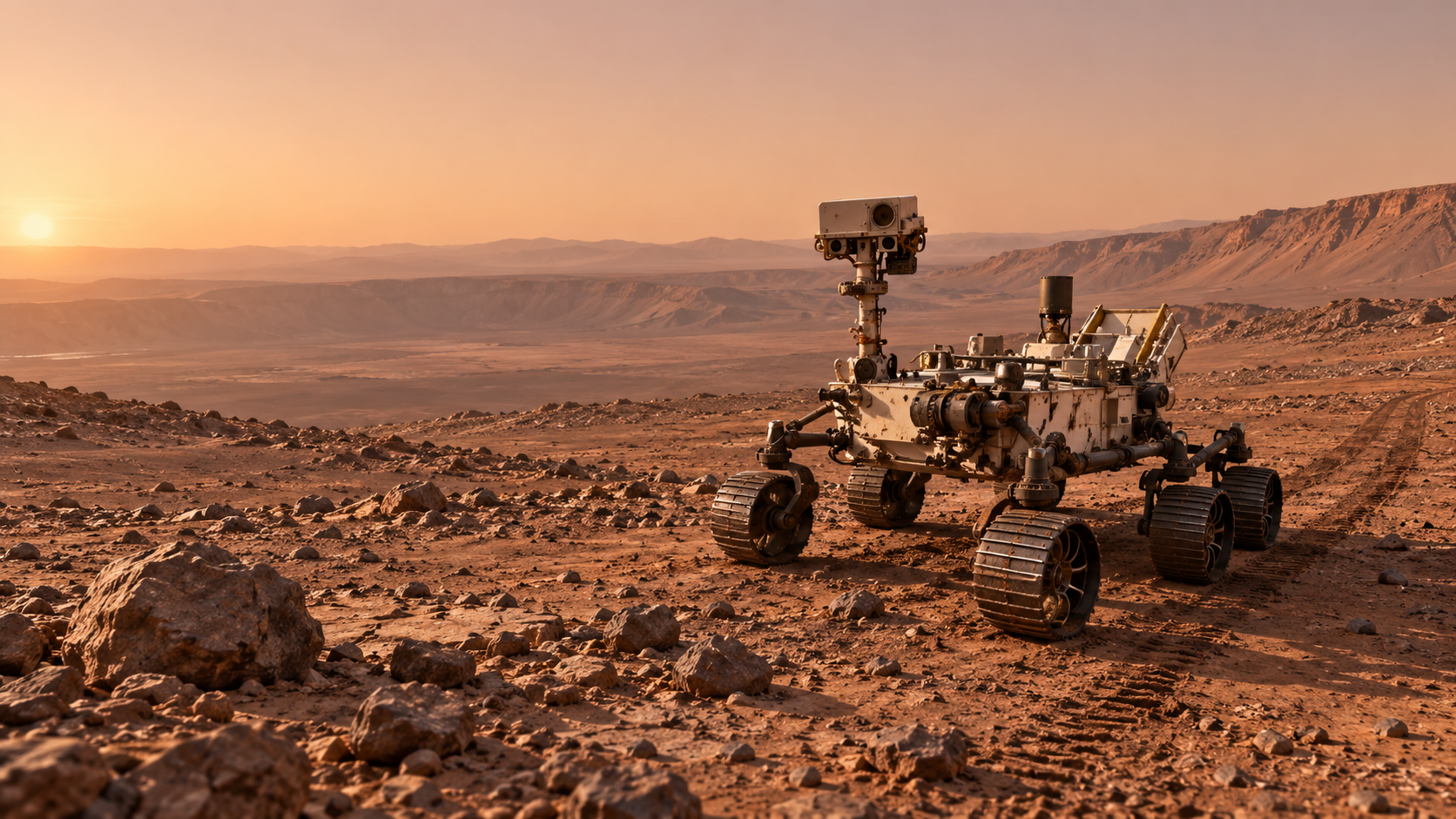
NASA’s Curiosity rover reaching mysterious Martian cliffs illustrates humanity’s broader effort to investigate difficult environments beyond Earth. The mission has spent years studying the Martian surface and geological history (Source 7).
Curiosity studies the Martian surface directly, while Antarctic neutrino detectors study particles arriving from distant cosmic sources. The projects are not connected, but both use specialized instruments to investigate environments that ordinary methods cannot easily reach.
Laser-equipped drones have also helped researchers identify ancient sites and artifacts that conventional surveys overlooked (Source 9). The comparison is methodological rather than scientific: in both cases, advanced instruments expose evidence hidden from conventional observation.
What Comes Next
Future projects may pursue larger detection areas, more sensitive sensors, improved calibration, and stronger background rejection. These developments could increase the number of detectable events and improve estimates of their origins.
Antarctic instruments may also work more closely with optical, radio, gravitational-wave, and space-based observatories. Rapid communication between facilities can help researchers determine whether different signals came from the same cosmic event.
Public understanding will remain important. Nobel recognition can make complex research more accessible when it is explained through practical questions: What is a neutrino? Why use Antarctic ice? How can particles reveal distant cosmic events? What does a Nobel Prize recognize?
Conclusion
Antarctica’s importance extends beyond climate research and Earth science. Its long darkness, dry atmosphere, geographic isolation, and deep ice create conditions that support astronomy and particle physics.
Neutrino observatories show how a natural material can become part of a sophisticated detector. By recording faint flashes produced inside the ice, researchers investigate particles that may have traveled across the universe from violent cosmic environments.
The supplied reports connect this work with Physics Nobel attention, but the specific Nobel year, recipients, citation, and experimental contribution require verification before publication. The broader conclusion is secure: Antarctica has become a valuable platform for exploring questions that reach far beyond Earth.
Some of the most important discoveries about the universe begin in the most remote places on our planet.
Frequently Asked Questions
Why is Antarctica useful for astronomy and physics research?
Antarctica offers long periods of darkness, dry air, low light pollution, geographic isolation, and vast quantities of deep ice. These conditions support astronomical observations and particle-detection experiments.
How can scientists use Antarctic ice to study particles from space?
Sensors embedded in the ice can detect brief flashes of light created when high-energy particles interact with it. Researchers analyze the timing and pattern of those flashes to estimate the particles’ direction and energy.
What is the connection between Antarctica and the Physics Nobel?
The supplied reports connect Antarctic cosmic research with Nobel-recognized physics, but they do not provide enough verified information to identify the specific Nobel year, recipients, official citation, or direct experimental contribution.
What are neutrinos, and why do scientists study them?
Neutrinos are electrically neutral particles that interact weakly with matter. They can travel across cosmic distances and pass through dense environments, providing information about powerful events that may be difficult to study through light alone.
Is Antarctic research the same as space exploration?
No. Antarctic research is conducted on Earth, but it can investigate cosmic phenomena by detecting particles and radiation arriving from space. It complements spacecraft, telescopes, and planetary missions.
What other missions show humanity’s interest in exploring extreme environments?
NASA’s Curiosity rover, mentioned in Source 7, demonstrates the effort to study difficult environments beyond Earth. Its Mars exploration is separate from Antarctic physics but reflects the broader goal of using advanced instruments to investigate the unknown.