Kilauea Erupts Again in Its 55th Reported Episode
Kilauea Erupts Again in Its 55th Reported Episode
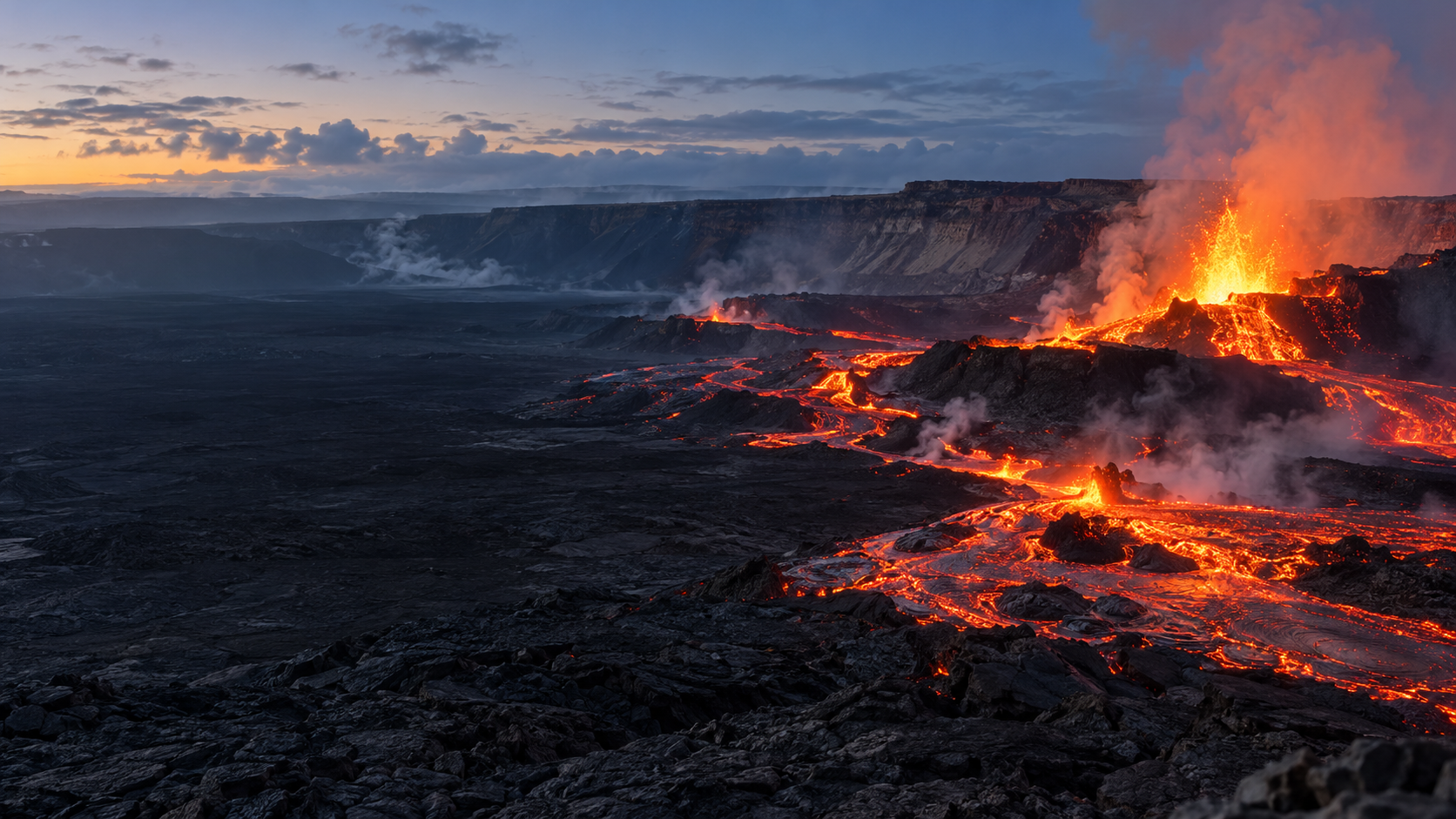
Kilauea has resumed eruptive activity after an approximately two-month pause, according to FOX Weather. The report describes the renewed activity as the volcano’s 55th eruptive episode in the sequence tracked since 2024.
FOX Weather also published video of the eruption. However, the available report summaries do not confirm the exact start time, duration, lava-fountain height, gas conditions, affected areas, or current alert level. Readers should consult the U.S. Geological Survey and the Hawaiian Volcano Observatory for current scientific and safety information.
The wording matters. “Kilauea erupts for the 55th time since 2024” is headline language, while “Kilauea begins its 55th eruptive episode” more precisely reflects the reported counting method. Eruptive episodes may be separated by pauses and restarts, so the count does not necessarily represent 55 entirely separate volcanic events.
Latest report: FOX Weather says Kilauea has resumed eruptive activity after a rare two-month pause and has begun its 55th reported eruptive episode since 2024. Source
What the Report Confirms
The available coverage confirms that:
- Kilauea is erupting again.
- FOX Weather identifies the activity as the 55th eruptive episode in the reported sequence since 2024.
- The restart followed an approximately two-month pause.
- FOX Weather supplied video showing the eruption.
The summaries do not confirm the eruption’s location, duration, lava-flow measurements, gas concentrations, ash conditions, access restrictions, evacuation orders, injuries, property damage, or official alert level.
A visible eruption does not automatically indicate an emergency for nearby communities. The risk depends on the activity’s location and intensity, lava movement, volcanic-gas emissions, weather, terrain, and official hazard guidance.
Why the Two-Month Pause Matters
The pause indicates that visible eruptive activity was not continuous during that period. It does not prove that all subsurface volcanic activity stopped, nor does it explain why the eruption resumed.
Volcanic systems can shift between active and quiet phases as magma movement, pressure, gas release, and underground pathways change. Determining the cause of this restart requires current measurements of earthquakes, ground deformation, volcanic gases, thermal conditions, and surface activity.
Watch the Eruption Video
FOX Weather’s report includes video of Kilauea’s renewed activity. The footage is a visual snapshot, not a complete scientific assessment. Video alone cannot establish lava temperature, eruption volume, gas concentration, hazard boundaries, or current conditions.
Nighttime exposure, zoom, cloud, haze, and volcanic gases can alter how an eruption appears. Viewers should check the recording time and compare the footage with the latest official monitoring information.
The U.S. Geological Survey’s Kilauea updates provide scientific context, including seismic data, ground-deformation information, gas observations, maps, hazard notices, and access guidance.
Kilauea’s Volcanic Hazards
Kilauea is an active volcano in Hawaii. Its eruptions attract global attention because they offer a visible example of ongoing volcanic processes and may affect visitors, residents, air quality, public access, and infrastructure.
Potential hazards include:
- Lava movement.
- Volcanic gases and vog.
- Ash or fine particles.
- Rockfall and unstable terrain.
- Earthquakes.
- Changes to roads, park access, and hazard zones.
Activity within a restricted summit area may require strict visitor controls without creating an evacuation emergency. Conditions can change if lava moves, gas emissions increase, weather shifts, or terrain becomes unstable.
Episode Count Versus Continuous Eruption
An eruptive episode is a defined period of volcanic activity within a broader sequence. News organizations and scientists may use different definitions for an episode, pause, restart, or end.
For that reason, the 55th-episode count should be attributed to FOX Weather unless it is independently confirmed by the Hawaiian Volcano Observatory. Editors should compare the report with the latest official terminology before presenting the number as a scientific classification.
What Residents and Visitors Should Do
People in or near potentially affected areas should:
- Check updates from the Hawaiian Volcano Observatory and local emergency-management authorities.
- Follow closures, barriers, restricted-area rules, and evacuation instructions.
- Avoid entering closed areas to view or record the eruption.
- Stay away from vents, lava flows, unstable cliffs, and areas affected by volcanic gases.
- Keep roads, emergency routes, and access points clear.
- Use only authorized viewing areas.
- Monitor wind conditions and air-quality guidance.
- Follow Hawaii Volcanoes National Park instructions in park-managed areas.
Volcanic emissions can affect air quality downwind. The supplied reports do not confirm current gas concentrations or whether vog affects specific communities. Those details require current monitoring and public-health information.
People with respiratory conditions should follow advice from public-health authorities. Eruption video cannot reliably indicate the presence or concentration of volcanic gases.
What Remains Unknown
The available summaries do not establish:
- The exact start time.
- The current eruption status.
- The eruption location.
- Lava-fountain or lava-flow measurements.
- Gas and ash conditions.
- The official alert level.
- Evacuations or access restrictions.
- Injuries, damage, or infrastructure effects.
- The duration of the latest episode.
- Conditions in nearby communities and visitor areas.
The absence of these details means they were not supplied, not that the conditions are absent. They should not be inferred or invented.
Recommended Sources
Use FOX Weather for the news report and video reference. Use official agencies for scientific and safety information:
- U.S. Geological Survey: Kilauea updates
- Hawaiian Volcano Observatory
- Hawaii County Civil Defense
- Hawaii Volcanoes National Park
- National Weather Service
Because volcanic conditions can change quickly, any published report should include a visible “Last updated” timestamp.
Frequently Asked Questions
How many times has Kilauea erupted since 2024?
FOX Weather reports that the latest activity is Kilauea’s 55th eruptive episode in the sequence since 2024. The counting method should be checked against the latest Hawaiian Volcano Observatory update.
Why did Kilauea erupt again after a two-month pause?
The available source summaries do not identify a confirmed cause. Changes in magma movement, pressure, gas conditions, or underground pathways can produce alternating active and quiet periods. The specific cause requires current monitoring data.
Is Kilauea’s current eruption dangerous?
The danger depends on the eruption’s location, intensity, gas emissions, lava movement, weather, terrain, and official hazard zones. Check the U.S. Geological Survey, Hawaiian Volcano Observatory, Hawaii County Civil Defense, and Hawaii Volcanoes National Park for current guidance.
Where can people watch video of the eruption?
FOX Weather’s report includes video of Kilauea’s renewed activity. Check the footage’s recording time and location because it may not show current conditions.
Can visitors safely watch Kilauea erupt?
Visitors should use authorized viewing areas and follow closures, barriers, and emergency instructions. They should not enter restricted areas, approach vents or unstable terrain, or rely on unofficial viewing locations.
What should people do if volcanic gas or ash affects their area?
Follow instructions from local emergency and public-health authorities, monitor air-quality updates, and reduce exposure when advised. Conditions can vary with wind direction and eruption activity.
Artikel Terkait
-
 NASA’s Roman Telescope Beats Image Forecast by Nearly 30%
-
 How Seeing Earth From Space Changes Astronauts
-
 Invisible Radioactive Jet: Should Earth Be Worried?
-
 Ancient Arctic Clues May Reveal Greater Winter Sea-Ice Loss
-
 Kīlauea Lava Flows Increase Ahead of Episode 40
-
 How to Watch the Orionid Meteor Shower in 2026