Ancient Arctic Clues May Reveal Greater Winter Sea-Ice Loss
Ancient Arctic Clues May Reveal Greater Winter Sea-Ice Loss
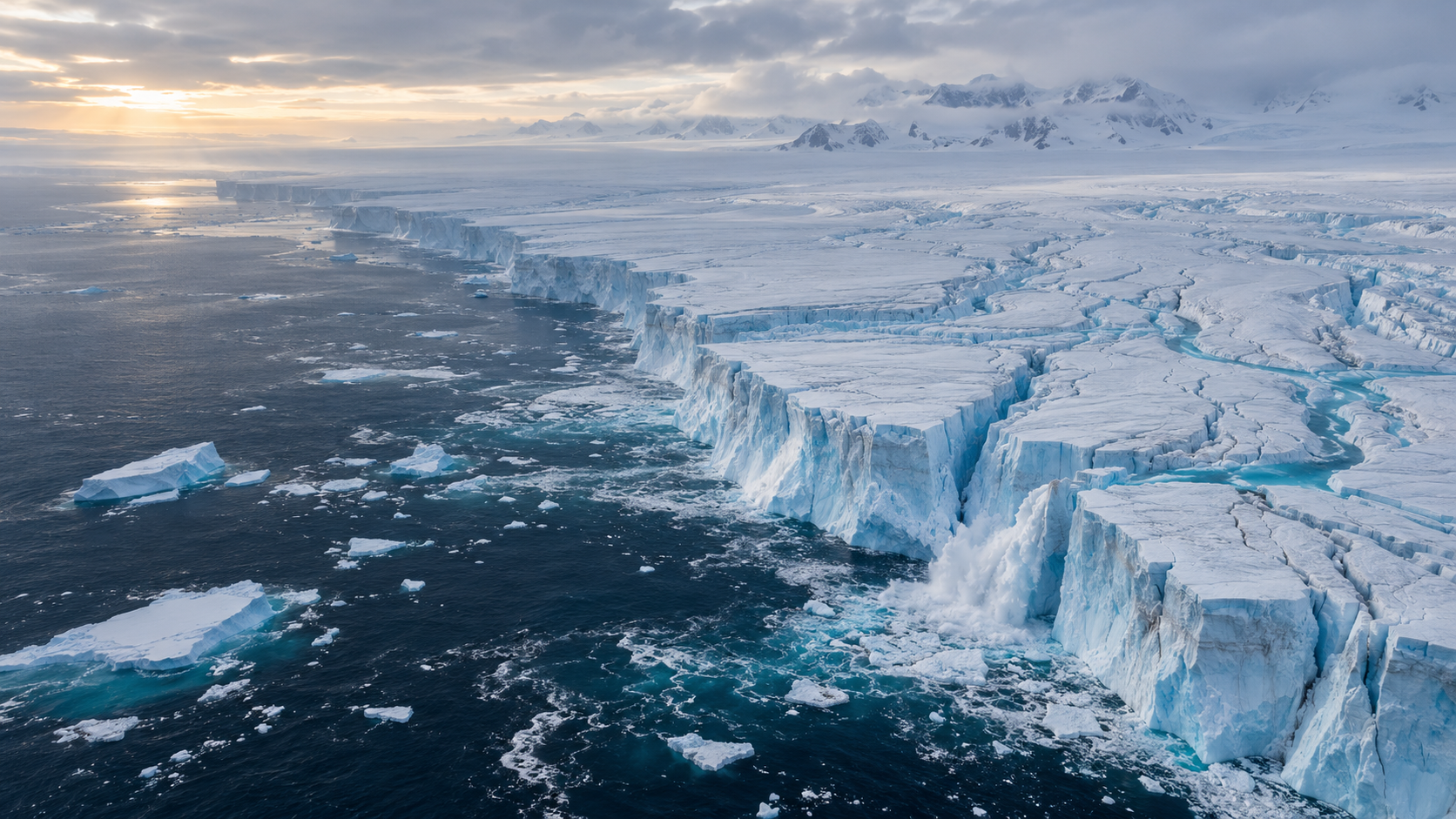
Arctic sea ice is declining, but modern observations may not show the full scale of winter change. Evidence from warmer periods in the ancient Arctic suggests that current estimates could underestimate how extensively and rapidly winter sea ice retreats during sustained warming Source 1.
This finding does not mean that every modern climate projection is wrong. It indicates that short observational records may not capture the full range of Arctic responses to prolonged warmth. Ancient environmental evidence extends the climate record and reveals conditions that developed over periods much longer than the satellite era.
Winter sea ice regulates heat exchange between the ocean and atmosphere, reflects sunlight, supports Arctic ecosystems, and influences transportation and community planning. It also affects how much ice survives into the following summer.
The evidence concerns floating sea ice, not land-based ice sheets. Melting sea ice has little direct effect on global sea level because it already floats in the ocean. Glaciers and ice sheets, including those in Greenland and Antarctica, raise sea levels when land-based ice melts or flows into the sea. These subjects are connected but require separate analysis.
Why Winter Arctic Sea Ice Is Difficult to Measure
Satellite observations have transformed knowledge of Arctic sea ice. They monitor ice extent, concentration, movement, and seasonal changes across a vast, remote region. However, the continuous satellite record covers only a small part of Earth’s climate history.
A few decades of observations may not show how Arctic sea ice behaves after centuries of sustained warming. The record may also miss rare events, delayed responses, and feedbacks that develop slowly. Modern measurements could therefore underestimate:
- The maximum extent of past winter sea-ice loss.
- The speed of change during prolonged warm periods.
- The sensitivity of sea ice to ocean warming.
- The vulnerability created by thinner, younger ice.
This does not invalidate satellite data. It shows that modern observations should be interpreted alongside older environmental records, climate simulations, and ocean measurements.
Summer sea-ice decline receives considerable attention because the late-summer minimum is a visible indicator of Arctic change. Winter conditions are equally important, although they are more difficult to interpret. Winter ice can become thinner, form later, or cover a smaller area. These changes can increase heat transfer from the ocean to the atmosphere, alter freeze-up and spring melt, affect atmospheric circulation, and reduce the ice available to survive the following summer.
How Scientists Reconstruct Ancient Arctic Sea Ice
Before satellites, aircraft, buoys, and regular ship surveys, scientists had no direct basin-wide record of Arctic sea ice. They reconstruct earlier conditions from natural archives, including ocean sediments, ice cores, microfossils, chemical markers, and sediment layers associated with sea-ice conditions.
These archives can preserve evidence of past temperatures, ocean circulation, seasonal ice conditions, warmer intervals, and changes in atmospheric and oceanic processes. Each archive records a different part of the climate system. Ocean sediments may preserve biological remains or chemical signals linked to surface conditions. Ice cores can record atmospheric composition, temperature-related chemistry, and snowfall history. Microfossils can indicate the water temperature or ice environment in which organisms lived.
Scientists use climate proxies to infer past conditions. A proxy relates to a climate variable but does not measure it directly in the same way as a modern instrument. Researchers compare multiple indicators to assess whether a region had more extensive ice, thinner or less persistent ice, longer ice-free seasons, different ocean temperatures, or altered circulation.
Calibration is essential. Modern observations help establish how chemical or biological signals correspond to present-day conditions, while dating techniques determine when layers formed. Comparing independent proxies reduces reliance on any single uncertain signal.
Ancient reconstructions still contain limitations. A record may represent one location rather than the entire Arctic, and some signals may be stronger in one season than another. Even so, paleoclimate evidence can reveal climate behavior that recent observations cannot capture.
Why Modern Estimates May Be Too Conservative
A short observational record can make a system appear more stable than it is over longer periods. It may capture only part of a natural cycle or fail to include a delayed response to warming in the ocean.
If ancient records show more extensive winter loss during earlier warm periods, modern observations may represent an early stage of a longer response rather than its full outcome. This matters for climate projections. A model calibrated only against recent observations may not reproduce processes that emerge after many decades of sustained warming.
Sea ice responds to more than air temperature. Other influences include:
- Ocean heat entering from below.
- Wind direction and strength.
- Ocean currents.
- Snow cover.
- Ice thickness and age.
- Freshwater input.
- The timing of freeze-up and melt.
Snow can insulate ice from cold air and slow its growth. Warm water moving beneath the ice can thin it even when surface air temperatures remain low. Winds can compact ice in one region and spread it apart in another. These interactions make winter sea-ice change difficult to estimate from surface temperature alone.
Thickness and age also matter. Older, thicker multiyear ice generally resists melting and mechanical breakup better than thin first-year ice. A region can retain substantial ice area while becoming more fragile if average thickness declines. Thin ice freezes quickly during cold conditions but can melt rapidly, break apart during storms, allow greater heat exchange, and reduce the amount of ice that survives into the next year.
What Ancient Evidence Means for Climate Models
Ancient warm periods provide an additional way to evaluate climate models. Researchers can compare simulations with reconstructed evidence for temperature, sea-ice extent, seasonal conditions, and ocean behavior.
A model that reproduces known past Arctic conditions is more credible when used to project future change. A mismatch may indicate that the model handles a process incorrectly, that the reconstruction needs further investigation, or both.
Paleoclimate evidence can highlight processes that require improvement, including ocean heat transport, ice-thickness distribution, snow insulation, atmospheric circulation, freeze-up timing, melt-season timing, multiyear-ice survival, and sea-ice interactions with clouds.
If ancient evidence shows that winter sea ice declined more extensively during sustained warmth than models simulate, researchers may need to reassess delayed ocean responses, ice thickness, and seasonal feedbacks. Better estimates could affect Arctic shipping, marine safety, Indigenous and local community planning, wildlife management, infrastructure, search-and-rescue capacity, and climate adaptation.
Winter Sea Ice and Arctic Feedbacks
Sea ice has a high albedo, so it reflects much of the sunlight that reaches it. Open ocean is darker and absorbs more solar energy. When ice retreats, exposed water can absorb additional heat during the sunlit season. That heat can delay autumn freeze-up and contribute to further ice loss.
Winter ice affects the system differently. Even when sunlight is weak or absent, its presence influences insulation and heat transfer between the ocean and atmosphere. Thin or absent ice allows more heat and moisture to move from relatively warm ocean water into cold Arctic air, changing near-surface temperature, humidity, clouds, atmospheric stability, regional circulation, and storm development.
The condition of ice at the end of winter also influences spring. Thin ice has less stored mass and may melt earlier. Changes in freeze-up can alter the age distribution of the ice cover. Repeated weak winters can reduce the multiyear ice that survives into later years, linking winter loss to long-term summer decline.
What the Evidence Does—and Does Not—Prove
Ancient Arctic evidence supports several conclusions:
- The Arctic can lose sea ice extensively under sustained warmth.
- Modern observations may not represent the full range of possible change.
- Short records can underestimate delayed or long-term responses.
- Paleoclimate evidence can improve climate-model evaluation.
- Winter sea-ice conditions deserve greater attention in risk assessments.
Important uncertainties remain. An ancient record may represent a limited area or a particular season. Researchers may not know the exact timing or duration of a warm interval, and ancient climate drivers differed from modern greenhouse-gas-driven warming.
Ancient evidence is not a daily measurement of modern sea ice and cannot establish a precise annual loss rate by itself. A potential underestimate also does not mean that every forecast has been disproven. It means that projections may need adjustment as new evidence becomes available.
Floating sea ice should not be confused with Greenland or Antarctic land ice. Sea-ice loss has important climate and regional consequences, but land ice is the major direct source of future global sea-level rise.
Connection to Sea-Level Rise Research
Floating sea ice already displaces seawater, so its melting has limited direct influence on global sea level. Land-based glaciers and ice sheets add water to the ocean when they melt or discharge ice.
Warming can affect both Arctic sea ice and the Greenland Ice Sheet, but evidence about winter sea-ice loss should not be presented as direct evidence of a specific sea-level increase. Ancient ice records and other paleoclimate evidence can separately show how land-based ice responded during earlier warm periods and help researchers assess long-term sea-level risks Source 3.
Communities should track multiple indicators, including sea-level rise from land-ice loss, changing waves and storms, atmospheric circulation, marine ecosystems, sea-ice access, infrastructure, and transportation.
What Researchers Should Study Next
Future research should distinguish winter from summer conditions and separate the central Arctic from marginal seas. Higher seasonal resolution could show whether loss begins with later autumn freeze-up, weaker winter growth, earlier spring melt, or a combination of processes.
The strongest assessments will combine paleoclimate records, satellite observations, buoy measurements, ship and aircraft surveys, ocean-temperature data, ice-thickness observations, and climate-model simulations. Modern measurements help calibrate ancient proxies, while ancient records test whether models work beyond the satellite era.
Researchers and communicators should clearly explain what the evidence shows, which conclusions are well supported, what remains uncertain, how projections differ across emissions scenarios, and which risks are immediate or long term. Uncertainty is a reason to prepare for a range of outcomes, especially when underestimating change could have substantial consequences.
Conclusion
Ancient evidence from warmer Arctic conditions suggests that modern estimates may not fully capture the potential scale or speed of winter sea-ice loss. The satellite era provides essential information, but it is too short to represent every response that can emerge under sustained warming.
Winter sea ice affects ocean–atmosphere heat exchange, seasonal ice stability, ecosystems, communities, and future summer conditions. Thin and young ice can make the Arctic more vulnerable even when remaining ice area appears substantial.
Paleoclimate records extend the climate perspective and allow researchers to test models against conditions beyond recent observations. Improved reconstructions can strengthen projections and support decisions about shipping, infrastructure, conservation, and adaptation.
The practical implication is clear: Arctic planning should account for the possibility that winter sea-ice change is occurring beyond the limits suggested by the short modern record.
Frequently Asked Questions
Is Arctic winter sea ice declining?
Evidence indicates that Arctic sea ice is declining, although the precise rate and seasonal pattern remain active research topics. Ancient records suggest that modern observations may underestimate some aspects of winter loss under sustained warming.
Why do scientists study ancient Arctic climate?
Ancient records extend climate knowledge beyond the satellite era. They show how the Arctic responded during warmer periods and help researchers test models, identify feedbacks, and assess whether recent observations capture the full range of possible change.
Does melting sea ice directly raise global sea levels?
Floating sea ice has little direct effect on sea level when it melts because it already displaces seawater. Melting land-based ice, including glaciers and ice sheets, directly adds water to the ocean.
How can winter sea-ice loss affect future Arctic warming?
Thinner or less extensive ice allows more heat exchange between the ocean and atmosphere. Reduced ice cover also exposes darker ocean water that absorbs more sunlight during the bright season, increasing Arctic vulnerability to continued warming.
Do ancient warm periods exactly predict the future?
No. Ancient climates had different greenhouse-gas concentrations, geography, circulation patterns, and warming rates. Their value lies in showing how the climate system can respond under sustained warmth, not in providing an exact forecast.
What could an underestimation of winter sea-ice loss mean for communities?
It could affect Arctic infrastructure, shipping, wildlife management, Indigenous communities, emergency planning, and climate adaptation. Updated estimates can help decision-makers prepare for changes that may be faster or more extensive than short modern records suggest.