Why the Sky Glowed After the SpaceX Launch
Why the Sky Glowed After the SpaceX Launch
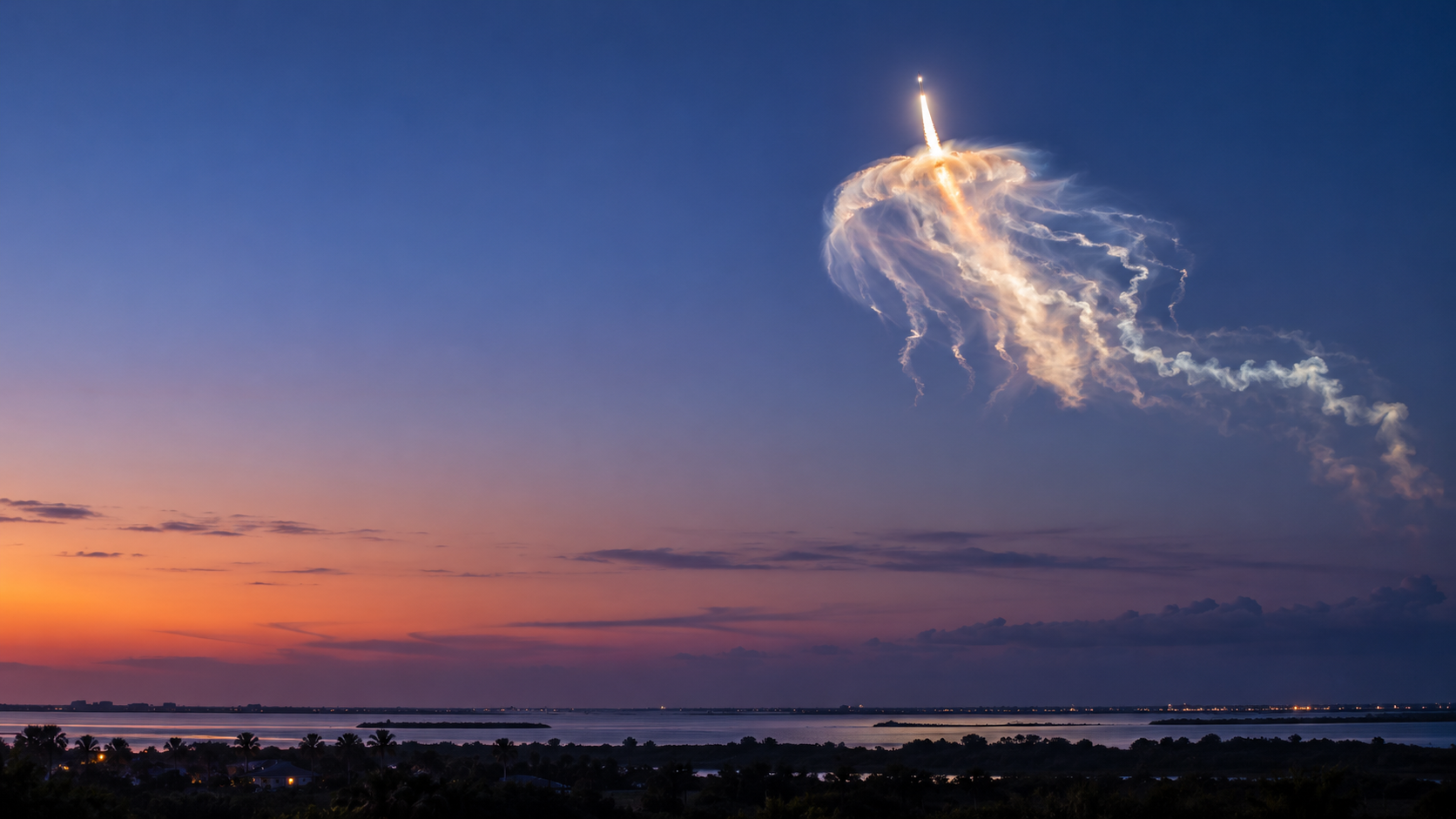
A strange, jellyfish-shaped glow captured attention after a SpaceX launch, turning a routine rocket flight into a dramatic skywatching event. The luminous structure appeared to have a rounded upper body and trailing strands, creating the impression of a giant creature floating above the horizon.
The image was reportedly selected by Space as its space photo of the day for October 14, 2026 (Source 1). The “cosmic jellyfish” description is visual, not scientific. No evidence indicates that the object was a biological organism, an alien craft, or a newly discovered deep-space nebula.
The most likely explanation is illuminated rocket exhaust expanding high above Earth. Sunlight, atmospheric motion, the rocket’s flight path, stage events, and camera exposure combined to create the unusual shape.
What Did Skywatchers See?
Observers and photographers described a bright, diffuse structure with a rounded or bulbous upper region and faint trails extending beneath it like tentacles. The feature appeared to spread across the sky as the rocket climbed and its exhaust expanded.
A rocket plume has no fixed shape. It changes continuously as the vehicle accelerates, moves through different atmospheric layers, changes direction, separates stages, or alters engine operation. A photograph freezes one moment in that process, making the plume resemble a floating object.
The view can also differ sharply between the naked eye and a camera. A long exposure collects light over several seconds, revealing faint exhaust structures that may be difficult to see in real time. Digital cameras can increase contrast, adjust color, and brighten areas that appear nearly invisible to observers.
The final appearance depends on:
- Camera exposure and image processing.
- Lens type and focal length.
- Atmospheric clarity and humidity.
- The observer’s distance from the launch path.
- The rocket’s altitude when the image was captured.
- The vehicle’s direction relative to the observer.
A nearby viewer may see a bright, fast-moving rocket. Someone hundreds of miles away may see only a broad glowing cloud after the vehicle has disappeared below the horizon.
How Rocket Exhaust Creates a Jellyfish Shape
Expansion in the Upper Atmosphere
Rocket engines produce hot gases and particles as they propel a vehicle upward. Near the rocket, the exhaust forms a narrow, rapidly moving trail. At higher altitudes, the surrounding air becomes thinner, allowing the plume to expand dramatically.
The plume can change as the rocket accelerates, pitches over during ascent, changes altitude, throttles its engines, shuts down an engine, separates a stage, or starts a new burn. These events can produce overlapping trails or clouds. Exhaust may spread away from the vehicle’s immediate path, creating a detached appearance.
The plume is not a solid formation. It is a changing mixture of gases, particles, ice crystals, and other exhaust products. Its density and brightness vary across the structure, producing the rounded head and narrow extensions associated with the jellyfish comparison.
Sunlight After Sunset
The most important visual effect involves sunlight. A launch can occur after sunset at the observer’s location while the upper-stage exhaust remains high enough to receive direct sunlight.
This creates a striking contrast:
- The ground and lower atmosphere are in darkness.
- The high-altitude plume remains illuminated by the Sun.
- The glowing exhaust appears against a dark blue or black sky.
The effect is strongest during twilight or shortly after sunset. The Sun may be below the horizon for the observer but still above the horizon at the rocket’s altitude. Sunlight then reflects from exhaust particles and condensed material, making the plume visible from a great distance.
The plume is not producing starlight. It is reflecting sunlight under unusual geometric conditions.
Why the Plume Has “Tentacles”
The trailing strands may result from several overlapping effects. Exhaust spreads through air moving at different speeds and directions. Wind shear can pull portions of the plume into separate streamers, while turbulence distorts the edges.
Other contributing factors may include:
- Changes in engine thrust.
- Stage separation.
- Multiple engine burns.
- The rocket’s changing flight direction.
- Expansion into thinner air.
- Differences in wind speed between atmospheric layers.
The “tentacles” are a visual comparison rather than physical appendages. Long-exposure photography can make the strands appear longer, smoother, or brighter than they looked to the naked eye. Without detailed mission data and analysis of the original image, no single mechanism should be treated as proven.
Why SpaceX Launches Produce Unusual Sky Images
SpaceX’s high launch cadence gives the public more opportunities to witness unusual rocket effects. A launch that might once have been a rare local event can now be observed and photographed across a wide region.
Visibility does not end at the launch site. A rocket may travel below the horizon for a distant observer while its high-altitude exhaust remains visible. The plume can extend across a large section of sky and appear detached from the rocket itself.
Distance changes the experience. Near the launch site, observers see motion and a clearly defined vehicle. Farther away, perspective compresses the flight path and can make the plume appear larger, slower, or almost stationary.
Modern launch vehicles also follow complex flight profiles. Different stages can produce separate visual signatures, and upper-stage activity may occur after the main rocket is no longer visible from the ground. Possible features include:
- The initial ascent plume.
- A second-stage engine burn.
- Stage separation.
- A change in trajectory.
- A returning booster.
- Payload deployment.
Not every feature appears on every mission. The specific explanation depends on the launch vehicle, mission profile, timing, and viewing location.
Social media amplifies dramatic comparisons such as “jellyfish,” “alien sky,” and “space cloud.” These labels help users find and share images, but they can oversimplify the science. A useful verification process compares the photograph’s timestamp, the official launch time, the observer’s location, the direction of the feature, images from other locations, and the object’s movement.
Is the Cosmic Jellyfish a Real Astronomical Object?
The supplied report connects the display with a SpaceX launch (Source 1). The most likely interpretation is an illuminated rocket plume or a related launch effect.
That makes the display temporary and local to Earth’s atmosphere or near-Earth space. It does not place the feature in deep space.
A true astronomical nebula is a vast cloud of gas and dust located far beyond Earth. Other diffuse deep-space objects include planetary nebulae, supernova remnants, interstellar clouds, and galaxies. These objects do not transform visibly over a few minutes. A rocket plume, by contrast, can expand, twist, brighten, and fade rapidly.
| Feature | Rocket plume | Deep-space nebula |
|---|---|---|
| Origin | Human-made propulsion system | Gas and dust in space |
| Distance | Atmosphere or near-Earth space | Many light-years away |
| Duration | Minutes to hours | Thousands to millions of years |
| Motion | Follows a launch trajectory | Appears fixed relative to stars |
| Formation | Exhaust expansion and sunlight | Stellar radiation, explosions, or gravity |
| Visibility | Linked to launch timing and twilight | Determined by location and observing conditions |
The display also differs from an aurora. Auroras occur when charged particles interact with gases in Earth’s upper atmosphere and commonly appear as curtains, arcs, bands, or shifting patches of light. Rocket plumes are produced by engines, generally appear shortly after launch, and follow the vehicle’s path. Timing, movement, location, and the presence of a launch provide stronger clues than color alone.
When Are Rocket Jellyfish Displays Most Visible?
Twilight Conditions
Launches shortly before or after sunset offer the best conditions for illuminated-plume effects. The lower sky is dark enough to provide contrast, while the upper plume remains exposed to sunlight.
The launch direction also matters. A rocket traveling toward or away from the observer creates a different visual pattern from one moving across the field of view. The rocket’s altitude determines whether sunlight reaches the exhaust.
Clear, Dry Weather
Clear skies reveal more detail. Clouds can hide the plume or make it appear fragmented. Haze and humidity scatter light, reducing contrast and altering perceived color. Light pollution can obscure faint structures near the horizon.
Even under clear conditions, the plume may look different from one location to another because of viewing angle and atmospheric depth.
Distance From the Launch Site
Nearby observers may see the rocket as a bright point moving quickly through the sky. Distant observers may see an expanded plume after the vehicle has disappeared from view.
Perspective affects apparent size. A large, high-altitude plume viewed from far away can seem to hang in one place even though it is expanding rapidly. This perspective often contributes to the impression of a giant jellyfish floating in the sky.
How to Photograph a Rocket Plume
A wide-angle lens helps capture the entire plume and surrounding sky. A tripod reduces camera shake during longer exposures, while manual focus set near infinity can improve sharpness.
Useful practices include:
- Frame the sky before the launch.
- Keep the camera stable.
- Use a wide field of view.
- Take several images as the plume evolves.
- Avoid pointing directly at bright lights.
- Preserve the original files and metadata.
Rocket plumes can brighten quickly and become overexposed. A sequence of images with different exposure levels can preserve both the bright core and faint outer structures. Foreground objects, buildings, or landscape features provide scale and help establish the plume’s apparent position.
Record the exact time, location, viewing direction, and weather conditions. This information allows later comparison with the launch trajectory.
A factual caption should identify the event as a rocket-launch phenomenon unless a reliable expert source supports another explanation. It should avoid claiming that the image shows an alien object, a new nebula, or a dangerous atmospheric event.
How to Identify a Rocket Plume
Check Launch Schedules
Compare the sighting time with official SpaceX or launch-provider information. Verify whether the launch was visible from the observer’s region and account for time zones, delays, and rescheduled attempts.
A launch connection becomes more likely when the sighting occurs within minutes of a confirmed launch and appears along the expected flight direction.
Look for Movement and Shape Changes
Rocket plumes often expand, twist, brighten, and fade within minutes. They may follow a path across the sky or divide into several features after a stage event.
Clouds and lens flares can change as well, so movement alone is not conclusive. The object’s relationship to the launch timeline remains important.
Compare Multiple Viewpoints
Photographs and videos from different locations can show whether the same structure followed a consistent trajectory. Independent images can help distinguish a plume from clouds, lens flare, aircraft contrails, auroral activity, atmospheric reflections, or fireworks.
The Broader Spaceflight Context
The spectacle reflects a broader period of expanding commercial spaceflight. One reported U.S. national space policy aims to support as many as 1,000 rocket launches annually (Source 3). This is broader context, not a direct explanation for the specific image.
More launches could produce more public sightings, photographs, twilight displays, stage-separation effects, and confusion between rocket activity and astronomical events.
Space activity now reaches the public through live broadcasts, commercial missions, social media, and citizen photography. A rocket launch is no longer visible only to engineers and professional observers; it can become a shared event across an entire region.
Accurate reporting should distinguish the confirmed launch, the photograph’s appearance, expert analysis, atmospheric effects, and online speculation. Explaining how light, exhaust, altitude, and weather interact preserves the wonder without turning speculation into fact.
Conclusion
The reported cosmic “jellyfish” after the SpaceX launch was a striking visual effect associated with rocket activity. Its appearance likely resulted from expanding exhaust, sunlight at high altitude, atmospheric motion, the rocket’s changing flight path, and photographic exposure.
The display looked cosmic because it was bright, diffuse, and set against a dark sky. Its origin, however, was much closer to Earth than a nebula or galaxy. Timing, motion, launch schedules, and independent photographs provide the clearest way to identify it.
As commercial launches become more frequent, skywatchers will have more opportunities to observe unusual interactions between technology, atmosphere, and light. The next glowing shape may resemble a jellyfish, comet, or alien craft. Checking launch data provides a stronger explanation than trusting the label alone.
Frequently Asked Questions
What was the jellyfish-shaped object seen after the SpaceX launch?
It was a rocket-related sky display described as a cosmic “jellyfish.” The shape was likely created by expanding, sunlit exhaust associated with the launch. The precise appearance depends on the mission, viewing location, atmospheric conditions, and photograph.
Why can a rocket plume glow after sunset?
The ground may be dark while the plume has risen high enough to remain in sunlight. Sunlight reflecting from exhaust gases, particles, or condensed material can make the plume glow against the darker twilight sky.
Is the SpaceX jellyfish a nebula or an alien object?
No evidence in the supplied reports supports either claim. The display was linked to a SpaceX launch and is best understood as a temporary rocket-launch phenomenon rather than a deep-space object.
Why did the rocket plume look like a jellyfish?
The plume may have expanded into a rounded cloud while winds, turbulence, engine activity, stage events, or changes in the rocket’s trajectory created trailing structures. Long-exposure photography can make those features more pronounced.
Can people see a SpaceX rocket plume from far away?
Yes. High-altitude exhaust can remain visible across a wide area, especially during twilight. Visibility depends on launch direction, weather, atmospheric clarity, rocket altitude, and observer location.
How can skywatchers verify a strange object after a launch?
Compare the sighting time with official launch information, review photographs from other locations, and check whether the object moved or changed shape. Reliable identification should use multiple observations rather than appearance alone.
Sources
Artikel Terkait
-
 Dogs May Link “Bouba” With Round Shapes and “Kiki” With Spiky Ones
-
 Why Some Deep-Sea Rocks Combust at the Surface
-
 Injured Kitten Gelato Finds a Home With Toy-Car Wheelchair
-
 Microplastic–Water Interfaces: Activity and Environmental Effects
-
 Stanford Researchers Explore Coral Recovery Method
-
 SpaceX Rocket Creates ‘Jellyfish Cloud’ Over East Coast