The Biggest Questions in Science Today
The Biggest Questions in Science Today: 100 Scientists Weigh In
Science advances through unanswered questions. Every major discovery expands what researchers can explain while revealing new problems that earlier generations could not define.
The New York Times feature “What Are the Biggest Questions in Science Today? 100 Scientists Weigh In” presents perspectives from scientists across disciplines. Its importance lies less in naming one universally dominant question than in showing how scientific priorities differ across physics, biology, mathematics, climate research, neuroscience and computer science. Source 3
The largest scientific questions cross traditional boundaries. They concern the origin and structure of the universe, the emergence of life and consciousness, planetary change, artificial intelligence and the limits of mathematics.
1. What Is the Universe Made Of?
Dark Matter and Dark Energy
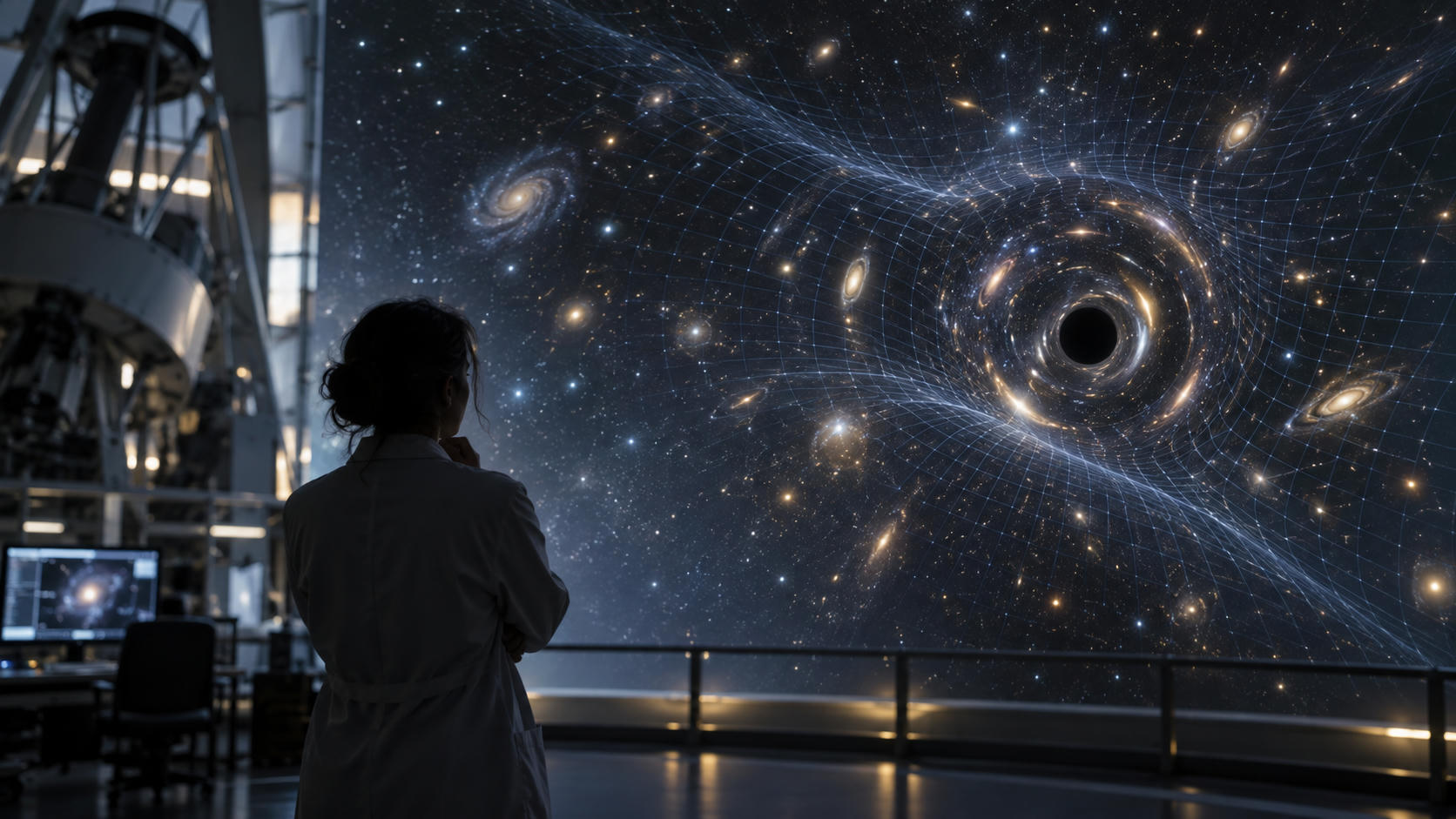
The universe contains far more than the stars, planets and galaxies visible through telescopes. Current cosmological models suggest that ordinary matter makes up only a small fraction of the universe. The remainder is generally described through two unresolved concepts: dark matter and dark energy.
Dark matter is a proposed form of matter that does not emit or absorb light but appears to exert gravitational effects. Its presence is inferred from galaxy motion, gravitational lensing and the formation of large-scale structures.
Dark energy refers to the unknown cause associated with the accelerating expansion of the universe. It could be a property of space itself, a new physical field or evidence that current theories of gravity are incomplete.
Researchers are testing all of these possibilities through astronomical surveys, laboratory experiments and increasingly precise measurements of cosmic expansion.
How Did the Universe Begin?
The Big Bang model describes the universe’s expansion from an extremely hot, dense early state. It explains observations such as the cosmic microwave background and the distribution of galaxies, but it does not fully explain why the universe began, what occurred at its earliest moment or whether “before the Big Bang” has physical meaning.
Answering these questions may require a theory that unifies quantum mechanics with gravity. Such a theory could clarify the origin of space-time and the behavior of matter during the universe’s earliest stages.
How Do Galaxies Evolve?
Galaxies are shaped by stars, gas, gravity, mergers and the supermassive black holes at their centers. Scientists still do not fully understand how these influences interact over billions of years.
One report described evidence that winds produced by supermassive black holes may be far more powerful than previously estimated—potentially by a factor of 100. Source 7
If confirmed, such winds could remove gas from galaxies, suppress or regulate star formation and influence the growth of their host galaxies.
2. Can Physics Explain Reality at Every Scale?
Quantum mechanics describes matter and energy at very small scales. General relativity describes gravity, space-time and large cosmic structures. Both theories have been extensively tested, but they do not provide one consistent description under extreme conditions.
The conflict is especially important inside black holes and during the universe’s earliest moments. A successful theory of quantum gravity could explain how space-time behaves when quantum effects and intense gravity occur together.
Black holes also raise questions about singularities and information. General relativity predicts that matter can collapse into regions of extreme density and curvature, while quantum theory implies that information should not simply disappear. Resolving this black-hole information problem could reveal whether space-time emerges from deeper quantum principles.
Science also faces practical limits. Some regions of the universe are too distant to observe directly, some events cannot be reproduced and some calculations exceed current computational capacity. These limits do not make all explanations equally credible; they define the strength and boundaries of available evidence.
3. How Did Life Begin, and How Common Is It?
One of biology’s central questions is how nonliving chemistry produced the first system capable of replication, evolution and sustained organization.
Researchers study possible pathways involving early Earth environments, self-replicating molecules, cell membranes, energy sources and chemical networks. Proposed settings include oceans, mineral surfaces, volcanic regions and hydrothermal environments. No single pathway has been established as the definitive origin of life.
The question also requires a definition of life. Scientists must determine which characteristics are essential, including reproduction, metabolism, adaptation, information storage and the ability to maintain an organized boundary.
The search for life beyond Earth depends on understanding habitability and biosignatures. Mars, icy moons and planets orbiting other stars may contain conditions suitable for life-related chemistry, but potentially habitable environments are not evidence that life exists there.
Discovering even simple extraterrestrial life would transform biology by showing that life is not unique to Earth. Failing to find life in promising environments would also provide evidence about how rare its emergence may be.
4. How Does the Brain Produce Consciousness?
Consciousness connects neuroscience, psychology, philosophy and computation. Scientists can associate patterns of brain activity with perception, memory, attention and wakefulness. The deeper problem is explaining how electrical and chemical activity produces subjective experience.
A brain scan may show which networks become active when someone sees a color or feels pain, but it does not explain why those processes are accompanied by an inner perspective. Researchers continue to develop theories involving information processing, neural integration and conscious states.
Human intelligence includes learning, abstraction, flexible reasoning, language, creativity and generalization. Machines can outperform humans in specific tasks, yet often struggle with context, common sense and transfer between unrelated problems. This raises the question of whether intelligence is one general capacity or a collection of abilities shaped by biology.
Consciousness is also difficult to measure. Scientists rely on behavior, verbal reports, brain activity and physiological signals. Better measures could improve the diagnosis of consciousness in people affected by coma, anesthesia or brain injury and help assess possible consciousness in animals, infants and future artificial systems.
5. Can Science Predict and Manage Planetary Change?
Climate science has established that human-produced greenhouse gases are warming the planet. Researchers continue to refine predictions about regional effects, extreme weather, ice-sheet stability, ocean circulation and ecological responses.
Uncertainty remains for specific locations and time scales. Scientists may not know exactly how rainfall will change in a particular region or when an ice-sheet threshold could be crossed. That uncertainty does not undermine the strong evidence for human-driven warming.
Ecosystems face habitat loss, pollution, invasive species, rising temperatures and changing rainfall. Researchers are studying whether ecosystems can absorb disturbances, whether biodiversity improves resilience and where irreversible thresholds may occur.
Carbon removal, clean energy, ecosystem restoration and climate adaptation may reduce future risks. However, technical feasibility does not resolve questions about cost, scale, governance and unintended consequences. Climate solutions require scientific evidence as well as public decisions about fairness, risk and responsibility.
6. What Will Artificial Intelligence Change About Science?
AI systems can generate conjectures, identify patterns, search large spaces, design experiments and assist with calculations. At the 13th Heidelberg Laureate Forum, mathematicians and computer scientists discussed AI’s role in mathematical research and the relationship between human and machine reasoning. Source 9
Scientific discovery requires more than producing a correct output. Researchers must determine whether a result is meaningful, establish why it works, test it independently and explain its implications.
Many AI systems rely on statistical patterns in large datasets, while human reasoning often combines abstraction, causal understanding, intuition, physical experience and interpretation. A correct prediction without an inspectable explanation creates challenges for scientific reliability.
AI-assisted research also carries risks, including fabricated references, biased training data, hidden errors and unsupported conclusions. Transparent methods, reproducible results, expert review and experimental confirmation remain essential.
AI could also help mathematicians find patterns, suggest conjectures, search for proofs and identify connections between distant fields. The unresolved issue is whether machine-generated insights will expand mathematical understanding or mainly accelerate existing methods.
7. Which Mathematical Problems Matter Most?
Mathematics supports cryptography, computing, physics, engineering, economics and data analysis. An abstract result may eventually influence technologies that did not exist when the original problem was formulated.
Scientific American has reported on mathematicians identifying 50 high-stakes unresolved problems, although the available source summary does not provide the complete list or explain each problem’s significance. Source 5
A problem may be important because it affects other fields, changes theoretical understanding, produces practical applications or reveals the limits of current methods. “High stakes” does not necessarily mean immediate commercial value.
Mathematics also contains questions that may be undecidable within a particular formal system. This distinction connects mathematics to computation and knowledge by asking whether every well-defined question has an answer derivable from accepted rules.
8. Why Do Scientific Questions Keep Expanding?
Discoveries often reveal deeper mechanisms rather than closing a field. Cosmology still asks what dark matter is after measuring its gravitational effects. Biology can describe genetic systems while lacking a complete account of life’s origin. AI answers some questions while raising new ones about reasoning, consciousness and explanation.
Scientific progress depends on better tools, including telescopes, particle detectors, genetic sequencing, brain-imaging systems, supercomputers and AI models. New observations can challenge accepted estimates, as research into unexpectedly powerful supermassive-black-hole winds illustrates. Source 7
The largest problems rarely belong to one field. Understanding consciousness may require neuroscience, psychology, philosophy and computer science. Climate research combines physics, chemistry, biology, economics and public policy. The origin of life links geology, chemistry, biology and planetary science.
Conclusion
The biggest questions in science today concern the universe’s composition, the origin of space-time, black holes, the emergence of life, consciousness, climate change, artificial intelligence and the limits of mathematics.
The 100-scientist perspective is valuable because scientific importance cannot be reduced to one ranking. Different fields measure significance through explanatory power, practical consequences, intellectual difficulty and potential effects on humanity.
Scientific progress depends on defining concepts precisely, testing assumptions and accepting the limits of current knowledge. Future breakthroughs may come from unexpected connections between fields—and from questions scientists have not yet learned to ask.
FAQ
What are the biggest unanswered questions in science today?
Major questions concern the origins of the universe, dark matter and dark energy, the origin of life, consciousness, climate change, artificial intelligence and the relationship between mathematics and reality. Source 3
Why are dark matter and dark energy still unexplained?
They account for observations that current models do not fully explain. Researchers are testing whether they represent undiscovered forms of matter and energy or indicate limitations in existing theories of gravity and cosmology.
Could AI solve major scientific and mathematical problems?
AI can assist with pattern detection, conjectures, simulations, calculations and proof-related tasks. Reliability, explanation, verification and experimental testing remain essential. Source 9
What is the central question about the origin of life?
Scientists seek to explain how nonliving chemistry became a system capable of replication, evolution and sustained organization. No definitive explanation has been established.
Why are black holes important to science?
Black holes test theories of gravity, quantum mechanics, information and cosmic evolution. Evidence that supermassive-black-hole winds may be more powerful than previously estimated could also change models of galaxy formation. Source 7
Do unsolved mathematical problems matter outside mathematics?
Yes. Mathematical ideas support cryptography, computing, physics, engineering and data analysis. Their practical importance may not be visible when the problems are first formulated. Source 5
Artikel Terkait
-
 Second-Generation Planet Candidate Around a White Dwarf
-
 Star May Be Consuming a Brown Dwarf 300 Light-Years Away
-
 Sotheby’s Dinosaur Auction Signals a Resilient Fossil Market
-
 Possible Planet Found in Hot Star’s Habitable Zone
-
 Could Tiny Black Holes Exist in Five Dimensions?
-
 How NASA Studies Wildfire-Generated Fire Clouds