Possible First Radio Signal From an Exoplanet
Possible First Radio Signal From an Exoplanet
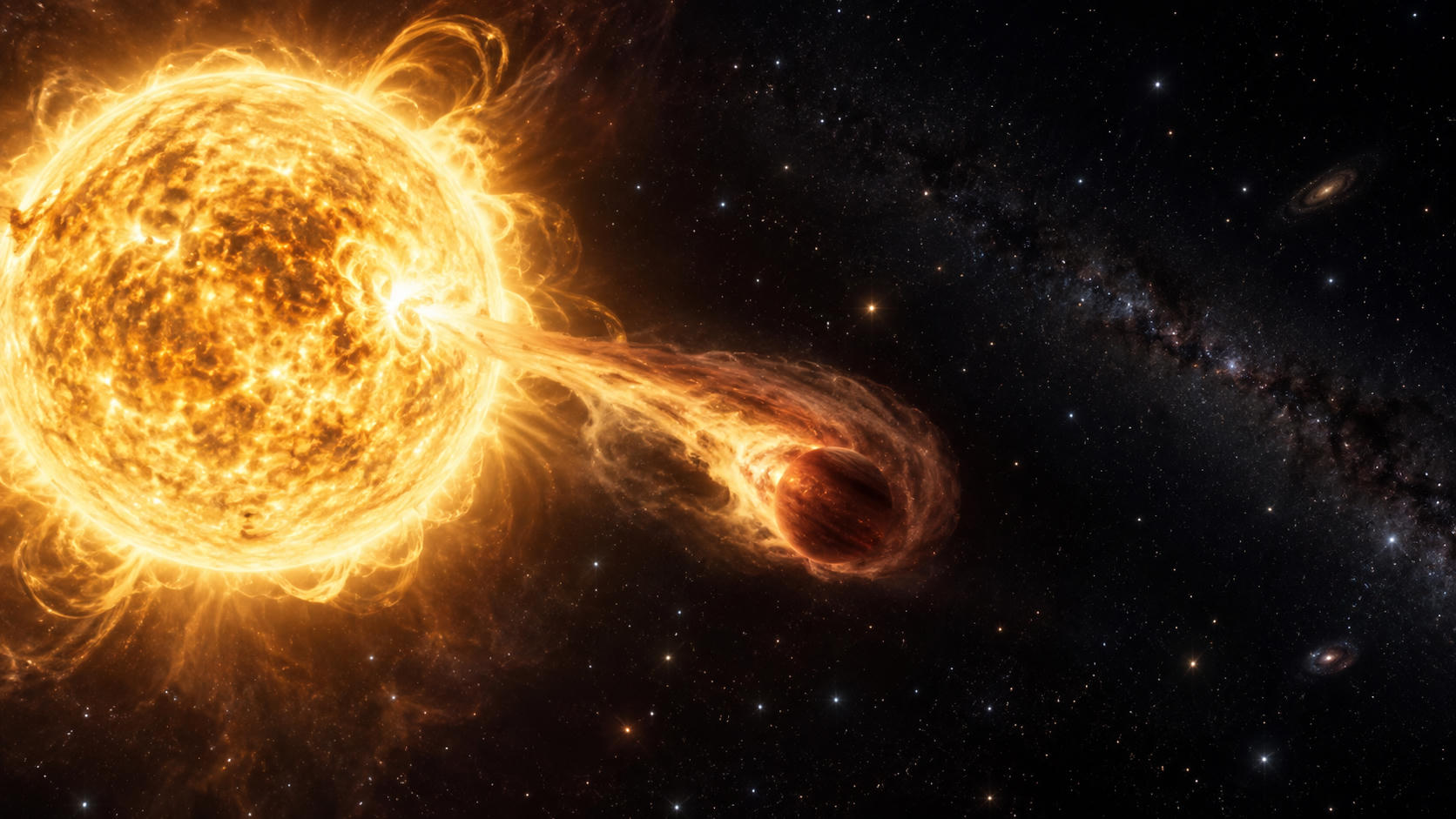
Astronomers may have identified radio waves associated with a planet beyond the Solar System. If later observations confirm the interpretation, the result could become a major milestone in exoplanet research: the first confirmed radio emission directly linked to an exoplanet, or the first detection of a specific type of planetary radio signal beyond the Solar System.
The claim remains tentative. Available reports describe a possible detection rather than a confirmed discovery. The headline circulated through several social media posts, including links to a New York Times report titled “Radio Waves Coming From an Alien Planet May Be a Cosmic First” Source 1 Source 7.
In this context, “alien planet” means an exoplanet. It does not mean that the planet contains aliens, intelligent life, or an extraterrestrial civilization. Natural planetary and stellar processes can produce radio waves. Scientists must determine where the signal originated, whether it can be repeated, and what physical mechanism generated it.
A confirmed radio detection would matter because radio observations can reveal planetary magnetic fields, charged particles, stellar winds, atmospheric escape, and interactions between planets and their host stars. These properties are difficult or impossible to study through visible light alone.
What the Available Reports Say
The Headline Describes a Possible Planetary Radio Signal
The available reports share a central claim: radio waves may be coming from a planet beyond the Solar System, and the observation could represent an unprecedented event in astronomy Source 3 Source 5 Source 9.
The most informative reference is a post by JoseABNolla, which identifies the New York Times as the source Source 7. Other posts repeat the headline or summarize the same possible detection. They demonstrate widespread reporting, but they do not independently verify the scientific result.
The available summaries do not identify:
- The planet’s name
- Its distance from Earth
- The host star
- The radio telescope or instrument
- The signal’s frequency
- Its strength or duration
- The research team
- The proposed emission mechanism
- A peer-reviewed scientific paper
These omissions limit what can responsibly be concluded. The signal may be associated with an exoplanet, but the available information does not establish whether the emission came from the planet itself, its host star, or an interaction between the two.
Some supplied entries contain only labels such as “1000+,” “5000+,” or unrelated titles. They provide no scientific evidence and cannot verify the claim.
Source Quality and Verification Limits
Repeated social media posts are not equivalent to independent scientific confirmation. Posts from SJSUHumanRights, mawby, toproudlygo, JoseABNolla, and JerryGonzalez93 point to the same news claim Source 1 Source 3 Source 5 Source 7 Source 9. They do not represent separate telescope observations or independent analyses.
A reliable assessment requires the original news article, an official observatory or university release, and the underlying research paper. Those sources should describe the observing method, data analysis, interference checks, and evidence connecting the radio emission to the planet’s orbit.
Until those details become available, accurate wording includes “may have detected,” “could be associated with,” and “researchers are investigating.” Definitive statements should wait for technical confirmation.
Why Radio Waves Matter in Exoplanet Research
Radio Emissions Reveal Invisible Planetary Processes
Most exoplanets are discovered through their effects on stars. A planet may slightly dim its star during a transit, cause the star to wobble through gravity, or magnify a background star through gravitational microlensing. These methods reveal a planet’s presence, but they do not necessarily show how it interacts with the surrounding space environment.
Radio astronomy offers a different perspective. Radio emissions can reveal energetic particles, magnetic fields, stellar winds, and plasma environments. They can also indicate that a planet is exchanging energy with its host star.
A radio signal may help scientists study:
- Planetary magnetic fields
- Charged particles trapped around a planet
- Stellar-wind interactions
- Atmospheric escape
- Space-weather conditions
- Star–planet magnetic connections
These processes are especially important for planets orbiting close to active stars. A planet in a tight orbit may experience intense ultraviolet radiation, X-rays, and streams of charged particles. Such conditions can heat and erode an atmosphere over time.
Planetary Magnetic Fields Are a Major Scientific Target
Moving charged particles can generate radio waves. A planetary magnetic field can guide those particles and shape their interaction with stellar wind. In the Solar System, Jupiter produces strong radio emissions associated with its magnetic environment and interactions with charged particles. Earth also produces radio emissions linked to its magnetosphere.
Magnetic fields matter because they may help protect planetary atmospheres from stellar particles and radiation. They can also provide clues about a planet’s interior. On Earth, the magnetic field is generated by motion in the electrically conducting outer core. Other planets may generate fields through different internal processes.
A radio signal associated with an exoplanet could help researchers investigate whether that world has a magnetic field and estimate its strength. It could also help scientists compare distant planets with Earth, Jupiter, and other Solar System bodies.
The reported observation does not, by itself, prove that the planet has a magnetic field. Scientists must connect the signal’s properties to a physical model and exclude alternative explanations.
How Astronomers Test a Signal’s Origin
Observations Must Match the Planet’s Position
A credible planetary origin requires more than a radio signal appearing near a known exoplanet. Astronomers compare the signal’s timing with the planet’s orbital position.
If the emission is genuinely connected to the planet, it may appear at predictable orbital phases. The signal could strengthen when the planet encounters a particular region of the stellar wind or when its magnetic interaction with the star becomes especially strong.
Researchers may compare:
- The planet’s orbital phase
- The host star’s activity
- The timing of radio bursts
- Signal intensity
- Frequency and polarization
A single detection is difficult to interpret. A repeated pattern that follows the planet’s orbit would provide stronger evidence.
Scientists Rule Out Interference
Radio astronomers must remove many possible sources of contamination. Human-made transmissions, satellites, aircraft, electronics, and local communication systems can create signals that resemble astronomical observations.
The Earth’s ionosphere can also affect radio measurements. Telescope hardware, data-processing systems, and calibration errors may produce instrumental artifacts. Unrelated background sources can enter the same field of view.
The host star presents another major challenge. Stars can produce radio bursts and other energetic activity. A signal that appears connected to a planet may actually come from the star or from plasma between the two bodies.
Astronomers strengthen a result by observing the target repeatedly, using different instruments, and comparing data from independent facilities. They must demonstrate that the signal is not caused by Earth, the telescope, a background source, or ordinary stellar activity.
Signal Properties Provide Additional Evidence
Scientists examine several characteristics when determining a radio signal’s origin:
- Frequency
- Polarization
- Intensity
- Duration
- Repetition
- Direction of arrival
- Variation over time
These properties can help distinguish natural planetary emissions from stellar bursts, interference, and background radio sources. Polarization, for example, can provide information about magnetic fields and the propagation of radio waves.
The available summaries provide none of these technical measurements. No frequency, signal strength, duration, or polarization information should be invented.
Why This Could Be a Cosmic First
Astronomers have confirmed thousands of exoplanets, but most were found through indirect effects. The transit method detects the small dip in starlight caused when a planet passes in front of its star. The radial-velocity method detects the star’s movement caused by the planet’s gravitational pull.
Other methods include gravitational microlensing and direct imaging. Microlensing uses the gravity of a foreground system to magnify light from a more distant star. Direct imaging can capture some planets, particularly large, young worlds far from their stars.
Detecting radio emissions associated with a planet would reveal a different property: its electromagnetic environment. Instead of observing only a planet’s effect on starlight or stellar motion, astronomers could study its magnetic field, plasma interactions, and space weather.
The phrase “cosmic first” requires careful definition. It might mean:
- The first confirmed radio emission from an exoplanet
- The first radio signal directly associated with a specific exoplanet
- The first detection of a particular planet–star radio interaction
- The first observation of a specific magnetic emission mechanism beyond the Solar System
The exact meaning should come from the original scientific report, not from the headline alone.
What the Signal Does Not Mean
It Is Not Evidence of an Alien Civilization
Natural radio emissions and artificial transmissions are different phenomena. A planet can produce radio waves through magnetic activity, charged particles, stellar-wind interactions, or atmospheric processes.
The available reports describe a possible astronomical observation. They do not report a coded message, a technological pattern, or an intentional transmission. Radio waves alone do not demonstrate communication, technology, or intelligent life.
It Does Not Confirm Habitability
A radio signal does not establish the presence of liquid water, a breathable atmosphere, biological activity, or a surface suitable for life.
Radio observations may reveal a magnetic field or interactions between a planet and its star while providing little information about surface conditions. A planet can have strong radio emissions and still be extremely hot, heavily irradiated, or otherwise hostile to life as known on Earth.
A Possible Detection Is Not a Final Discovery
Scientific findings generally pass through several stages:
- A candidate signal appears in observational data.
- Researchers analyze possible sources and contamination.
- Additional observations test whether the signal repeats.
- Independent teams examine the result.
- A peer-reviewed study presents the evidence and interpretation.
A news report may describe an important candidate before all these stages are complete. That does not make the report meaningless, but it requires careful language.
Questions Researchers Must Answer
Researchers must determine whether the signal is reproducible, whether it originates from the planet or its star, and what it reveals about the system.
Follow-up observations should test whether the signal appears again during later observing sessions or at predictable orbital phases. Repetition would reduce the likelihood that the original observation resulted from random noise, temporary interference, or an instrument problem.
Scientists must also distinguish among radio waves generated directly by the planet, emissions produced by the host star, star–planet interactions, and plasma activity elsewhere in the system. A planet may influence a signal without being its direct source.
If the detection survives testing, researchers may investigate whether the planet has a magnetic field, whether stellar activity is stripping its atmosphere, and whether its close orbit creates unusually strong electromagnetic interactions.
How Follow-Up Observations Could Test the Claim
Independent Radio Telescopes
Different observatories can test whether the signal is genuine. Independent facilities help eliminate local interference, telescope-specific artifacts, calibration problems, and data-processing errors.
Confirmation from more than one instrument would strengthen the result. Repeated observations over time would provide an even stronger test.
Multiwavelength Studies
Radio measurements become more useful when combined with optical, infrared, ultraviolet, and X-ray observations. These data can reveal stellar flares, magnetic activity, atmospheric composition, ultraviolet and X-ray exposure, orbital behavior, and possible atmospheric loss.
A multiwavelength view can show whether the radio signal occurs during stellar activity or follows the planet’s orbital cycle.
Updated Planetary and Stellar Models
Researchers can compare the observation with models of magnetic-field generation, stellar winds, planetary atmospheres, and orbital dynamics. Models can test whether the proposed system should produce radio emissions of the reported type.
Agreement between data and models supports an interpretation, but it does not replace direct confirmation.
Why the Finding Matters
Radio astronomy could become a tool for comparing hot planets near active stars, gas giants, rocky planets, and worlds with different magnetic environments. A larger sample would help scientists determine whether planetary radio emissions are common or unusual and how they vary with planet size, orbital distance, atmospheric composition, and stellar age.
Studying other planetary systems may also improve understanding of Earth’s magnetosphere, solar-wind interactions, atmospheric protection, and long-term planetary stability. An exoplanet observation would not directly predict Earth’s future; it would provide a natural comparison for testing broader theories about how planets respond to their stars.
Radio observations could complement transit spectroscopy, infrared measurements, optical monitoring, and stellar-activity studies as part of a broader toolkit for characterizing exoplanets.
What Readers Should Watch for Next
Important updates would include:
- A peer-reviewed paper describing the observation
- The candidate planet’s name and location
- The observing facility and radio frequency
- The signal’s duration, intensity, and polarization
- Confirmation from independent telescopes
- Evidence connecting the signal to the planet’s orbit
- Expert analysis of planetary, stellar, or star–planet origins
- A clear definition of the claimed “cosmic first”
These details will determine whether the report describes a confirmed exoplanet radio detection, a candidate signal, or a previously known type of stellar interaction.
Conclusion: A Promising Signal, Not Proof of Alien Life
Astronomers may have identified radio waves associated with an exoplanet. If confirmed, the observation could establish a new way to study worlds beyond the Solar System and might represent a first in planetary radio astronomy.
The available summaries do not establish the signal’s exact origin, mechanism, frequency, or reliability. Repeated observations, interference checks, independent analysis, and peer-reviewed research are necessary before the finding can be treated as confirmed.
The result should not be interpreted as evidence of intelligent life. Its potential importance is physical, not biological. Radio observations could reveal magnetic fields, atmospheres, charged particles, and star–planet interactions across distant planetary systems.
Frequently Asked Questions
What are radio waves from an alien planet?
They are electromagnetic emissions that may originate from a planet beyond the Solar System. Here, “alien planet” means exoplanet and does not imply extraterrestrial life.
Has radio emission from an exoplanet been confirmed?
The available summaries describe a possible detection and a potential cosmic first. They do not provide enough technical information to confirm independent verification or peer-reviewed acceptance.
Do the radio waves prove that aliens are communicating?
No. Natural planetary and stellar processes can produce radio waves. The available reports do not describe an artificial transmission, technological pattern, or communication from an alien civilization.
What could produce radio waves from an exoplanet?
Possible mechanisms include charged particles moving through a planetary magnetic field, interactions between a planet and its host star, stellar-wind effects, and magnetic activity in the surrounding plasma environment.
Why would this detection be important?
A confirmed detection could give astronomers a new way to study exoplanetary magnetic fields, atmospheres, stellar interactions, and space weather. It could also expand exoplanet research beyond traditional detection methods.
What evidence would confirm the discovery?
Researchers would need repeated observations, careful removal of Earth-based interference, evidence that the signal follows the planet’s orbit, and independent confirmation that the emission comes from the planet or a clearly identified planet–star interaction.
Artikel Terkait
-
 Francis Halzen and IceCube’s Neutrino Breakthrough
-
 Moon and Jupiter to Align in Rare Occultation
-
 SpaceX NASA Record Claim Still Needs Verification
-
 How to See Saturn at Opposition on October 4, 2026
-
 Second-Generation Planet Candidate Around a White Dwarf
-
 Star May Be Consuming a Brown Dwarf 300 Light-Years Away