October Skywatching Guide: Moon, Meteors and Saturn
October Skywatching Guide: Moon, Meteors and Saturn
October brings longer nights, cooler air and several accessible celestial targets. Depending on the year and your location, highlights may include the Hunter’s Moon, the Orionid meteor shower, Saturn near opposition, seasonal star clusters and a Moon–Venus pairing.
Exact dates, rise times, meteor rates and planetary positions change annually. Visibility also depends on latitude, weather, daylight-saving changes and local horizons. Check a current astronomy calendar, planetarium service or observatory before planning a specific night.
October Skywatching Calendar
| Event | Timing | Best viewing | Equipment |
|---|---|---|---|
| Hunter’s Moon | Full Moon after the Harvest Moon; date varies annually | Moonrise, moonset and the night around full phase | Naked eye, camera or tripod |
| Orionid meteor shower | Active during October; peak varies slightly by year | Late night to pre-dawn | No equipment |
| Saturn near opposition | Annual event; verify the date | Evening and late evening | Naked eye, binoculars or telescope |
| Moon–Venus pairing | Occasional; date and separation vary | Shortly after sunset or before sunrise | Naked eye, camera or binoculars |
| Pleiades and seasonal star fields | Visible during October evenings | Late evening and after midnight | Naked eye or binoculars |
The Hunter’s Moon, Orionids and Saturn are recurring October highlights. Moon–Venus conjunctions and the visibility of Jupiter or Mars require year-specific confirmation. July’s Buck Moon and August’s Perseid meteor shower should not be listed as current October events.
The Hunter’s Moon
The Hunter’s Moon is the traditional name commonly given to the full Moon after the Harvest Moon. The name comes from seasonal traditions associated with preparing for winter. It does not indicate a physical change in the Moon, and naming traditions differ among cultures and regions.
The most dramatic views often occur near moonrise or moonset. The Moon may look orange, amber or reddish near the horizon because its light passes through more of Earth’s atmosphere. The Moon can also appear unusually large beside buildings, trees or mountains. This is the Moon illusion, a change in perception rather than actual size.
The exact date changes each year. Use local moonrise and moonset times, and choose a location with an unobstructed eastern horizon for moonrise or western horizon for moonset.
A bright full Moon is excellent for lunar observation and photography but reduces contrast across the sky. Dim galaxies, nebulae, star fields and many meteors are harder to see in strong moonlight.
Photographing the Hunter’s Moon
- Use a tripod and delayed shutter release.
- Expose for the lunar surface so it does not become a featureless white disk.
- Include a building, tree, bridge, mountain or other foreground subject.
- Use a telephoto lens for a large Moon beside a distant object.
- Use a wide-angle lens for a broader landscape.
- Take several exposures as the Moon rises.
- Focus manually or lock focus on the Moon.
- On a smartphone, lock focus on the Moon and lower the exposure.
Arrive early to identify a clear composition and confirm the direction of moonrise or moonset.
October Meteor Showers
The Orionids
The Orionids are October’s main annual meteor shower. They are produced by dust left by Halley’s Comet. When Earth passes through this debris stream, particles enter the atmosphere and create fast, bright streaks.
The shower is active during part of October and usually reaches its strongest period in the latter half of the month. Check the relevant year for the exact peak date and predicted rate. A quoted maximum assumes dark skies, a high radiant and little or no moonlight; most observers see fewer meteors.
The radiant lies near Orion, but do not stare directly at it. Meteors can appear anywhere across the sky. Looking 30 to 60 degrees away from Orion often reveals longer streaks across a wider field of view.
The best viewing period is usually late night through pre-dawn, after Orion has risen higher. Moonlight, clouds, light pollution and a low radiant can significantly reduce the visible count.
Other October Meteor Activity
Minor showers, including the Draconids and Southern Taurids, may also be active in October. They usually produce fewer meteors than the Orionids, but patient observers may see occasional members. Sporadic meteors appear throughout the year and do not belong to a named shower.
Choose a location away from streetlights, buildings and illuminated signs. Use a reclining chair or blanket, allow 20 to 30 minutes for dark adaptation and watch for at least an hour. Keep phone screens dimmed or covered, use red light when possible and dress for overnight temperatures.
Saturn at Opposition
Saturn reaches opposition when Earth lies approximately between the Sun and Saturn. Around opposition, Saturn is generally closer and brighter than at many other times of year and remains visible for much of the night.
Opposition does not mean that Saturn is physically close by human standards. The planet remains hundreds of millions of miles away. It describes favorable viewing geometry.
Use a current planetarium app or star chart to locate Saturn. It usually appears as a bright, steady point of light rather than a strongly twinkling star. Observe it after sunset when it is above the horizon, preferably near its highest point.
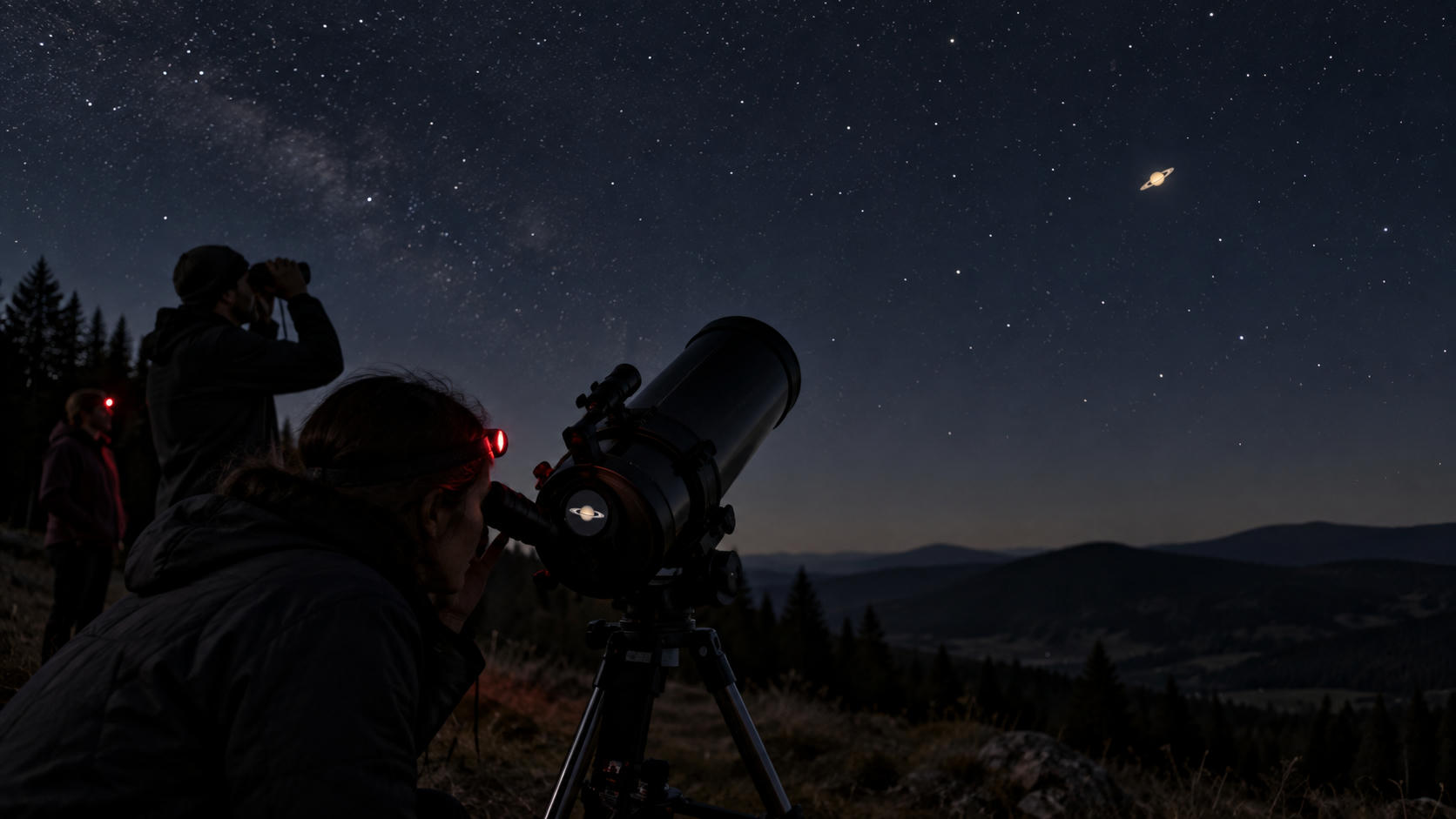
A telescope is needed to see Saturn’s rings clearly. Binoculars can help locate the planet and nearby stars but normally cannot resolve the rings. A small telescope may show the rings and Titan. Larger instruments may reveal the Cassini Division when atmospheric conditions, focus and equipment are good.
Allow the telescope to reach outdoor temperature, begin with moderate magnification and observe Saturn when it is highest. Atmospheric turbulence can blur fine detail.
The Moon and Venus
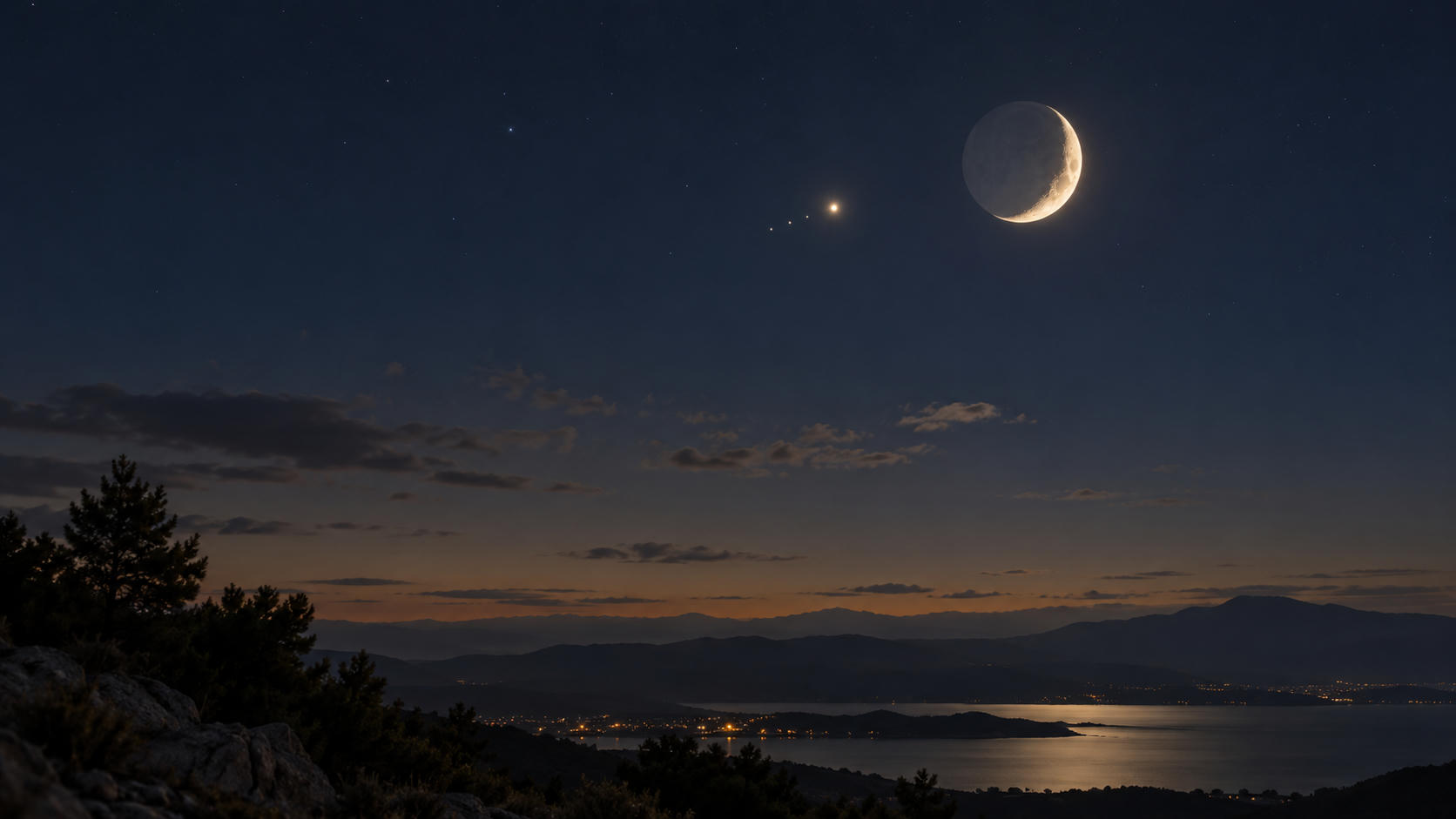
A Moon–Venus conjunction occurs when the two objects appear close together from Earth’s perspective. The Moon may be a thin crescent, while Venus appears as an exceptionally bright point nearby. The objects are not physically close in space; the pairing is a line-of-sight effect.
The date, direction and angular separation vary by year. Look toward the correct horizon shortly after sunset or before sunrise, depending on the event. A clear horizon is important because Venus and a young crescent Moon may remain low in the sky.
Find the Moon first, then locate Venus nearby. Binoculars can provide a wider view, but use them only after the Sun is fully below the horizon.
Never point binoculars or a telescope near the Sun. Direct sunlight through optical equipment can cause permanent eye damage within seconds.
For photography, use a wide-angle lens or smartphone night mode. Include a foreground landmark, take several exposures and avoid excessive digital zoom.
Other October Targets
Jupiter and Mars may also be visible, depending on the year. Confirm their rise and set times before planning an observation. Planets generally shine more steadily than stars, although atmospheric conditions can make any bright object shimmer.
Seasonal stars and constellations provide reliable alternatives. Northern observers may find Orion, Taurus, Capella and the Pleiades during October evenings. The Pleiades are visible to the naked eye and become more prominent through binoculars.
Southern-hemisphere observers should use a hemisphere-specific star chart and explore targets such as the Southern Cross, Canopus and the Magellanic Clouds where visible.
For beginners, bright star clusters are often better starting points than faint galaxies. Dark skies usually matter more than expensive equipment for diffuse deep-sky objects.
A Practical October Stargazing Plan
Early Evening
Begin with the Moon, Venus or Saturn if visible. Twilight makes bright planets easier to identify. Observe western targets before they set, then move to Saturn and seasonal constellations.
Late Evening
Once the sky is fully dark, look for Saturn and star clusters. Move away from nearby lights and scan a broad area if a meteor shower is active.
After Midnight
Check whether the Orionids or another verified shower has reached its strongest viewing period. Revisit targets that were low earlier and monitor clouds, dew and falling temperatures.
Equipment Checklist
No Equipment Required
Bring a current star map or astronomy app, a red-light flashlight, warm clothing, water, a snack and a reclining chair or blanket. Charge your phone or carry a backup battery.
Binoculars
Binoculars offer a wide field of view and work well for the Moon, Pleiades, bright star fields and planetary pairings. Never use binoculars while the Sun is above the horizon unless they have certified solar filters designed for that instrument.
Telescope
A telescope is most useful for Saturn, lunar craters, double stars and planetary details. Test the mount, eyepieces, alignment and batteries before the main event. Stable setup and clear optics matter more than extreme magnification.
Choosing a Viewing Location
City skies hide faint meteors and deep-sky objects. Suburban skies provide better access to bright planets and the Moon, while rural or designated dark-sky locations reveal more stars.
A full Hunter’s Moon washes out faint stars and meteors, so schedule deep-sky observing around darker lunar phases. Check cloud cover, humidity, wind and visibility. Transparent, stable air benefits Saturn and lunar detail, while turbulence can blur planets even under clear skies.
Use a clear horizon for moonrise, moonset, Venus and low planets. Avoid roads, unstable cliffs and restricted areas. Confirm site access and local regulations before traveling at night, and bring a companion to remote locations.
Common Mistakes to Avoid
- Treating a meteor-shower peak as a guarantee. Peak rates are averages, not promises.
- Expecting a full Moon to reveal many stars. Bright moonlight reduces contrast.
- Using unverified dates. Confirm the Hunter’s Moon, Orionid peak, Saturn’s opposition and any Moon–Venus pairing for the relevant year.
- Using July’s Buck Moon or August’s Perseid coverage as October scheduling evidence.
- Looking through optical equipment near the Sun without certified, correctly fitted solar filters.
October Skywatching FAQ
When is the Hunter’s Moon in October?
The date changes each year. It is commonly the full Moon following the Harvest Moon. Check a current lunar calendar and local moonrise and moonset times.
What meteor shower is visible in October?
The Orionids are the primary October meteor shower. Minor showers may also be active, depending on the year and location.
Can I see Saturn without a telescope?
Yes. Saturn can appear as a bright, steady point of light. A telescope is needed to see its rings clearly.
When can I see the Moon and Venus together?
The timing depends on the year, location and orbital geometry. Check a current astronomy calendar for the date, direction and angular separation.
What is the best time to stargaze in October?
Choose the time according to the target: moonrise or moonset for lunar photography, evening for Saturn and bright planets, and late night or pre-dawn for many meteor-shower observations.
Do I need a telescope?
No. The Hunter’s Moon, Orionids, Venus, Saturn and many bright stars are visible without optical equipment. Binoculars expand the range of targets, while telescopes provide detailed lunar and planetary views.
Plan an October Night Under the Stars
Start with the Hunter’s Moon, watch for Orionid meteors, observe Saturn near opposition and check whether a Moon–Venus pairing appears in your local sky.
Choose one primary event and one backup date. Check the forecast, Moon phase, local rise and set times, horizon conditions and site access. Pack warm clothing, dim your screens and allow your eyes to adjust.
A clear October night can reveal several sights, from a bright planet and lunar landscape to a sudden meteor crossing the sky.
Artikel Terkait
-
 Francis Halzen and IceCube’s Neutrino Breakthrough
-
 Moon and Jupiter to Align in Rare Occultation
-
 SpaceX NASA Record Claim Still Needs Verification
-
 How to See Saturn at Opposition on October 4, 2026
-
 Second-Generation Planet Candidate Around a White Dwarf
-
 Star May Be Consuming a Brown Dwarf 300 Light-Years Away