Mars Round-Trip Mission: Why It Matters
Mars Round-Trip Mission: Why It Matters
A mission capable of traveling to the Mars system and returning scientific material to Earth would represent a major advance in planetary exploration. Unlike a conventional flyby, orbiter, lander, or rover, a round-trip mission must complete the journey in both directions while protecting its scientific payload.
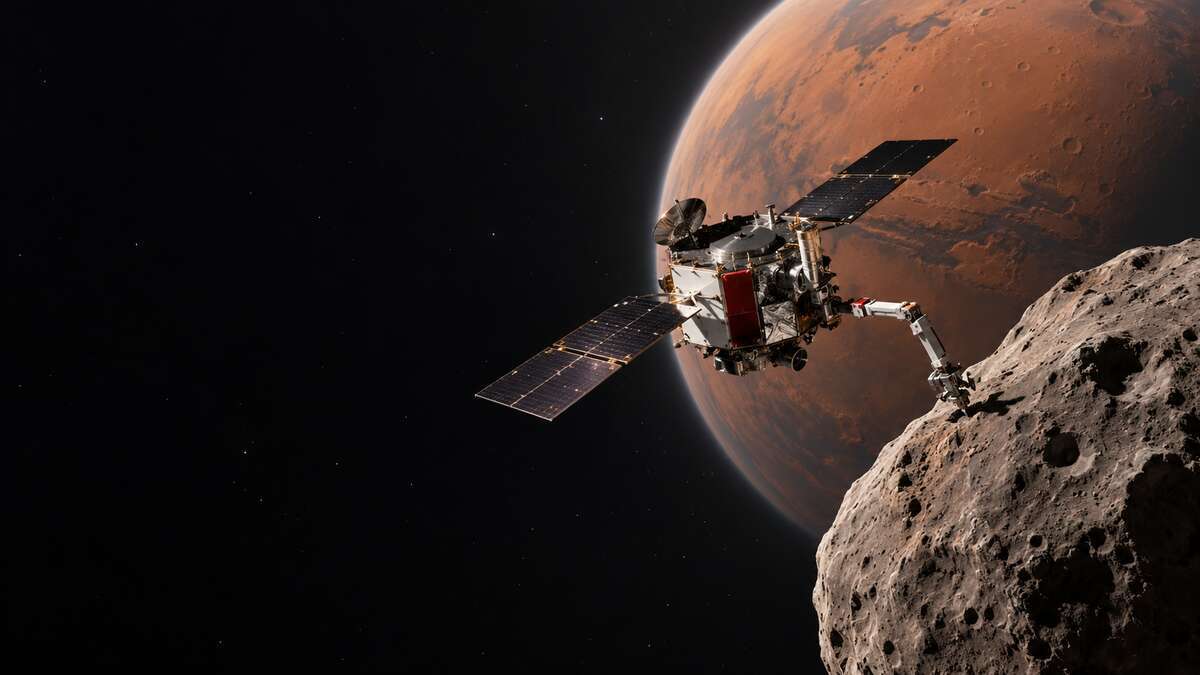
A Live Science report describes what it calls the world’s first round-trip mission to Mars as launched Source 1. However, the supplied report does not identify the spacecraft, launch vehicle, launch date, target, or return schedule. Those details require confirmation through official mission records before publication.
The distinction matters because Japan’s Martian Moons eXploration mission, or MMX, is a separate program designed to visit Phobos and return samples from that moon to Earth Source 3. A mission returning material from Phobos is not automatically the same as one collecting samples directly from Mars.
What Is a Round-Trip Mission to Mars?
A round-trip Mars mission must complete a demanding sequence:
- Launch from Earth.
- Cruise through interplanetary space.
- Enter the Mars system.
- Study Mars, Phobos, or another target.
- Collect samples or scientific data.
- Depart from the Mars system.
- Navigate back to Earth.
- Deliver the spacecraft or sample container safely.
Each stage depends on the next. A spacecraft can reach Mars successfully but still fail its primary objective if its sampling system malfunctions, its return trajectory becomes unusable, or its entry capsule cannot be recovered.
One-way robotic missions have already transformed knowledge of Mars. Orbiters have mapped the planet, landers have measured local conditions, and rovers have examined rocks and soil directly. A round-trip mission adds a different capability: it brings physical material into laboratories on Earth.
Why Sample Return Changes Planetary Science
Spacecraft instruments face strict limits on weight, power, size, data transmission, and operating conditions. Even advanced robotic laboratories can carry only a limited selection of instruments. Their results may also depend on the environment in which measurements are made.
Earth-based laboratories offer far greater flexibility. Scientists can use high-resolution microscopes, mass spectrometers, isotope analyzers, radiation facilities, and other instruments that are too large or complex to send to Mars. Researchers can repeat tests, compare results between laboratories, and apply new methods as technology develops.
Returned samples also create a long-term scientific archive. A measurement made by a spacecraft may be difficult to reproduce once the mission ends. A sealed sample can be studied decades later by researchers using instruments that do not yet exist. Sample return therefore creates a permanent resource for planetary science.
Mars Samples and Phobos Samples Are Different
Mars and Phobos are separate destinations with different scientific objectives.
The supplied report describes a round-trip mission to Mars but provides no official mission name or detailed technical documentation Source 1. It is therefore necessary to establish whether the mission collects material directly from Mars, studies a Martian moon, or uses “Mars” as a broader term for the Mars system.
By contrast, Japan’s MMX mission is explicitly focused on Phobos. It is intended to observe the moon, investigate its composition and evolution, and return samples to Earth Source 3.
What Scientists Could Learn
Mars’ geological history
Martian rocks and soil may preserve evidence of environments that existed billions of years ago. Scientists could investigate when Mars had liquid water, how long wetter conditions lasted, and why the planet eventually became colder and drier.
Minerals could reveal whether they formed in lakes, groundwater systems, volcanic environments, or under conditions dominated by wind and radiation. Researchers could also determine how Mars’ crust changed as the planet lost internal heat.
Signs of ancient life
Returned samples could improve the search for evidence of ancient microbial activity. Scientists may examine organic molecules, mineral structures, chemical imbalances, microscopic textures, isotopic patterns, and evidence of past water-rock interactions.
Organic molecules alone would not prove that life existed on Mars. Such compounds can form through nonbiological chemistry, arrive through meteorites, or result from contamination. Scientists would need several independent lines of evidence, repeated analyses, and geological context.
The advantage of sample return is independent verification. Laboratories around the world could examine the material using different instruments and analytical methods. Agreement between teams would strengthen a discovery, while conflicting results would identify areas requiring further research.
Atmosphere and habitability
Minerals can preserve chemical evidence of past atmospheric conditions. Some rocks contain trapped gases or record interactions with water and the atmosphere. Their isotopic composition may reveal how Mars lost atmospheric material over time.
These findings could address whether liquid water was available, whether temperatures remained stable, whether chemical energy sources existed, and whether soil chemistry could support microbial metabolism.
Habitability and life are different questions. A sample could show that Mars once offered suitable conditions without demonstrating that organisms ever lived there.
Why Phobos Matters
Phobos is one of Mars’ two moons and orbits close to the planet. Its origin remains an important planetary-science question. It could be a captured asteroid, material formed from Mars, debris produced by a major impact, or the result of more complex processes.
Its composition, surface structure, and internal properties could help distinguish among these explanations. If Phobos formed from Martian material, its samples could preserve clues about Mars’ ancient crust. If it is a captured asteroid, they could reveal how bodies from elsewhere in the Solar System became trapped in Mars’ orbit.
Japan’s MMX mission is designed to study Phobos, investigate its origin and evolution, and return samples to Earth Source 3. Its findings could complement direct Mars research by revealing material associated with the planet’s early history.
MMX should not be presented as the same spacecraft described in the supplied round-trip report without evidence linking the two missions. Final publication should confirm its planned launch date, current status, target operations, and expected sample-return date through official Japan Aerospace Exploration Agency and mission documentation.
The Engineering Challenge
Interplanetary missions must launch during precise windows determined by orbital mechanics. Earth and Mars must occupy suitable positions for the spacecraft to travel between them using an achievable trajectory. Navigation teams must correct small errors in speed and direction because an early error can grow into a major positional error later.
A Mars-system spacecraft must also operate with limited assistance. It may face communication delays, radiation exposure, extreme temperature changes, restricted power, limited fuel, dust, and difficult surface conditions. Autonomous software must protect the spacecraft and continue routine operations when contact with Earth is delayed.
Sampling requires the spacecraft to identify valuable material, collect it, prevent contamination, and seal it securely. The sample container must then survive vibration, temperature changes, radiation, the return journey, and atmospheric entry.
Mission risk continues until the samples are recovered and documented. A successful launch or Mars arrival is not enough to establish round-trip success.
Building on Earlier Mars Exploration
Mars exploration has developed through successive stages. Early flybys provided basic observations. Orbiters mapped the planet and studied its atmosphere. Landers and rovers then measured surface conditions directly.
Sample-return missions expand that capability by combining remote sensing, field geology, autonomous operations, and laboratory analysis. Orbital maps help select landing sites, rover measurements help identify promising rocks, and returned samples allow detailed examination on Earth.
NASA’s Perseverance rover demonstrates the value of detailed surface imaging, geological analysis, environmental measurements, and careful sample selection Source 9. However, Perseverance is not a completed round-trip mission. Its role is to investigate Mars and support future analysis of selected material.
Risks and What to Verify
Before publication, confirm the mission’s official name, launch vehicle, launch date, destination, sample target, expected return date, and current operational status. The supplied report does not provide these details Source 1.
Potential failure points include launch failure, navigation errors, communication loss, sampling-equipment malfunction, container damage, return-trajectory failure, atmospheric-entry failure, and recovery delays.
Planetary protection would also be central. Researchers must prevent Earth organisms, chemicals, and particles from entering the samples while handling returned material in a way that protects Earth from any unknown biological hazard. Controlled landing and recovery, specialized receiving laboratories, sterile handling, chain-of-custody records, and independent contamination monitoring would help protect both public safety and scientific integrity.
Conclusion
A successful first round-trip mission to Mars would move exploration from remote observation toward direct laboratory investigation. Returned material could improve understanding of Mars’ geological history, atmospheric evolution, ancient habitability, and possible biological activity.
Phobos research could add another dimension by revealing how Mars and its moons formed and evolved. Japan’s MMX mission is designed to study Phobos and return samples, but its identity and timeline must remain distinct from the unidentified mission described in the supplied launch report Source 3.
The mission’s importance ultimately depends on verified launch status, safe sample recovery, contamination control, and careful analysis. Its greatest impact may emerge over decades as scientists study the material with increasingly powerful instruments.
FAQ
Is this the first round-trip mission to Mars?
The supplied report describes the mission as the world’s first round-trip mission to Mars Source 1. Final publication should verify the claim through official mission records and clarify whether “round trip” means returning material from Mars itself or from a Martian moon.
What is the purpose of a round-trip Mars mission?
The purpose is to travel to the Mars system, collect scientific data or samples, and return them to Earth. Samples can be analyzed with larger and more advanced laboratory instruments than spacecraft can carry.
What is the MMX mission?
Japan’s Martian Moons eXploration mission is designed to study Phobos, one of Mars’ moons, and return samples to Earth. Its goals include investigating Phobos’ origin, composition, and evolution Source 3.
Could returned samples prove that life existed on Mars?
They could provide stronger evidence about whether Mars was once habitable and whether biological activity may have occurred. Organic molecules or unusual mineral patterns alone would not prove past life. Scientists would need multiple independent lines of evidence and would need to exclude contamination and nonbiological processes.
Why are Mars samples more valuable than rover measurements?
Rovers provide important on-site measurements, but returned samples can undergo repeated testing in specialized laboratories. Researchers can compare results across independent teams and reanalyze the material with future instruments.
What happens after the samples return to Earth?
The samples would be recovered, transferred under controlled conditions, documented, and examined in specialized facilities. Planetary-protection procedures would help prevent contamination and preserve their scientific value.