Japan’s MMX Mission Will Return a Phobos Sample
Japan’s MMX Mission Will Return a Phobos Sample
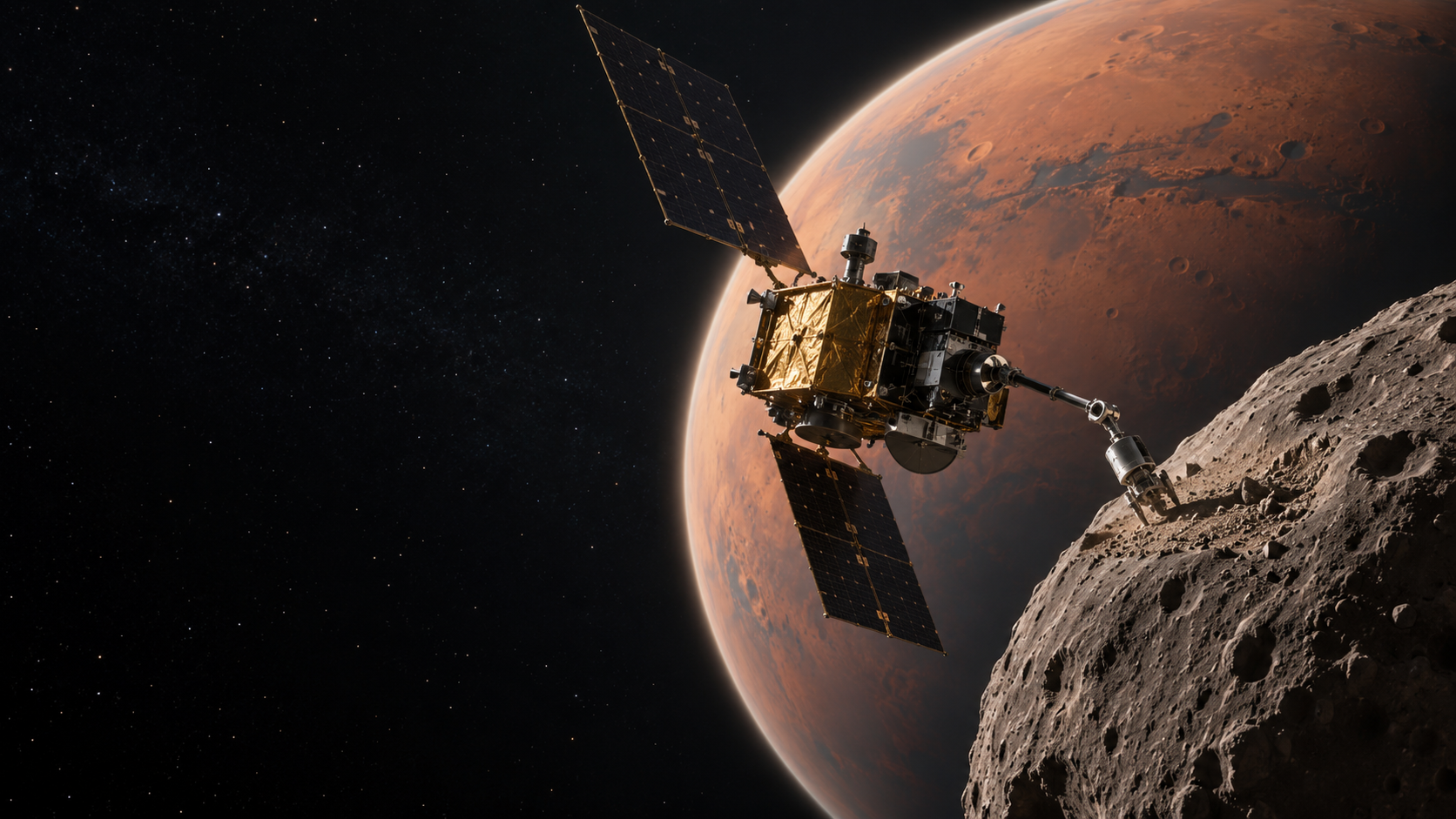
Japan is developing a spacecraft to travel to Mars, study its moons, collect material from Phobos, and return that sample to Earth. The mission, called Martian Moons Exploration, or MMX, could become the first mission to return samples from a Martian moon.
A Phobos sample could answer questions that spacecraft observations cannot resolve. Earth-based laboratories can examine its minerals, chemistry, isotopes, textures, and space-weathering effects with instruments more powerful and flexible than those carried by a spacecraft.
The results could reveal whether Phobos formed from material linked to Mars, arrived as a captured asteroid-like body, or contains material from multiple sources.
What Is Japan’s MMX Mission?
The Martian Moons Exploration mission is a Japanese-led planetary science project focused on Mars’ two natural satellites, Phobos and Deimos. Its central objective is to study the Mars system and return a sample from Phobos to Earth.
The planned mission sequence includes:
- Traveling from Earth to the Mars system.
- Observing Mars, Phobos, and Deimos.
- Approaching and surveying Phobos.
- Selecting a scientifically valuable and operationally safe sampling site.
- Collecting surface material.
- Departing the Mars system.
- Returning the sample to Earth for laboratory analysis.
MMX is therefore a sample-return mission rather than only an orbital or flyby mission. Japan’s space agency leads the project, with international partners, including NASA, participating in the broader effort to study Mars’ moons and their origins.
Why Is Phobos the Target?
Phobos is the larger and closer of Mars’ two moons. It is an irregular, heavily cratered body that orbits unusually close to the planet. Its gravity is too weak to pull it into a spherical shape.
The origin of Phobos remains unresolved. One possibility is that it is a captured asteroid-like object that formed elsewhere and was later caught by Mars. Another is that it formed from debris produced by a major impact on Mars. In that case, Phobos could contain material excavated from the Martian crust.
MMX aims to collect direct evidence that can test these explanations. The sample may show whether Phobos is related to Mars, resembles a primitive small body, or contains a mixture of materials.
Phobos and Deimos
Mars has two natural satellites: Phobos and Deimos. Phobos is larger, closer, and more prominent, while Deimos is smaller and farther from the planet.
Phobos is the primary sampling target, but observations of both moons can help scientists compare their shapes, surfaces, orbits, and compositions. Their differences may reveal whether they share a common origin or formed through separate processes.
What Could Scientists Learn From a Phobos Sample?
The Origin of Mars’ Moons
Researchers could examine the sample for:
- Mineral composition.
- Chemical signatures.
- Isotopic ratios.
- Textures and grain structure.
- Radiation exposure and space weathering.
A captured asteroid-like body might resemble material found in other primitive objects. A moon formed from Martian impact debris could show a stronger relationship to Martian rocks. Phobos may also contain material from both sources.
Scientists would compare the returned grains with Martian meteorites, asteroid samples, lunar material, and laboratory models. The results could narrow the range of possible formation histories.
Mars’ Geological History
MMX will not collect material directly from Mars. However, large impacts may have ejected rocks into orbit, where some material could have become incorporated into Phobos or settled on its surface.
If scientists identify Martian material in the sample, they may gain information about ancient rocks and impact events that are no longer clearly exposed on Mars. Phobos could preserve evidence of material exchange between the planet and its moons over geological time.
The Early Solar System
Phobos may preserve material from the period when rocky planets and smaller bodies were forming. Scientists could use the sample to investigate the building blocks of rocky planets, the relationship between asteroids and moons, and the movement of material during planetary formation.
Why Return the Sample to Earth?
Spacecraft instruments face strict limits on size, weight, power, and operating conditions. Earth-based laboratories can use larger and more specialized equipment. Multiple research teams can examine separate portions of the sample, compare results, and reanalyze the material as technology improves.
Researchers can identify minerals directly, measure isotopes precisely, inspect grains under microscopes, and study chemical changes caused by exposure to space. Careful storage and documentation could preserve the sample’s scientific value for decades.
The mission’s value will depend not only on reaching Phobos, but also on collecting a representative sample and preserving its geological context.
How MMX Is Expected to Work
Traveling to Mars
MMX must complete a long interplanetary journey that requires precise navigation and timing. Communication delays will limit real-time control, so the spacecraft must combine ground-based planning with reliable onboard navigation, fault protection, and communications systems.
Surveying the Moons
Before sampling, the spacecraft is expected to study Phobos in detail. Reconnaissance can document its shape, composition, terrain, slopes, boulders, loose dust, and other hazards.
Mission planners must choose a location that offers scientific value while providing a realistic chance of safe contact.
Operating Near Phobos
Phobos’ weak gravity and irregular shape create a difficult operational environment. Its gravitational field does not behave like that of a smooth, spherical world. The spacecraft must control its position and velocity carefully because small navigation errors can become significant during close operations.
Collecting the Sample
The spacecraft must approach the selected area, make controlled contact, gather surface material, and store it for the return journey. A smooth site may be safer but less informative, while a crater rim or geologically distinct region may offer greater scientific value at higher operational risk.
Returning to Earth
After sampling, the spacecraft or return system must leave the Mars system, navigate toward Earth, protect the material during transit, and deliver a return capsule for recovery. Containment and contamination control are essential to preserve the sample’s integrity.
International Cooperation
Japan leads MMX as a major national engineering and planetary science effort. NASA and other international partners are involved in the broader program. Collaboration can distribute responsibilities for spacecraft operations, navigation, surface contact, sample handling, recovery, curation, and laboratory analysis.
Specific instruments, hardware, and responsibilities should be confirmed through official JAXA and NASA documentation.
Main Challenges Facing MMX
The mission must overcome several major challenges:
- Navigation: Phobos’ weak gravity requires precise trajectory control.
- Surface uncertainty: Images cannot fully reveal dust depth, surface strength, loose debris, or rock distribution.
- Communication delays: Some operations must rely on prepared commands, automation, and fault protection.
- Sample protection: The material must be shielded from contamination and unnecessary alteration.
- Return operations: Departure, Earth approach, capsule recovery, and laboratory transfer each create separate risks.
What Happens After the Sample Reaches Earth?
Recovery teams will secure the capsule, document its condition, and move it into controlled handling. The sample will then undergo curation before portions are distributed for analysis.
Researchers may study its mineral identity, chemical composition, isotopic ratios, grain textures, microscopic structure, radiation damage, and space-weathering effects. Results may be compared with Martian meteorites, asteroid samples, lunar samples, and laboratory simulations.
The first analyses may resolve some questions while raising others. Sample-return missions can produce scientific results for decades as new instruments and interpretations become available.
Why MMX Matters
MMX will test capabilities needed for future missions to asteroids, moons, and other small bodies, including autonomous navigation, precision surface contact, sample collection, long-duration operations, interplanetary return navigation, capsule recovery, and sample curation.
The mission also expands the study of Mars from the planet itself to the wider Mars system. A successful Phobos sample return could show how material moves between a planet and its moons and improve understanding of planetary formation.
Frequently Asked Questions
What is Japan’s MMX mission?
MMX is a Japanese-led mission designed to study Mars’ moons, especially Phobos, collect surface material, and return it to Earth for laboratory analysis.
Why is Japan targeting Phobos?
Phobos may contain clues about the origin of Mars’ moons, Mars’ geological history, and the early Solar System. Scientists are testing whether it formed from Martian debris or was captured as an asteroid-like body.
Will MMX collect a sample from Mars itself?
No. Its primary target is Phobos. The sample could still provide indirect information about Mars if Phobos contains material ejected by impacts on the planet.
What could scientists learn from the sample?
They could study its minerals, chemistry, isotopes, textures, and space-weathering effects to determine whether Phobos is related to Mars, resembles a captured asteroid, or contains material from multiple sources.
Is NASA involved in MMX?
Yes. MMX is a Japanese-led mission involving NASA and international cooperation. Specific NASA hardware and instrument responsibilities should be confirmed through official mission documentation.
Why return the sample to Earth?
Earth-based laboratories can use larger and more precise instruments than a spacecraft can carry. Researchers can also share, preserve, and reanalyze the material with future technologies.
Conclusion
Japan’s MMX spacecraft aims to study Phobos, collect surface material, and return it to Earth. The mission could provide direct evidence about the moon’s origin, Mars’ geological past, ancient impacts, and the early Solar System.
MMX must navigate across interplanetary distances, operate near a weak-gravity irregular moon, collect material from an uncertain surface, and return the sample safely. A small piece of Phobos could answer major questions about how moons form, how planets exchange material, and how the Solar System developed.