How to See Saturn’s Rings This Week
How to See Saturn’s Rings This Week
Saturn is one of the most rewarding targets in the night sky. Even a small telescope can reveal its famous rings, transforming a distant point of light into a distinct planetary world. Under steady skies, observers may also see Titan, Saturn’s largest moon, and sometimes the narrow Cassini Division between the brighter rings.
Saturn’s rise and set times depend on the date, location, daylight, and its position relative to the Sun. Because this guide does not specify a city or publication date, use a current astronomy app or planetarium program to confirm exact times for your location. NASA’s Skywatching resources and the free Stellarium planetarium are useful starting points.
This week, check when Saturn rises, find it after twilight ends, and observe it while it is as high above the horizon as possible.
When and Where to See Saturn
Check Saturn’s Visibility
The best time to observe Saturn is not necessarily when it first rises. Near the horizon, its light passes through a thicker layer of atmosphere. Trees, buildings, haze, and heat rising from rooftops can distort the view.
A better observing window usually occurs after Saturn has climbed higher and before it approaches the opposite horizon. Saturn is easiest to study in a dark sky when it reaches a substantial altitude.
Use a current planetarium app, astronomy website, or observatory tool to check:
- Best date: Confirm the date with a current local sky chart.
- Best viewing window: Usually after astronomical twilight and near Saturn’s highest point.
- Direction: Check where Saturn rises and sets.
- Maximum altitude: This varies substantially with latitude and date.
- Constellation: Confirm Saturn’s current constellation.
Timeanddate’s night-sky tools provide location-based information, while Stellarium can display Saturn’s position hour by hour. Rise, transit, and set times change from one night to the next, and a schedule for one city cannot be applied accurately to another.
Find Saturn in the Night Sky
Begin by identifying the horizon rather than searching randomly overhead. Use a compass or astronomy app to locate east, south, west, and north, then look for bright stars and planets that establish the larger pattern.
Saturn usually appears as a fairly steady, yellowish or golden point of light. Stars often twinkle more strongly because they are distant point sources. Planets show tiny disks, so their light generally appears steadier, although atmospheric turbulence can still make them shimmer.
A phone app can identify Saturn quickly, but avoid using a bright white screen continuously. Activate its red-light or night-vision mode to preserve dark adaptation and improve your view of faint stars and moons.
Binoculars can help confirm Saturn’s location, especially from light-polluted areas. They usually will not resolve the rings, but they can make nearby stars easier to identify and may show Saturn as a small, non-stellar disk.
Choose the Best Observing Time
Wait until Saturn is well above the horizon. The higher it rises, the less atmosphere its light must cross before reaching the telescope. This often produces a sharper image with more visible detail.
Avoid sightlines over:
- Rooftops and chimneys.
- Parking lots and paved roads.
- Buildings that release stored heat.
- Trees and low hills.
- Bright lights shining toward the telescope.
Full darkness is particularly helpful when searching for moons. Saturn itself is bright enough to observe from many suburban locations, but darker surroundings improve contrast and make faint companions easier to detect.
Why Saturn’s Rings Are Fascinating
What the Rings Are Made Of
Saturn’s rings are not a single solid structure. They consist of countless particles made mainly of water ice, along with rock and dust. The particles range from fine grains to much larger fragments.
From Earth, the rings look like a smooth, continuous disk. A telescope reveals their overall structure, but they remain separate particles orbiting Saturn. Their brightness comes largely from ice reflecting sunlight.
The rings are extraordinarily broad compared with their thickness. Their flat shape creates Saturn’s distinctive appearance. As Saturn and Earth move around the Sun, we see the rings from different angles.
The Main Ring Divisions
The most prominent regions are the bright B ring, the outer A ring, and the darker C ring, also called the Crepe Ring. The B ring is generally the brightest. The A ring lies outside it, while the C ring is fainter and more difficult to see against Saturn’s disk.
The Cassini Division is a dark gap separating the A and B rings. It is not completely empty; it contains particles, but at a much lower density than the surrounding regions. Through a telescope, it can appear as a fine black line.
Whether you can see the Cassini Division depends on:
- Telescope aperture and optical quality.
- Accurate focus.
- Atmospheric steadiness.
- Saturn’s altitude.
- Magnification.
- The apparent angle of the rings.
- Observer experience.
A small telescope may show the rings clearly while failing to reveal the Cassini Division. That is normal. The division requires sharper conditions and sufficient resolution.
Saturn’s Changing Ring Angle
Saturn’s rings appear at different angles from Earth over time. When they are more open toward us, their shape is easier to appreciate and the system looks broader. Near an edge-on orientation, they become narrower and harder to distinguish.
The ring angle changes gradually as Saturn and Earth move around the Sun. Do not assume that a particular week represents the best possible ring opening without checking current astronomical data. A current ephemeris or planetarium program can show the ring orientation for your observing date. NASA’s Saturn resources provide additional background.
What Saturn Looks Like Without a Telescope
Saturn is visible to the unaided eye as a star-like point. It often has a soft yellow or golden color and usually appears steadier than nearby stars.
The rings normally cannot be resolved without optical aid. Human eyesight lacks the angular resolution needed to separate the narrow ring system from Saturn’s disk. Binoculars may help locate the planet, but they generally do not show the rings clearly.
Without a telescope, look for:
- A steady golden point.
- A location predicted by a sky map.
- Nearby bright stars or planets that provide orientation.
- A difference between Saturn’s steady appearance and the stronger twinkling of stars.
Finding Saturn without equipment helps you understand its position and makes a telescope session easier.
How to See Saturn’s Rings Through a Telescope
Start with a Small Telescope
A modest amateur telescope can show Saturn’s rings under suitable conditions. Optical quality and mount stability matter more than exaggerated magnification claims.
Start with the lowest-power eyepiece. Its wider field of view makes Saturn easier to locate and center. Once the planet is centered, increase magnification gradually.
A stable mount is essential. A shaky tripod or loose mount can make Saturn vibrate whenever you touch the focusing knob. Allow the image to settle before judging its sharpness.
Adjust Focus and Magnification
Focus carefully on Saturn’s disk and the edges of the rings. Move the focus control slowly through the sharpest point rather than stopping at the first acceptable image.
Use moderate magnification when the atmosphere is unstable. High power enlarges the image but also enlarges blur, shimmer, and vibration. A smaller, sharp image is more useful than a large, soft one.
A practical sequence is:
- Locate Saturn at low power.
- Center the planet.
- Focus on the disk and ring edges.
- Increase magnification one step.
- Wait for moments of steady air.
- Reduce power if the image becomes dim or blurred.
The highest available magnification is rarely the best choice. The useful limit changes from night to night.
Look for Saturn’s Moons
Titan is usually the easiest moon to identify. It is large and relatively bright, although its apparent position changes around Saturn. A sky chart or planetarium program can show where Titan should appear.
Other moons may require darker skies, a larger telescope, sharper focus, and accurate positional charts. Saturn’s bright disk and rings can hide faint moons, especially near the planet.
Confirm current moon positions with a planetarium app before observing. Do not rely on a fixed diagram because the moons move noticeably from night to night. Record the observation time and compare sketches from different nights to track their movement.
Use Filters Carefully
Color filters are optional. Some observers use pale yellow, green, or blue filters to increase contrast in Saturn’s atmosphere or reduce glare. Any improvement is usually subtle and depends on the conditions.
Learn the unfiltered view first. Filters cannot correct poor seeing, inaccurate focus, vibration, or excessive magnification. They also reduce brightness, which may make faint moons harder to see.
Best Conditions for Observing Saturn
Dark Skies Help, but Saturn Is Bright
Saturn remains visible from suburban areas because it is comparatively bright. Light pollution does not usually prevent you from seeing the planet or its rings through a telescope.
Dark skies matter more when searching for moons and nearby stars. Choose a location with a clear view and limited direct lighting. Shield the telescope from nearby lamps without blocking the sky.
Watch the Weather and Atmosphere
Look for clear skies, low humidity, and stable air. Astronomers call atmospheric steadiness seeing. Good seeing allows a telescope to show fine detail. Poor seeing makes Saturn shimmer, ripple, or blur.
Light pollution and poor seeing affect different aspects of the view:
- Light pollution brightens the background sky and reduces contrast.
- Poor seeing distorts the planetary image and hides fine detail.
A transparent sky is not always a steady sky. Thin haze may still allow Saturn to appear bright, while turbulent air can ruin the view under otherwise clear conditions.
Let the Telescope Reach Outdoor Temperature
A telescope moved from a warm room into cool outdoor air may produce unstable images. Air currents inside the tube can create a soft, shifting view that resembles atmospheric turbulence.
Place the telescope outside before detailed observation and allow it to reach approximately outdoor temperature. The required time depends on the telescope’s size and design. Protect the equipment from moisture, rain, severe cold, and strong wind. A dew shield can help prevent condensation on the front lens or mirror.
A Simple Saturn-Viewing Plan
Before You Go Outside
- Check the local weather forecast.
- Confirm Saturn’s rise, transit, and set times.
- Select a location with an unobstructed view.
- Charge your phone or print a star chart.
- Prepare a red flashlight.
- Bring warm clothing, water, and a chair.
- Set the telescope outside to cool before observing.
During the Session
- Allow your eyes to adapt to darkness.
- Locate Saturn without the telescope.
- Center Saturn at low magnification.
- Refocus carefully.
- Increase magnification gradually.
- Look for the ring shape.
- Search for the Cassini Division during steady moments.
- Look for Titan and other visible moons.
- Record the date, time, telescope, eyepiece, and conditions.
Do not judge the entire night from one blurred view. Atmospheric turbulence changes from moment to moment. Watch Saturn continuously and observe during brief intervals when the image becomes sharper.
Compare Several Nights
Observe Saturn on more than one night if possible. The same telescope can produce dramatically different results depending on atmospheric steadiness, focus, temperature, and Saturn’s altitude.
Make a simple sketch of Saturn’s disk, rings, and visible moons. Sketching encourages careful observation and can reveal details that a quick glance misses.
Common Mistakes
Observing Too Close to the Horizon
Thick atmospheric air distorts Saturn when it is low. Wait until the planet rises higher.
Using Too Much Magnification
Excessive magnification creates a dim, blurry image and amplifies vibration. Return to a lower-power eyepiece when detail disappears.
Expecting Spacecraft Photos
A visual telescope view does not resemble a processed spacecraft image. Saturn may appear small, but its rings can still be unmistakable and scientifically meaningful to observe directly.
Ignoring Eye Safety
Saturn is safe to observe at night. Never point an unfiltered telescope or binoculars at the Sun. Solar observing requires an approved filter designed for the front of the instrument. Improvised filters, eyepiece filters, sunglasses, and exposed film are unsafe.
Other Night-Sky Targets
The Moon, bright planets, constellations, star clusters, and meteor showers can add variety to a Saturn session. Exact targets depend on the publication date, location, lunar phase, and current planetary positions.
Confirm every additional object with a current ephemeris or planetarium app. Check whether the Moon is above the horizon, whether another planet is visible after twilight, and whether a meteor shower is active during the observing window.
Useful companion topics include:
- How to Read a Star Chart
- Best Telescopes for Beginners
- Planets Visible Tonight
- How to Photograph Saturn
Frequently Asked Questions
Can I see Saturn’s rings without a telescope?
No. Saturn is visible without optical aid, but its rings normally require a telescope to resolve. Binoculars can help locate the planet but generally do not show the rings clearly.
What is the best telescope for viewing Saturn’s rings?
A small, well-aligned amateur telescope can reveal Saturn’s rings. Choose a stable mount and good optics over extremely high advertised magnification.
What magnification do I need?
Moderate magnification is often sufficient. Start with low power to locate Saturn, then increase magnification while the image remains sharp. Atmospheric conditions determine the practical limit on any night.
Can I see the Cassini Division this week?
Possibly. The division is easier to see when the rings are sufficiently open and the air is steady. Telescope size, focus, magnification, altitude, and atmospheric stability all matter.
What is the best time to see Saturn tonight?
The best time is usually when Saturn reaches its highest altitude during local darkness. Check a current location-based sky chart for exact rise, transit, and set times.
Why does Saturn look blurry through my telescope?
Blur can result from poor seeing, low altitude, incorrect focus, excessive magnification, telescope vibration, or insufficient cooling time. Reduce magnification, wait for steadier air, and refocus carefully.
Final Takeaway
Find Saturn with a current local sky chart, observe it after darkness falls, and wait until it climbs high above the horizon. Start with low magnification, focus carefully, and increase power only while the image remains sharp. Let the telescope cool, avoid heat sources, and expect atmospheric conditions to affect the view.
Prepare your equipment, check the local forecast, and observe Saturn on several nights. The rings may vary in clarity from one session to the next, but each steady glimpse offers a direct view of one of the Solar System’s most recognizable worlds.
Artikel Terkait
-
 Francis Halzen and IceCube’s Neutrino Breakthrough
-
 Moon and Jupiter to Align in Rare Occultation
-
 SpaceX NASA Record Claim Still Needs Verification
-
 How to See Saturn at Opposition on October 4, 2026
-
 Second-Generation Planet Candidate Around a White Dwarf
-
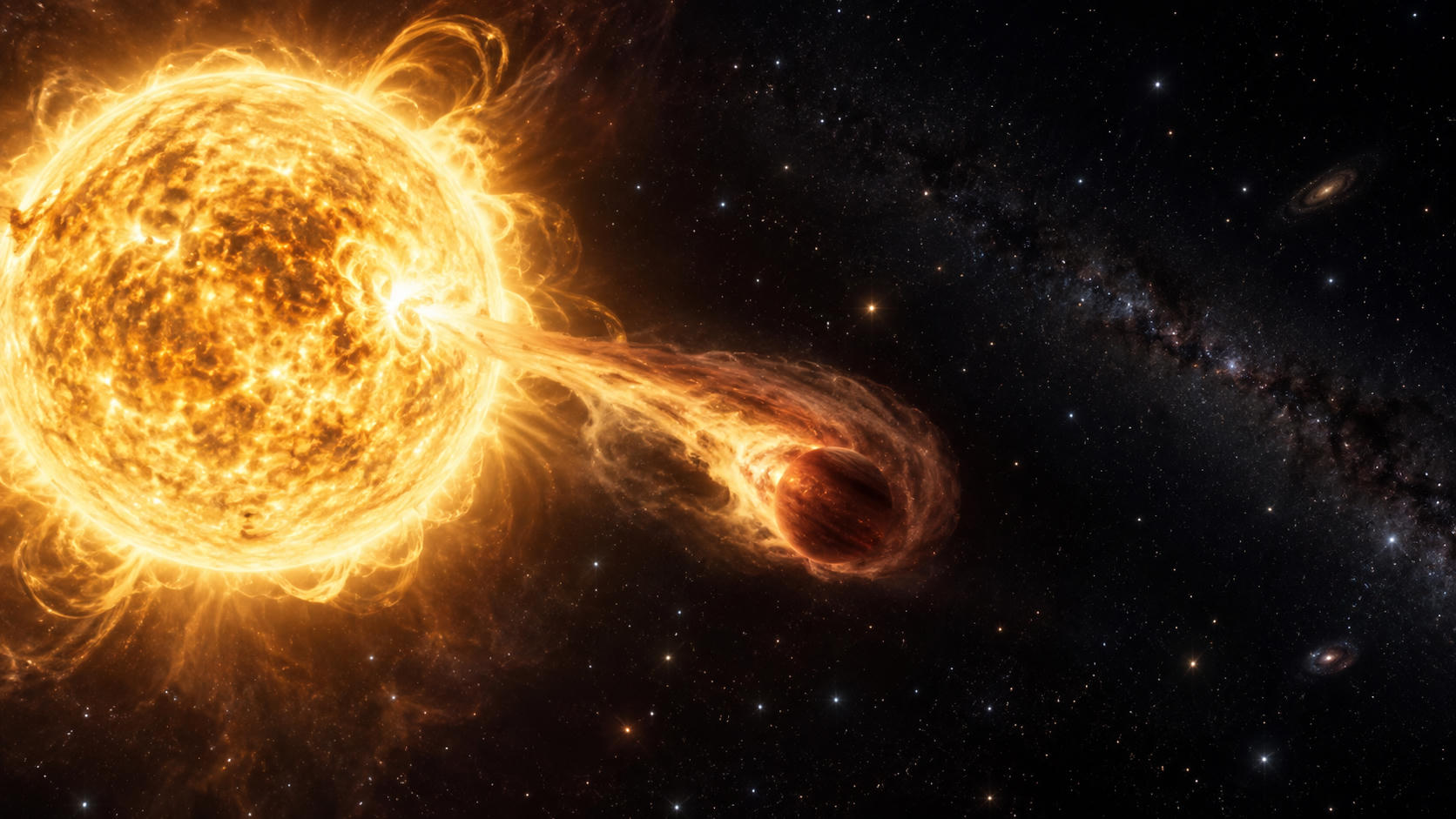 Star May Be Consuming a Brown Dwarf 300 Light-Years Away