How Deep-Sea Telescopes Test Physics, Not Just Relativity
How Deep-Sea Telescopes Test Physics, Not Just Relativity
A telescope positioned roughly 1.5 miles beneath the sea sounds like an instrument designed to test Einstein’s theory of relativity. In practice, deep-sea telescopes are primarily particle detectors that search for elusive particles from space, especially neutrinos.
Their observations can contribute to tests of fundamental physics. However, the available evidence does not verify a specific instrument, result, or experiment that directly tested Einstein’s theories at exactly 1.5 miles below the sea.
That distinction matters. A deep-sea observatory can measure signals affected by long-distance travel, gravity, matter, and extreme energy. Those measurements may constrain theories beyond established physics, including proposals that would modify relativity. Simply placing a detector underwater does not constitute a test of relativity.
The best-documented instruments in this field include the ANTARES neutrino telescope and the larger KM3NeT observatory in the Mediterranean Sea. Both use seawater as a detection medium and shield. Their main scientific goals include studying neutrinos, cosmic rays, astrophysical sources, and neutrino properties—not conducting a single confirmed experiment designed to overturn Einstein’s theory.
What Is a Telescope 1.5 Miles Under the Sea?
A deep-sea telescope is not usually an optical telescope used to photograph planets and galaxies. It is a particle detector that searches for signals produced when high-energy particles interact with seawater.
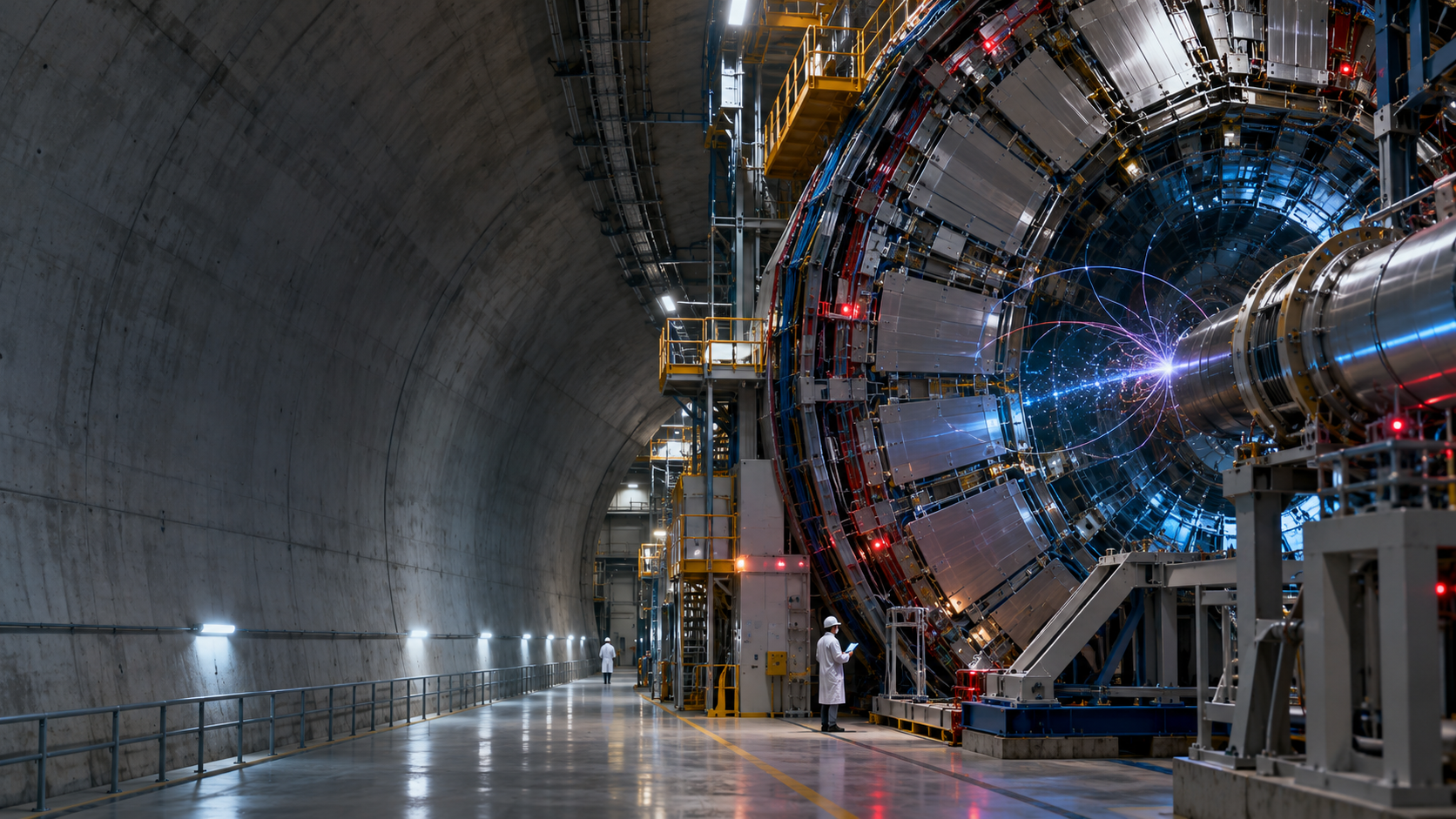
ANTARES, for example, was installed in the Mediterranean at a depth of about 2,500 meters, or approximately 1.55 miles. Its name stands for Astronomy with a Neutrino Telescope and Abyss environmental RESearch. The observatory used vertical detection lines equipped with optical modules to record faint flashes produced by charged particles moving through seawater (Source 1).
KM3NeT is a newer, multisite neutrino observatory being built in the Mediterranean. Its infrastructure is positioned at depths of several thousand meters and is designed to detect neutrinos from cosmic sources, study neutrino properties, and investigate high-energy processes in the universe (Source 2).
In this context, “telescope” describes an instrument that gathers information from distant cosmic events. It does not necessarily collect visible light.
Optical, Radio, Neutrino, and Gravitational-Wave Telescopes
Scientific telescopes detect different forms of information:
- Optical telescopes collect visible light.
- Radio telescopes detect radio waves.
- Neutrino telescopes record particles that rarely interact with matter.
- Gravitational-wave observatories measure tiny changes in distance caused by ripples in spacetime.
A deep-sea neutrino telescope detects light indirectly. When a neutrino collides with a particle in or near the detector, the collision can create charged particles. Those particles may travel through water faster than light travels through water, producing a faint flash called Cherenkov radiation.
Sensors record the flash’s timing and intensity. Researchers use those measurements to estimate the direction and energy of the original particle.
Why Put a Telescope Beneath the Ocean?
Depth serves two important purposes: it reduces unwanted background signals and provides a large volume of water in which particle interactions can be detected.
Earth’s surface is constantly bombarded by cosmic rays. These particles create showers of secondary particles that can overwhelm a detector near the ground. Seawater above an underwater observatory absorbs or weakens many of them.
The water does not eliminate all background noise. Radioactive materials, atmospheric particles, bioluminescent organisms, and mechanical movement can still affect measurements. Greater depth, however, improves the ratio between potentially useful events and unwanted events.
The surrounding water also acts as both shielding and detection material. A particle interaction can generate Cherenkov light, which optical sensors can record without requiring a solid tank or laboratory chamber.
How Cherenkov Radiation Works
Cherenkov radiation is sometimes described incorrectly as evidence that particles travel faster than light. More precisely, a charged particle can move faster than light moves through a material such as water.
Light travels at its maximum speed in a vacuum. In water, its effective speed is lower because it interacts with the material. A sufficiently energetic charged particle can exceed that reduced speed and produce a cone of blue or ultraviolet light.
This does not violate special relativity. The particle remains below the speed of light in a vacuum, which is the universal limit established by Einstein’s theory.
The geometry of the light cone helps researchers reconstruct the particle’s path. If several optical sensors detect the flash at slightly different times, computers can estimate where the interaction occurred and which direction the particle came from.
What Does Einstein’s Relativity Predict?
Einstein’s work includes two closely related theories.
Special Relativity
Special relativity describes motion, time, space, and energy for observers moving at constant velocity. It establishes that the speed of light in a vacuum is the same for all observers and that no material object can accelerate beyond that limit.
The theory also predicts time dilation and length contraction. At ordinary speeds, these effects are extremely small. At near-light speeds or across enormous distances, they become measurable.
A particle detector can test relevant predictions by measuring arrival times, energies, and trajectories. Such measurements require accurate clocks, detailed calibration, and careful control of systematic errors.
General Relativity
General relativity describes gravity as the curvature of spacetime caused by matter and energy. Massive objects alter the geometry around them, and objects and light follow paths through that curved geometry.
The theory has successfully explained observations including planetary motion, the bending of light, neutron-star behavior, and gravitational waves. The LIGO collaboration made the first direct detection of gravitational waves in 2015 (Source 3).
A neutrino telescope does not automatically test general relativity. Its relevance depends on the specific measurement. Neutrinos traveling across cosmic distances can help researchers examine how particles propagate through matter, fields, and gravitational environments. A claim that a particular deep-sea detector directly confirmed or disproved general relativity requires evidence from the experiment’s published design and results.
How an Underwater Detector Can Test Fundamental Physics
A deep-sea observatory can contribute to fundamental-physics research in several ways.
Measuring Particle Travel Times
If a source emits particles simultaneously, differences in their arrival times could reveal information about their speed or interactions during transit. Researchers must account for the source’s emission process, particle energy, detector timing, and travel distance.
A small clock error can imitate a physical effect. Neutrino experiments therefore use calibration systems, independent timing checks, and comparisons with other observatories.
Examining Energy-Dependent Behavior
Some theories beyond the Standard Model predict that particles with different energies could travel or interact in slightly different ways. Over astronomical distances, even a tiny effect might become measurable.
Researchers can search for:
- Arrival times that depend unexpectedly on energy.
- Directional changes inconsistent with known processes.
- Unusual differences between neutrinos and antineutrinos.
- Anomalous energy distributions.
- Deviations from predicted neutrino oscillations.
A failure to observe these effects does not prove that every alternative theory is wrong. It places limits on the size of those effects.
Testing Lorentz Symmetry
Lorentz symmetry is the principle that the laws of physics remain consistent for observers moving at constant velocities. Special relativity depends on this symmetry.
Some speculative models of quantum gravity predict tiny violations. High-energy particles traveling across the universe provide a way to search for such deviations. A deep-sea neutrino telescope may contribute data by recording particles with extreme energies and long travel histories.
Possible clues include energy-dependent speeds or unexpected arrival-time differences. Researchers must first rule out source behavior, detector-timing errors, background events, and statistical fluctuations.
Neutrinos: The Particles Beneath the Telescope
Neutrinos are electrically neutral elementary particles that interact very weakly with matter. Trillions pass through the human body every second, but almost all pass through without interacting.
That weak interaction makes neutrinos difficult to detect. It also makes them valuable astronomical messengers. Light can be absorbed or scattered by matter, while neutrinos can escape dense environments and travel across the universe.
Neutrinos may originate in:
- Supernova explosions.
- Active galaxies.
- Black-hole environments.
- Cosmic-ray collisions.
- Other high-energy astrophysical processes.
Because neutrinos interact so rarely, a detector must monitor a large volume of water and operate for long periods. The resulting data can reveal both the source and the particle’s behavior.
Neutrino oscillations provide another important research area. A neutrino can change between different flavors as it travels. Experiments measuring these changes have demonstrated that neutrinos have mass, extending beyond the simplest version of the Standard Model (Source 4).
Why the Ocean Is Useful—and Difficult
The ocean provides a natural environment for a large particle detector, but it creates major engineering challenges.
Extreme Pressure
Pressure rises rapidly with depth. Several kilometers below the surface, equipment must withstand hundreds of times the atmospheric pressure at sea level.
Sensitive electronics are placed inside pressure-resistant housings. Seals, connectors, cables, and glass spheres must tolerate constant exposure to high pressure and corrosive saltwater.
Darkness and Water Clarity
The darkness of the deep ocean allows optical sensors to detect faint flashes. Natural radioactivity and bioluminescent organisms can still create unwanted light.
Water clarity also changes. Sediment, marine organisms, and currents can affect how light travels through the detector. Scientists monitor these conditions and include them in calibration and data analysis.
Currents and Biofouling
Deep-sea currents can move long detection lines away from their intended positions. Researchers must track sensor movement to reconstruct particle paths accurately.
Marine organisms can attach themselves to equipment, a process known as biofouling. This can reduce optical performance or alter exposed surfaces.
Maintenance and Deployment
Installing and repairing an underwater observatory requires specialized ships, remotely operated vehicles, underwater cables, and carefully planned weather windows. Remote diagnostics and redundant systems are essential because a deep-sea detector cannot usually be reached through a conventional service corridor.
What Scientists Check Before Claiming New Physics
An unexpected pattern is not automatically a violation of relativity. Scientists must investigate several possible explanations.
Instrumental Errors
A faulty sensor, incorrect calibration, or synchronization problem could produce a false signal. Timing is especially important because a tiny error can affect the reconstructed direction or arrival time.
Researchers use redundant sensors, calibration light sources, independent clocks, and comparisons with other instruments.
Environmental Effects
Water temperature, current movement, sediment, pressure, and optical clarity can influence measurements. Environmental monitoring is therefore part of the physics experiment, not merely an engineering task.
Statistical Fluctuations
Random data can produce an apparently significant pattern. Researchers reduce this risk by analyzing large samples, defining methods before examining results, using control data, and requiring strong statistical evidence.
An intriguing anomaly may motivate additional research. It becomes a discovery only after independent checks and confirmation.
Would a Result Disprove Einstein?
No single unusual measurement would immediately disprove relativity.
Scientists would first examine the equipment, calibration, data processing, source behavior, and environmental conditions. If the anomaly survived those checks, it could challenge a particular prediction or constrain the range of possible theories.
A confirmed deviation might indicate:
- A modification of relativity.
- A new particle interaction.
- A previously unknown environmental effect.
- A deeper theory in which relativity remains an approximation.
Scientific theories are not usually discarded because of one unexplained event. They are revised when repeated, independent measurements show a persistent conflict with their predictions.
Results that agree with relativity are also valuable. They extend confidence in the theory under conditions that differ from those tested by optical astronomy, laboratory experiments, particle accelerators, and gravitational-wave detectors.
What the Available Evidence Shows
The supplied source summaries do not document the claimed telescope, research team, relativity experiment, or result. They describe unrelated subjects, including early-universe particles, stellar remnants, personality testing, archaeology, and weather listings. They cannot substantiate the headline.
The existence of deep-sea neutrino telescopes is well documented. ANTARES operated at approximately 2,500 meters in the Mediterranean, while KM3NeT continues developing a much larger underwater observatory. Their science programs demonstrate why the ocean is valuable for particle astronomy (Source 1 and Source 2).
The unsupported claim is that a particular telescope 1.5 miles underwater was deployed specifically to test Einstein’s relativity. That wording should not be presented as an established result without a primary research paper or official institutional release identifying the experiment.
The Broader Role of Deep-Sea Telescopes
Deep-sea observatories expand astronomy beyond visible light. They can detect particles from violent cosmic environments that ordinary telescopes cannot fully observe.
Their measurements complement those from:
- Space telescopes.
- Radio observatories.
- Particle accelerators.
- Underground laboratories.
- Gravitational-wave detectors.
- Precision atomic-clock experiments.
Each platform tests nature under different conditions. Agreement across independent methods strengthens confidence in physical theories. Disagreement can reveal a calibration problem, an astrophysical surprise, or new physics.
The ocean therefore offers more than a remote location. It provides shielding, a large detection medium, and access to particles carrying information across astronomical distances.
Conclusion
A telescope approximately 1.5 miles beneath the sea is most plausibly a deep-sea particle detector, not a conventional optical instrument. Its seawater surroundings reduce background radiation and allow researchers to detect flashes produced by high-energy particles.
Such an observatory can study neutrinos, cosmic accelerators, and matter under extreme conditions. Its data may also contribute to tests of special relativity, Lorentz symmetry, and theories beyond established physics.
However, the available source material does not verify a specific underwater experiment that directly tested Einstein’s relativity. The instrument’s identity, exact depth, research team, scientific objective, and reported result must be confirmed through a primary paper or official institutional source before publication.
Einstein’s theories remain powerful because scientists continue testing their predictions in new environments. Deep beneath the sea, the test is not the depth itself. It is the precision of the measurements made there.
Frequently Asked Questions
What is the telescope 1.5 miles under the sea designed to detect?
A deep-sea telescope at this depth is likely a neutrino or other particle detector rather than a visible-light telescope. Documented observatories such as ANTARES used optical sensors to record flashes produced when particles interacted in seawater (Source 1).
How can an underwater telescope test Einstein’s relativity?
It can measure particle arrival times, directions, energies, and interactions. Researchers compare these measurements with predictions from relativity and related theories. The exact test depends on the detector’s published research program.
Why place the detector so deep underwater?
The seawater above the detector absorbs many unwanted cosmic-ray particles. The surrounding water also acts as the medium in which particle interactions can produce detectable Cherenkov light.
Does a particle moving faster than light in water violate relativity?
No. The particle can move faster than light travels through water while remaining slower than light in a vacuum. Relativity’s universal speed limit applies to the vacuum speed of light.
Would an unexpected measurement disprove Einstein’s theory?
No. Scientists would first investigate calibration, hardware, data processing, environmental effects, source behavior, and statistical fluctuations. A persistent anomaly could challenge a prediction or suggest physics beyond the current model.
What other discoveries can a deep-sea telescope make?
Depending on its design, it can study neutrinos, cosmic-ray sources, supernovae, active galaxies, black-hole environments, and neutrino oscillations. Claims about specific discoveries should be matched to the instrument’s documented mission and published results.