Falcon Heavy Launches Classified U.S. Spy Mission
Falcon Heavy Launches Classified U.S. Spy Mission
SpaceX’s Falcon Heavy launched a classified U.S. national security payload, completing a reported three-launch sequence that also included military communications satellites and a Starlink deployment.
The mission gave SpaceX a headline-making “3 for 3” launch period while leaving the most important details—payload identity, destination, and operational purpose—undisclosed.
What Happened During the Launch
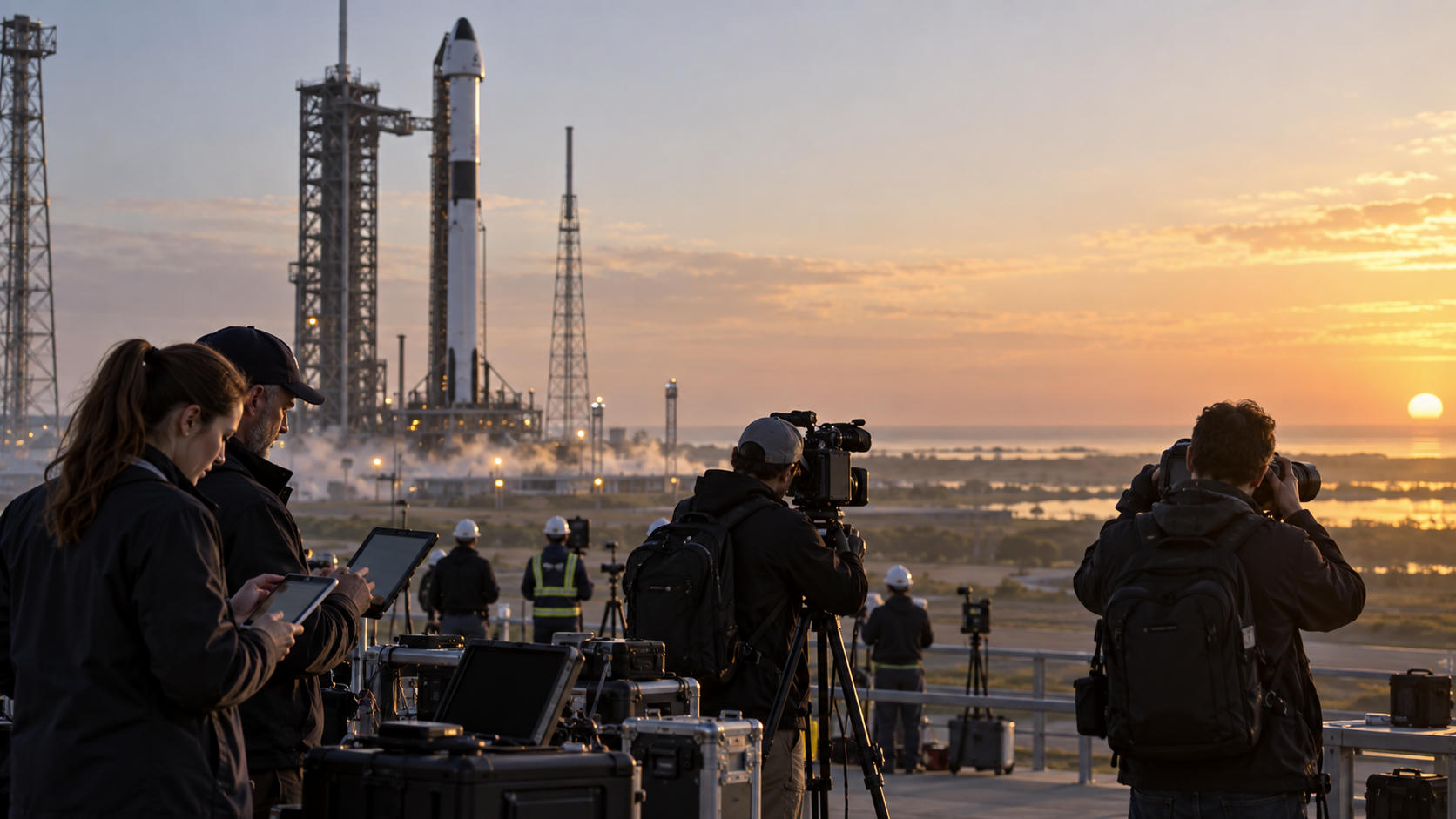
Falcon Heavy lifted off as the closing event in SpaceX’s reported tripleheader. The rocket uses three Falcon 9-derived cores: a central core joined by two side boosters. This configuration provides substantially more liftoff thrust than a standard Falcon 9.
News coverage described the payload as a secret U.S. spy mission and a national security payload. Available reports did not identify the spacecraft, provide a formal mission designation, state the target orbit, or explain its operational role. Source 1
This limited disclosure is typical of classified national security launches. Agencies and launch providers can announce the rocket, launch site, and departure time without revealing information that could expose sensitive spacecraft capabilities or orbital operations.
Public video documented ignition, liftoff, ascent, and other visible milestones. It did not reveal the spacecraft’s capabilities or complete mission profile.
Falcon Heavy Returns After an Extended Gap
The mission was reported as Falcon Heavy’s first launch in approximately 18 months. That interval should be treated as approximate unless the launch date and the vehicle’s previous mission are compared directly.
Falcon Heavy missions are less frequent than Falcon 9 flights because the vehicle is generally selected for demanding payloads that require greater performance. Such missions may involve specialized spacecraft processing, government certification, complex planning, or unusual orbital requirements.
Falcon 9 supports a broader and more regular manifest, including Starlink, commercial spacecraft, cargo missions, and selected government payloads. Falcon Heavy remains a specialized option for missions requiring additional performance.
What Is Known About the Classified Payload?
The clearest public description is that Falcon Heavy launched a classified U.S. national security payload. Media reports used the phrase “spy mission,” although official descriptions may use broader terms such as national security launch or classified government mission.
The available coverage does not support identifying the spacecraft as an imaging satellite, signals-intelligence platform, communications system, or another specific type of vehicle. Source 2
Mission Facts
- Rocket: Falcon Heavy
- Operator: SpaceX
- Customer: U.S. government or a national security program
- Payload: Classified
- Launch status: Reported as completed
- Payload identity: Not publicly disclosed
- Target orbit: Not publicly disclosed
Keeping payload details private can protect information about spacecraft design, sensors, communications systems, operating life, orbital behavior, and mission planning. A classified payload does not mean the entire launch must remain hidden. Rockets produce visible light, sound, radar signatures, and tracking data, making launches difficult to conceal.
SpaceX’s Three-Launch Sequence
The term “SpaceX tripleheader” refers to three SpaceX launches completed within the same broader launch period. The Falcon Heavy national security mission was reported as the final launch in that sequence.
The other two missions included a launch carrying 21 military data-transport satellites and a separate Falcon 9 mission deploying 29 Starlink satellites. Exact chronology should be tied to the original publication timestamps before assigning specific launch times. Source 5
The three missions represented different customers and objectives:
- A military communications mission carried 21 data-transport satellites.
- A commercial Falcon 9 mission deployed 29 Starlink satellites.
- Falcon Heavy carried a classified U.S. government payload.
Data-transport satellites can move information among users, sensors, command systems, and other spacecraft. However, the available material does not establish their detailed capabilities, coverage, encryption, or specific military users.
Starlink is SpaceX’s commercial broadband satellite network, designed to provide internet connectivity through a large low Earth orbit constellation. Source 7
The contrast demonstrated SpaceX’s operational range: commercial broadband, military data transport, and classified national security missions within one busy launch sequence.
Why the Mission Matters
Falcon Heavy is one option in the U.S. national security launch ecosystem. Its three-core design provides greater thrust and payload performance than Falcon 9, although the specific reason for choosing it on this mission was not disclosed.
The selection of Falcon Heavy does not prove that the payload required the rocket’s maximum capability. Mission choices can reflect performance, schedule, certification, customer requirements, or other factors that are not public.
The tripleheader also demonstrated SpaceX’s ability to support multiple mission types within a compressed period. Each flight required its own vehicle processing, payload readiness, trajectory, safety procedures, range operations, and post-launch objectives.
What the Launch Video Shows
Public footage shows the Falcon Heavy engines igniting, the rocket leaving the launch pad, and the three-core vehicle climbing through the atmosphere. Source 1
The footage confirms the vehicle’s departure and provides a public record of the launch. It should not be treated as proof of payload deployment, orbital insertion, booster recovery, or complete mission success unless those events are explicitly shown and confirmed by official sources.
Publicly observable: Ignition, liftoff, ascent, and some vehicle events.
Restricted: Payload design, sensors, communications systems, orbital details, and operational objectives.
Not automatically confirmed by video: Final orbit, payload deployment, or mission success beyond the reported launch.
What Happens After Liftoff?
Public updates for a national security launch may confirm liftoff, booster separation, payload deployment, or general mission status. Classified missions can also end public coverage before the spacecraft reaches its final orbit.
Official information may come from SpaceX, U.S. government agencies, or launch-range authorities. Independent tracking can provide useful context, but unofficial orbital estimates and social media claims should not be presented as confirmed facts.
The absence of detailed updates does not necessarily indicate a problem. It may reflect the mission’s classification and the government’s disclosure policy.
The launch adds another Falcon Heavy flight to SpaceX’s national security record and maintains access to a heavy-lift option for selected U.S. missions. It does not, by itself, establish a change in military strategy or intelligence capability.
Frequently Asked Questions
What did Falcon Heavy launch?
Falcon Heavy launched a classified U.S. national security payload described in news coverage as a secret spy mission. Public reports did not disclose its identity, purpose, or orbit.
What does “SpaceX tripleheader” mean?
It refers to three SpaceX launches completed within the same broader launch sequence or period: the Falcon Heavy national security mission, a 21-satellite military data-transport mission, and a 29-satellite Starlink deployment.
Can viewers watch the Falcon Heavy launch?
Yes. Launch video shows liftoff and early ascent, but it does not necessarily reveal the payload’s specifications, deployment details, or complete mission profile.
Why use Falcon Heavy instead of Falcon 9?
Falcon Heavy provides greater liftoff thrust and payload performance because it combines three Falcon 9-derived cores. The specific reason for selecting it was not publicly disclosed.
Did Falcon Heavy land its boosters?
The available summaries confirm the launch but do not provide enough information to state the recovery outcome. Recovery details should be included only when confirmed by official coverage or clearly documented launch video.
Conclusion
Falcon Heavy launched a classified U.S. national security mission and completed SpaceX’s reported tripleheader. The sequence also included 21 military data-transport satellites and a separate Falcon 9 launch carrying 29 Starlink spacecraft.
Public video documented the rocket’s liftoff and early flight, but the payload’s identity, orbit, and operational purpose remained undisclosed. The event showed SpaceX supporting commercial, military, and classified customers while reaffirming Falcon Heavy’s role as a heavy-lift option for selected U.S. missions.
The rocket’s flight was public; the mission it carried remains largely out of sight.
Artikel Terkait
-
 Francis Halzen and IceCube’s Neutrino Breakthrough
-
 Moon and Jupiter to Align in Rare Occultation
-
 SpaceX NASA Record Claim Still Needs Verification
-
 How to See Saturn at Opposition on October 4, 2026
-
 Second-Generation Planet Candidate Around a White Dwarf
-
 Star May Be Consuming a Brown Dwarf 300 Light-Years Away