Dengue Reports Raise Questions in Southern Florida
Dengue Reports Raise Questions in Southern Florida
Reports circulating online claim that a dengue fever outbreak prompted states of emergency in three southern Florida counties. The same reports cite 190 locally acquired dengue cases across six counties. However, the supplied posts do not independently establish the affected counties, declaration dates, or current case total. Those details should be confirmed through the Florida Department of Health, county health departments, mosquito-control districts, and emergency-management offices.
The reports matter because locally acquired cases indicate that dengue transmission may have occurred through mosquitoes in the affected area, rather than only among people infected while traveling. Local transmission can increase the need for mosquito surveillance, breeding-site removal, public communication, and medical awareness.
Social media posts have also questioned whether mosquito-control operations, including aerial spraying, are sufficient. A lack of visible spraying does not prove that no mosquito-control work is occurring. Officials may use ground treatments, larvicides, mosquito traps, inspections, and targeted applications that residents do not see.
This article explains dengue fever, summarizes what has been reported about the southern Florida outbreak, describes what emergency declarations may mean, and outlines ways residents can reduce their risk.
What Is Dengue Fever?
Dengue is a viral infection transmitted mainly by infected Aedes aegypti and Aedes albopictus mosquitoes. Four related dengue viruses can cause infection. A person may become infected more than once because infection with one virus type does not provide complete protection against the others.
Transmission follows this cycle:
- A mosquito bites a person who has dengue virus in their blood.
- The virus develops inside the mosquito.
- The infected mosquito bites another person and transmits the virus.
Dengue does not generally spread through ordinary casual contact, such as sitting near an infected person, shaking hands, or sharing household space. The primary concern is an infected mosquito biting someone who can then become ill.
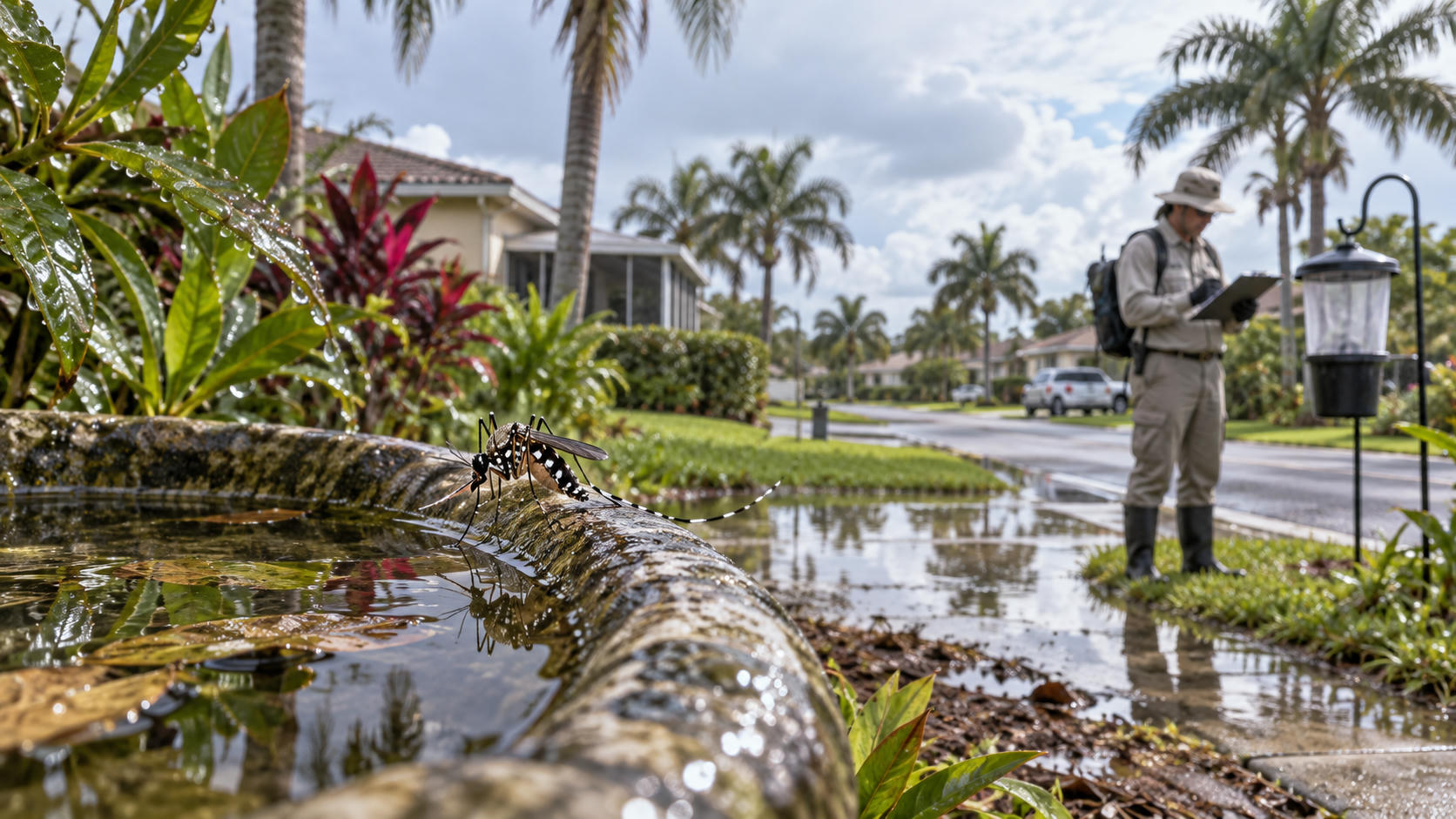
Aedes mosquitoes can live close to homes and human activity. They may breed in small amounts of standing water found in buckets, flowerpot saucers, tires, toys, gutters, and other containers. They can also bite during the day, so mosquito protection should not be limited to nighttime.
The Centers for Disease Control and Prevention identifies dengue as a common mosquito-borne viral illness in tropical and subtropical regions, including parts of the United States and its territories (Source 1).
Common Symptoms
Symptoms can range from mild illness to severe disease. Common symptoms include:
- High fever.
- Severe headache.
- Pain behind the eyes.
- Muscle, joint, or bone pain.
- Nausea or vomiting.
- Rash.
Symptoms often begin several days after infection, although timing varies. Some infected people have mild symptoms or no symptoms. Because dengue can resemble influenza, COVID-19, chikungunya, Zika, and other viral illnesses, symptoms alone cannot confirm a diagnosis.
People with possible dengue exposure and compatible symptoms should contact a healthcare professional. They should mention recent travel, outdoor activity, mosquito exposure, and any known local transmission.
Warning Signs of Severe Dengue
Severe dengue can develop after the fever begins to improve, creating a false impression that the illness is ending. Warning signs requiring urgent medical attention include:
- Severe abdominal pain.
- Persistent or repeated vomiting.
- Bleeding from the nose or gums.
- Blood in vomit or stool.
- Extreme weakness, restlessness, or unusual tiredness.
- Rapid breathing.
- Pale or cold skin.
- Sudden worsening after the fever declines.
People should ask a healthcare professional which pain and fever medicines are appropriate. Aspirin and nonsteroidal anti-inflammatory drugs, including ibuprofen and naproxen, may increase bleeding risk in some people with dengue. Medical guidance is especially important before using these medicines.
What Has Been Reported About the Outbreak?
Claims About Emergency Declarations
Several supplied social media posts repeat the claim that a dengue outbreak triggered states of emergency in three southern Florida counties (Source 2, Source 3, Source 4).
These posts should be treated as reports requiring confirmation, not independent proof. Repetition across multiple accounts does not establish accuracy. The supplied material does not include the text of an official emergency declaration, the names of all three counties, or a dated state or county announcement.
Depending on the issuing authority and wording of the declaration, possible measures may include:
- Expanded mosquito surveillance.
- Additional mosquito-control treatments.
- Increased case investigation.
- Emergency procurement.
- Additional staff or funding.
- More public health communication.
- Coordination among county, state, and local agencies.
An emergency declaration does not automatically mean that every resident faces the same level of risk or that a lockdown is planned. Residents should rely on current government instructions rather than speculation.
Claim of 190 Locally Acquired Cases
One supplied post sharing a Fox News report states that 190 locally acquired dengue cases were confirmed across six counties (Source 5). This figure is time-sensitive and should be checked against the latest Florida Department of Health data before publication or use in decision-making.
“Locally acquired” means health authorities believe the infection occurred in the area where the case was reported. The person may have been bitten by an infected mosquito locally. This differs from a travel-associated case, in which the person likely became infected outside the area.
The distinction matters because locally acquired cases suggest that infected mosquitoes may be present in the community. Case totals can change as agencies investigate suspected infections, receive laboratory results, revise classifications, and update public dashboards.
Any article citing a case count should include the date attached to that number. Without a date, a figure can quickly become misleading.
Questions About Mosquito Control
Another supplied post urged Lt. Gov. Jay Collins and Hillsborough County officials to provide daily updates. It claimed there had been no visible aerial mosquito spraying and that public communication was insufficient (Source 6).
The post establishes that a public criticism was made. It does not establish that mosquito-control agencies conducted no work. A claim that residents did not see aerial spraying is different from a verified statement that no mosquito-control activity occurred.
Mosquito-control programs may use:
- Ground-based spraying.
- Aerial applications.
- Larvicide treatments.
- Mosquito traps.
- Laboratory testing.
- Breeding-site inspections.
- Drainage and water-removal efforts.
- Public advisories.
Residents should check county mosquito-control records, treatment schedules, notices, and contact information. These sources provide stronger evidence than observations posted online.
How Officials May Respond
Surveillance and Testing
Mosquito-control agencies may place traps in affected neighborhoods to measure mosquito populations and identify species. Some mosquitoes can be tested for dengue virus or other pathogens.
Surveillance helps officials determine where mosquito activity is concentrated and whether control measures are reducing risk. Human case investigations can also identify likely transmission locations, recent travel, household exposure, and areas requiring additional inspections.
The response may change as laboratory results and mosquito data become available. A neighborhood with few reported human cases may still require monitoring if mosquito populations are high or infected mosquitoes are detected.
Removing Breeding Sites
Aedes mosquitoes can breed in small containers that hold water. Common sites include:
- Buckets.
- Flowerpot saucers.
- Tires.
- Birdbaths.
- Children’s toys.
- Clogged gutters.
- Trash and recycling containers.
- Outdoor equipment.
- Pet bowls.
- Uncovered water-storage containers.
Residents should empty, scrub, cover, or discard containers that collect water. Yard inspections should include patios, balconies, gardens, drainage areas, sheds, and spaces behind outdoor equipment.
Containers that cannot be removed should be covered securely or treated according to local guidance. Simply dumping water may not remove eggs attached to container surfaces, so scrubbing can also be important.
Ground and Aerial Treatments
Officials may use larvicides in water where mosquito larvae are present. Adult mosquito control can include truck-mounted applications or aerial treatments when authorized and appropriate.
Treatment decisions may depend on mosquito population density, confirmed disease activity, the location and size of affected areas, weather, wind, environmental requirements, access to private property, and trap or laboratory results.
Residents may not see every intervention. Some operations occur at night or during narrow treatment windows. Larvicide work may be limited to specific containers or drainage areas. Ground crews may operate without highly visible equipment, and rain or wind may delay applications.
Aerial spraying is only one part of a broader mosquito-control strategy. County schedules and official notices are more reliable than judging the response by whether an aircraft was visible.
Public Communication
Frequent, dated communication helps residents understand the level of risk and the actions expected of them. Useful updates should identify:
- Confirmed case totals.
- Affected counties or neighborhoods.
- The date of the data.
- Mosquito-control activity.
- Health advisories.
- Protective measures.
- Reporting channels.
- Contact information for questions.
Daily updates may not always be practical when agencies are verifying data. Agencies should still provide transparent updates when case counts, risk levels, treatment schedules, or public instructions change.
How Residents Can Reduce Risk
Residents can reduce exposure by:
- Using an Environmental Protection Agency-registered insect repellent.
- Wearing long-sleeved shirts and long pants.
- Choosing tightly woven clothing.
- Staying in screened or air-conditioned spaces.
- Using mosquito nets when appropriate.
- Following repellent label directions.
Because Aedes mosquitoes can bite during the day, residents should use repellent and protective clothing during daytime outdoor activities as well as at night. Parents and caregivers should follow product directions for children. Pregnant people should discuss specific concerns with a healthcare professional while following public health guidance.
Residents should also:
- Repair window and door screens.
- Keep doors closed when possible.
- Cover water-storage containers.
- Clean gutters and drains.
- Change water in pet bowls and birdbaths regularly.
- Remove standing water after rain.
- Turn over or cover outdoor containers.
- Report persistent mosquito problems to the local mosquito-control agency.
A person with dengue can infect mosquitoes that bite them while the virus is present in their blood. Those mosquitoes can later bite other people. People with suspected or confirmed dengue should use repellent, wear protective clothing, remain in screened or air-conditioned spaces, and follow healthcare advice while ill.
When to Seek Medical Care
People should seek medical advice for fever accompanied by severe headache, pain behind the eyes, body pain, rash, nausea, or vomiting, especially after mosquito exposure or travel to an area with dengue transmission.
A clinician may consider symptom timing, travel history, exposure history, local transmission, and testing availability. Patients should mention recent travel, outdoor activities, known mosquito bites, household or neighborhood cases, the date symptoms began, and medicines already taken.
Seek urgent medical care for severe abdominal pain, repeated vomiting, bleeding, trouble breathing, confusion, unusual drowsiness, extreme weakness, cold or pale skin, or sudden worsening after the fever improves. Infants, older adults, pregnant people, and people with certain medical conditions should seek medical guidance promptly when dengue is suspected.
How to Evaluate Outbreak Claims
Residents and journalists should verify information through:
- The Florida Department of Health.
- County health departments.
- County mosquito-control districts.
- Local emergency-management offices.
- The Centers for Disease Control and Prevention.
- The World Health Organization.
Check publication dates. Dengue case counts, affected areas, treatment schedules, and emergency declarations can change quickly.
The supplied posts repeat two central claims: that three southern Florida counties declared states of emergency and that 190 locally acquired cases occurred across six counties. Both claims require confirmation through official records.
The allegation that aerial spraying was absent is also a social media claim unless supported by county documentation. It should not be rewritten as proof that mosquito-control agencies failed to act.
The supplied material includes an unsupported allegation involving Bill Gates. It provides no evidence for that accusation, so it should not be presented as part of the outbreak report. Unrelated entries containing only figures such as “5000+” or “1000+” provide no evidence about dengue, case totals, counties, or emergency actions.
What Emergency Declarations Could Mean
Emergency declarations may support faster coordination and resource allocation. Possible actions include expanded mosquito surveillance, additional spraying or larvicide treatment, public information campaigns, increased case investigation, support for county governments, and additional personnel or equipment.
The exact legal and practical effects depend on the authority that issued the declaration and the language of the order.
Residents should monitor county health alerts, mosquito-control notices, emergency-management announcements, school and workplace advisories, outdoor event guidance, standing-water instructions, and notices about property inspections or treatment access.
Residents should follow current official instructions rather than rumors about lockdowns or unrelated political claims. The supplied sources do not establish that a lockdown is planned.
Conclusion
Reports claim that a dengue outbreak prompted emergency declarations in three southern Florida counties and that 190 locally acquired cases were confirmed across six counties. Those figures and county details should be verified through current state and local public health records.
The most useful immediate steps are clear:
- Prevent mosquito bites during the day and night.
- Remove standing water from homes and yards.
- Follow county mosquito-control guidance.
- Seek medical advice for dengue-like symptoms.
- Obtain urgent care for severe warning signs.
- Use dated official updates instead of unsupported social media claims.
Frequently Asked Questions
What is dengue fever?
Dengue fever is a viral illness spread mainly by infected Aedes mosquitoes. It can cause fever, headache, rash, nausea, and severe muscle or joint pain. Some cases become severe and require emergency care.
Why are states of emergency reportedly being declared in three southern counties?
The supplied reports claim that dengue transmission prompted emergency declarations in three southern Florida counties. Such declarations may support mosquito control, disease surveillance, staffing, resource allocation, and public communication. The affected counties and declaration details should be confirmed through official government sources.
How many locally acquired dengue cases have been reported?
One supplied report states that 190 locally acquired cases were confirmed across six counties (Source 5). The number can change as investigations continue. Verify the current total and reporting date through the Florida Department of Health or relevant county health departments.
How can residents prevent dengue infection?
Use EPA-registered insect repellent, wear long sleeves and pants, use window and door screens, stay in screened or air-conditioned spaces, and remove standing water from containers, gutters, toys, tires, and outdoor equipment.
Can dengue spread directly from one person to another?
Dengue is primarily spread when an infected mosquito bites a person. Someone with dengue can contribute to transmission if mosquitoes bite them and later bite others. Ordinary casual contact does not generally spread dengue.
When should someone seek emergency medical care?
Seek urgent care for severe abdominal pain, persistent vomiting, bleeding, trouble breathing, confusion, extreme weakness, cold or pale skin, or sudden worsening after a fever begins to improve. These can indicate severe dengue.
Artikel Terkait
-
 More Screen Time Is Linked to Poorer Child Development, Study Shows
-
 Blood Sugar Spikes: When They Are Normal and When They Matter
-
 Birth Order Does Not Predict Personality: What Does
-
 Pennsylvania Measles Outbreak: What Residents Need to Know
-
 3 Science-Backed Ways to Help Clear Brain Waste
-
 Florida Dengue Outbreak Reported as Largest in Decades