Could Modified Gravity Explain Changing Dark Energy?
Could Modified Gravity Explain Changing Dark Energy?
The universe is expanding, and its expansion is accelerating. Scientists usually explain this acceleration through dark energy, an unknown component that appears to counteract gravity on the largest scales. The simplest version of this idea treats dark energy as a constant feature of space.
New theoretical work is examining whether that assumption is necessary. Instead of attributing cosmic acceleration to a fixed energy component, researchers are exploring whether gravity itself changes across cosmic distances or over cosmic history. Under this approach, evolving gravitational behavior could resemble changing dark energy in astronomical observations. Source 1
The proposal remains unconfirmed. It does not prove that dark energy changes, replace the standard cosmological model, or establish the existence of hidden dimensions. Its importance lies in offering a testable alternative to the assumption that the cosmological constant has remained unchanged throughout cosmic history.
What Is Dark Energy?
Evidence for accelerated expansion
Galaxies generally move apart because space itself is expanding. For much of cosmic history, gravity slowed that expansion as matter attracted matter. Observations of distant Type Ia supernovae changed this picture by showing that expansion has accelerated over time.
Acceleration requires an explanation. The leading possibilities are:
- A component with unusual gravitational properties, called dark energy
- A modification of general relativity on cosmological scales
- A more complex interaction between matter, gravity, and spacetime geometry
Dark energy is therefore an interpretation of the universe’s expansion history, not a directly detected substance.
Why dark energy remains mysterious
No experiment has identified a dark-energy particle or measured dark energy as ordinary matter. Scientists infer its presence from its effects on cosmic expansion and large-scale structure.
The simplest explanation is the cosmological constant. In this model, empty space has a constant energy density. Matter becomes increasingly diluted as space expands, while the cosmological constant remains unchanged per unit volume. Its relative influence therefore grows until it drives accelerated expansion.
Major unresolved questions include:
- What is dark energy physically?
- Is its density truly constant?
- Why did it become important relatively recently?
- Does the apparent effect arise from an unknown field or incomplete gravitational theory?
- Why is the observed vacuum-energy value so small compared with some theoretical estimates?
These questions motivate research into evolving dark energy and modified gravity.
The Standard Cosmological Model
The standard framework is Lambda Cold Dark Matter, or ΛCDM. “Lambda” represents the cosmological constant, while “cold dark matter” describes the invisible matter thought to provide much of the gravitational structure needed to form galaxies and clusters.
ΛCDM includes:
- Ordinary matter, including stars, planets, gas, and dust
- Dark matter, which interacts gravitationally but emits little or no light
- Radiation, including relic light from the early universe
- Dark energy, represented by the cosmological constant
The model explains how these components change as the universe expands. Matter becomes less dense, while the cosmological constant retains the same density per unit volume. Its relative contribution consequently increases over time.
Strengths and unresolved problems
ΛCDM successfully describes major features of the cosmic microwave background, galaxy distribution, cosmic expansion, and gravitational effects commonly attributed to dark matter.
Its difficulties are better described as tensions and unresolved problems than as decisive disproofs. One is the cosmological constant problem: quantum theory suggests that empty space may possess vacuum energy, but theoretical estimates differ enormously from the value inferred from observations.
Another is the Hubble tension, the disagreement between expansion-rate estimates based on the early universe and those based on nearby distance indicators. The discrepancy could result from measurement systematics, incomplete astrophysical modeling, or new physics.
These issues do not invalidate ΛCDM. They explain why alternative models deserve careful testing.
How Modified Gravity Could Mimic Dark Energy
General relativity has passed precise tests in the solar system, binary systems, and gravitational-wave observations. Its success, however, does not guarantee that its current form is complete under every cosmological condition.
An alternative gravity theory changes the mathematical relationship between matter, spacetime geometry, and gravitational dynamics. Some proposals add fields to gravity, alter the curvature equations, or introduce new geometric structures. Others suggest that gravity behaves differently across enormous distances.
If the gravitational response changes on cosmic scales, the resulting expansion history could resemble the effect of dark energy. Observers might infer a repulsive energy component when the underlying cause is modified gravity. The proposal discussed here explores that possibility as a potential explanation for a changing dark-energy signal. Source 1
The effect could evolve with the universe’s:
- Average matter density
- Spacetime geometry
- Additional gravitational fields
- Distance or scale of measurement
- Conditions in the early universe and the present day
This could create an apparent form of evolving dark energy without requiring a substance that changes like ordinary matter.
Evolving dark energy versus modified gravity
Evolving dark energy treats acceleration as the result of a physical component whose density or equation of state changes over time. The equation of state describes the relationship between pressure and energy density.
Modified gravity changes the equations that determine how matter curves spacetime and how spacetime controls expansion. In that description, dark energy may not exist as a separate component.
Both ideas can produce similar expansion histories. Distance measurements alone may not distinguish them. Scientists must also compare predictions for:
- The growth of cosmic structure
- Gravitational lensing
- Galaxy clustering
- Matter motions
- The relationship between visible matter and gravitational fields
A successful alternative must explain more than acceleration alone.
What the Proposal Could Explain
If gravitational behavior evolves with cosmic conditions, the apparent dark-energy contribution could change as the universe expands. This might reduce the need to treat dark energy as an unchanging cosmological constant and provide an alternative interpretation of observations that have been viewed as hints of evolving acceleration.
The claim remains a hypothesis. A model can reproduce one feature of cosmological data while failing elsewhere. Its credibility depends on whether it explains multiple independent observations with a consistent set of parameters.
If an alternative gravity theory reproduced the cosmic microwave background, galaxy distribution, supernova distances, lensing data, and structure growth without requiring a fixed cosmological constant, it would challenge ΛCDM. It would still need to preserve the model’s successful explanations of:
- Cosmic microwave background fluctuations
- Galaxy formation and distribution
- Accelerated expansion
- Gravitational lensing around galaxies and clusters
- Solar-system dynamics
- Gravitational waves and compact binary systems
A proposal that addresses only dark energy would be incomplete.
Extra Dimensions and Hidden-Dimension Theories
Some theoretical models propose that the universe contains more dimensions than the familiar three dimensions of space and one of time. These additional dimensions could be compactified, hidden, or accessible to gravity while remaining invisible to ordinary matter.
If gravity can spread into extra dimensions, its apparent strength may change with distance. At ordinary scales, gravity could remain consistent with general relativity. At cosmological scales, additional geometry might alter expansion.
From the perspective of an observer confined to familiar dimensions, the result could resemble dark energy. The universe might appear to contain an accelerating component when the underlying mechanism is geometric.
This possibility remains speculative. A viable hidden-dimension theory must make distinctive predictions and remain compatible with particle physics, gravitational-wave observations, laboratory experiments, and astrophysical data. Hidden dimensions are not established by cosmological tensions. Source 9
Related work has explored whether five-dimensional black holes could help explain dark matter and neutrino behavior. Source 3
This is a separate hypothesis, not evidence for the gravity theory discussed here. A connection between dark energy, dark matter, neutrinos, and spacetime would be significant only if one framework produced accurate, independently testable predictions.
Why Other Cosmic Anomalies Matter
Unusually massive or mature galaxies can test assumptions about galaxy formation, dark-matter halos, star-formation rates, and cosmic evolution. One unexpected galaxy does not overturn cosmology; classification errors, distance uncertainties, unusual environments, and simulation limits can provide alternative explanations. Source 7
The Hubble tension is another important test. Early-universe methods infer the expansion rate from relic radiation and a model of cosmic evolution. Late-universe methods use supernovae and nearby galaxies. If both methods are accurate, the discrepancy could indicate missing physics. Modified gravity, evolving dark energy, and hidden dimensions are possible explanations, but calibration errors and astrophysical assumptions remain equally important.
Cosmology is therefore not necessarily in a state of collapse. It is in a period of active testing. Explaining one anomaly is insufficient if a theory creates larger contradictions elsewhere.
How Scientists Could Test the Theory
Mapping expansion history
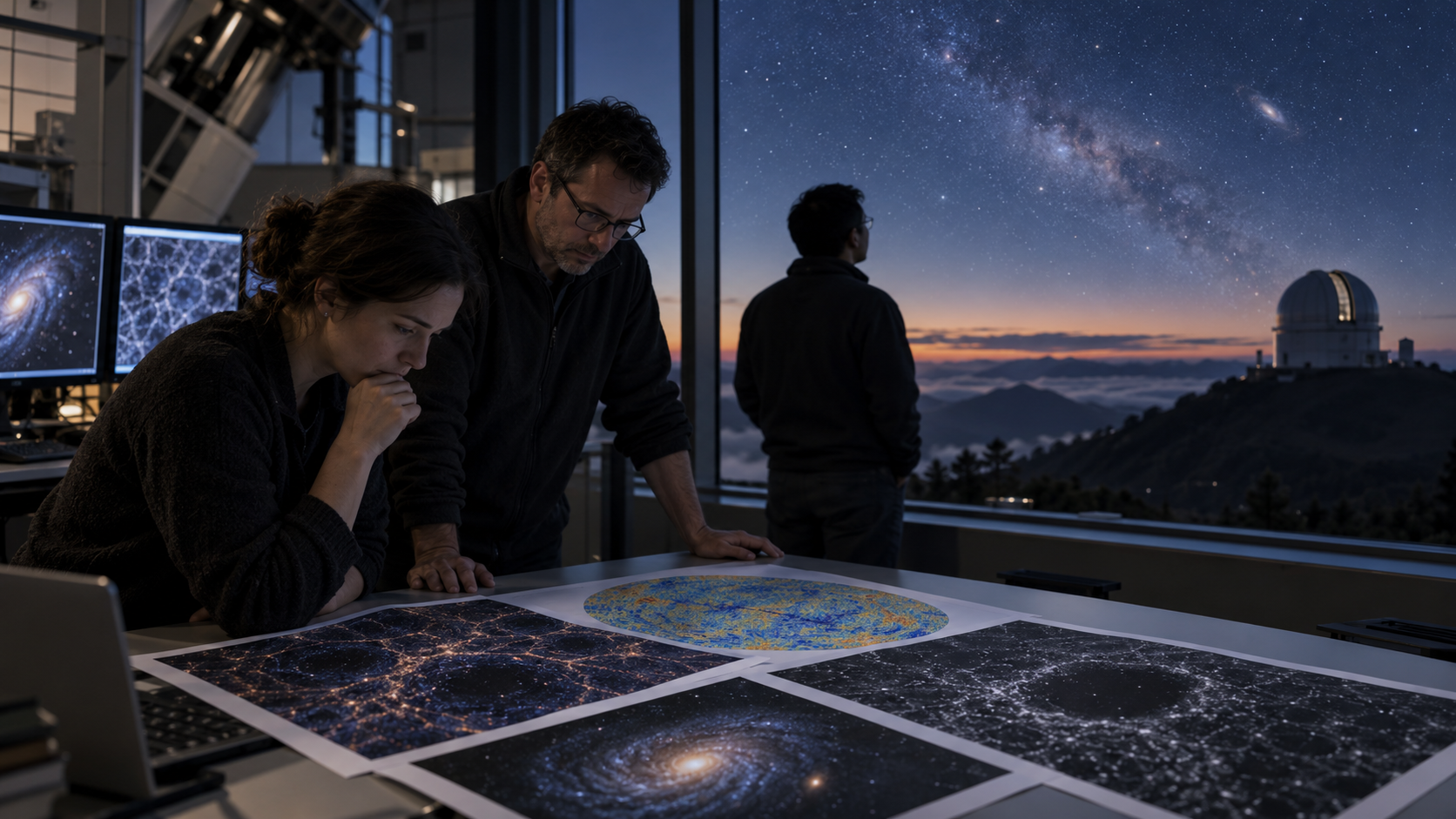
Researchers can reconstruct cosmic expansion using Type Ia supernovae, baryon acoustic oscillations, galaxy redshift surveys, and the cosmic microwave background. Larger surveys and improved distance measurements will test whether departures from a constant cosmological constant are statistically significant.
Measuring structure growth
Gravity controls how small density variations grow into galaxies, clusters, and the cosmic web. Key probes include:
- Galaxy clustering
- Weak gravitational lensing
- Galaxy-cluster abundance
- Redshift-space distortions
- The relationship between lensing mass and visible matter
These measurements can help distinguish modified gravity from evolving dark energy.
Testing local gravity
Any alternative theory must remain compatible with precise tests involving planetary motion, pulsar timing, black-hole environments, binary systems, and gravitational waves. A theory that modifies gravity only on cosmological scales may require a screening mechanism that suppresses the modification in dense or nearby environments.
What the Theory Does Not Prove
The proposal does not prove that dark energy is changing. It does not establish that dark energy does not exist, because modified gravity could replace dark energy, supplement it, or provide a different interpretation of the same observations.
It does not automatically resolve the Hubble tension. A successful theory must fit both early- and late-universe data without creating new conflicts. It also does not replace ΛCDM until it matches the full body of evidence, including the cosmic microwave background, galaxy clustering, lensing, supernova measurements, and local gravitational tests.
The proposal does not confirm hidden dimensions, five-dimensional black holes, or a connection between dark energy and neutrinos. A mathematical model becomes a physical hypothesis when it produces testable predictions. It becomes an observationally supported theory only after repeated tests show that its predictions match reality better than competing explanations.
Implications If Confirmed
Confirmation would show that general relativity requires modification on the largest scales or under specific cosmological conditions. That result would affect research into quantum gravity, spacetime geometry, and the relationship between gravity and matter.
Dark energy could turn out to be an emergent effect of gravity rather than a separate substance. Scientists would then reinterpret cosmic acceleration as evidence about the behavior of spacetime itself.
A successful extended framework might connect dark energy, dark matter, neutrinos, hidden dimensions, and cosmic expansion. Such unification would matter only if it produced precise predictions that independent observations could test.
Conclusion
An alternative gravity theory may explain why the effect associated with dark energy appears to change over time. Rather than assuming a perfectly constant cosmological component, the proposal examines whether gravity evolves across cosmic history or behaves differently on the largest scales.
The idea could address weaknesses in the cosmological constant model and offer a possible interpretation of expansion-rate tensions. ΛCDM remains the benchmark because it explains a wide range of observations. Future measurements of cosmic expansion, structure growth, gravitational lensing, the cosmic microwave background, gravitational waves, and local gravity will provide the decisive tests.
Those observations must determine whether the universe contains evolving dark energy, changing gravity, hidden geometric effects, measurement systematics, or another explanation.
Frequently Asked Questions
What is the alternative gravity theory trying to explain?
It attempts to explain cosmic acceleration without assuming that dark energy is perfectly constant. Changing gravitational behavior could produce an effect resembling time-varying dark energy.
Does the theory prove that dark energy is changing?
No. It provides a possible explanation for observations that may indicate an evolving dark-energy effect. The proposal requires comparison with expansion data, structure growth, lensing, and local-gravity measurements.
Would modified gravity eliminate dark energy?
Not necessarily. Modified gravity could replace dark energy, or both effects could contribute. The answer depends on which model best matches observations.
What is the standard cosmological model?
The standard model is ΛCDM. It describes the universe using ordinary matter, dark matter, radiation, and a cosmological constant representing dark energy. It explains many observations but faces unresolved issues, including the Hubble tension and the cosmological constant problem.
Could hidden dimensions explain the changing expansion rate?
Hidden dimensions could alter how gravity behaves across cosmological distances, potentially producing an effect similar to dark energy. This remains speculative and requires distinctive evidence.
How will scientists test the proposal?
Researchers will compare its predictions with measurements of cosmic expansion, galaxy clustering, gravitational lensing, the cosmic microwave background, gravitational waves, planetary motion, and other gravitational systems. A viable theory must explain existing observations and make successful new predictions.