Cosmic ‘Fart’ Makes a Zombie Star Flash in X-Rays
A Cosmic “Fart” Is Making a Zombie Star Flash in X-Rays
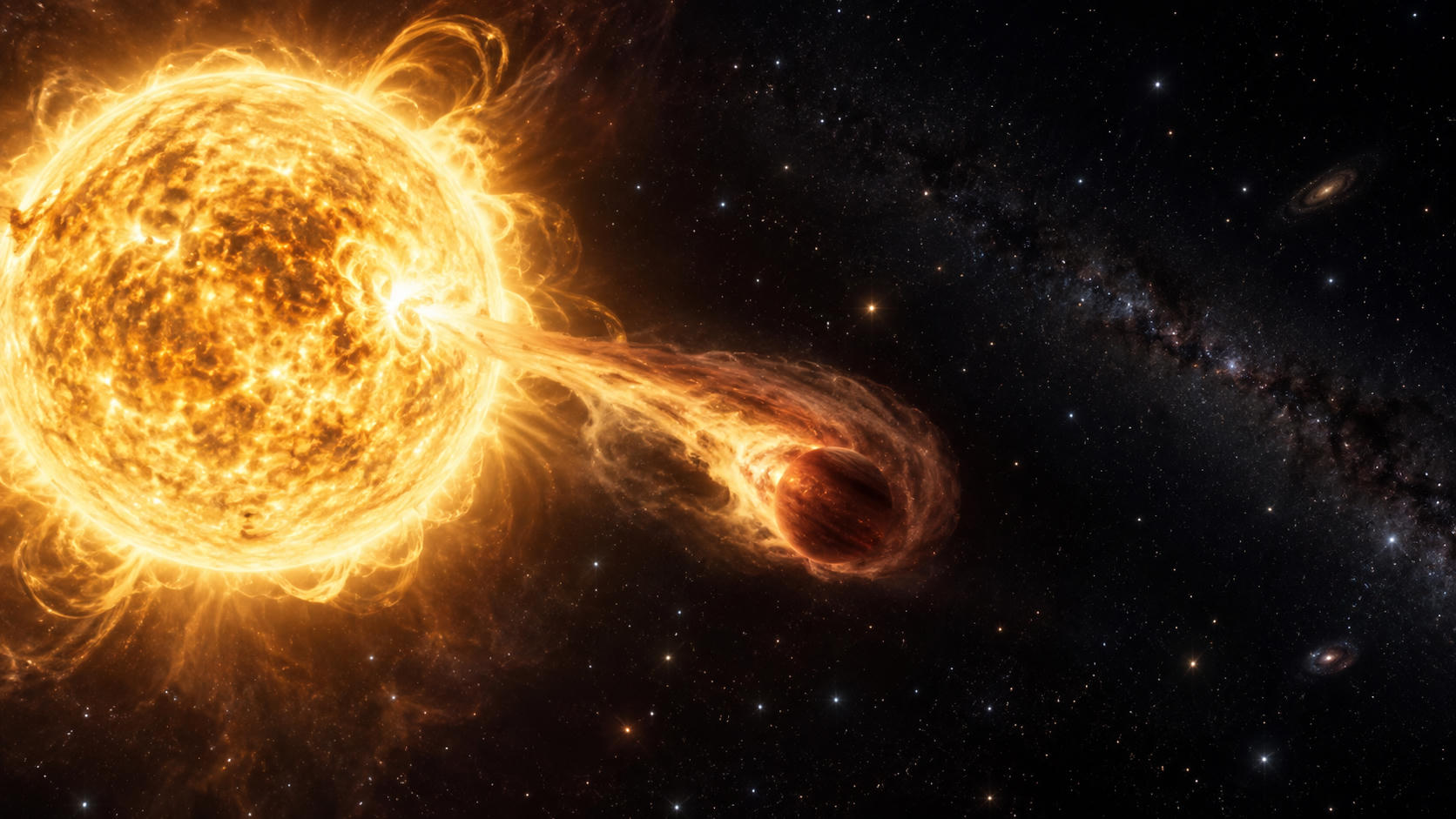
A neutron star in a distant binary system appears to flare in X-rays whenever it passes through an unusually dense plume of stellar-wind plasma. The dramatic event has been described as a cosmic “fart,” while the compact object has been nicknamed a “zombie star.”
The science is less sensational but more remarkable. The system, known as BP Crucis, contains the neutron star GX 301-2 and its massive companion, the hypergiant Wray 977. Located approximately 13,000 light-years away, the pair provides a natural laboratory for studying stellar winds, accretion and extreme X-ray emission.
Reported XRISM observations link the neutron star’s X-ray flares to its passage through dense material expelled by Wray 977. GX 301-2 also produces regular X-ray pulses approximately every 11 minutes, creating a repeating signal associated with the neutron star’s rotation. Source 9
The result is a two-part astronomical performance: Wray 977 supplies the material, GX 301-2 captures it, and the resulting accretion produces bursts of high-energy radiation detectable across interstellar space.
What the Cosmic “Fart” Really Is
A Giant Plume of Stellar-Wind Plasma
A stellar wind is a continuous flow of charged particles escaping from a star’s atmosphere. The Sun produces one, but winds from massive stars can be vastly more powerful, carrying enormous quantities of gas into surrounding space at high speeds.
Wray 977 is a hypergiant, one of the most massive and luminous types of stars. Its powerful stellar wind does not necessarily spread evenly in every direction. Instead, the outflow can contain clumps, streams, shocks and denser structures.
In the BP Crucis system, researchers propose that part of Wray 977’s wind forms a large, dense plume of plasma. GX 301-2 travels through this changing environment during its orbit. When it encounters more material, its gravity captures additional gas. The increased supply causes stronger accretion and brighter X-ray emission.
The plume is not an independent cloud drifting through space like a detached object. It is part of Wray 977’s structured outflow. “Cosmic fart” is a humorous media metaphor for this asymmetric release of stellar material, not a scientific term.
Why the Phrase Is Memorable but Misleading
Scientific descriptions would use terms such as:
- Stellar wind
- Plasma outflow
- Dense wind structure
- Accretion stream
- Wind plume
These terms describe the physical process more accurately. “Cosmic fart” makes the story memorable, but it can suggest an explosion or sound wave. Neither interpretation is correct.
The event involves charged particles and high-energy radiation. Sound cannot travel through the vacuum between stars in the ordinary way. The detected flashes are changes in X-ray brightness, not audible blasts or visible flashes seen by human eyes.
Several social-media posts repeat the colorful description of a cosmic outflow making a “zombie star” flash toward Earth. Source 1 Source 3 The underlying astrophysics concerns stellar-wind structure and neutron-star accretion.
Meet the “Wobbling Zombie Star,” GX 301-2
What Is a Neutron Star?
A neutron star is the compact remnant left after a massive star undergoes a supernova. Much of the original star’s material is expelled, while its central core collapses under gravity into an object only a few tens of kilometres across.
Despite its small size, a neutron star can contain more mass than the Sun. Its matter is compressed to extraordinary density, with atoms largely crushed apart and protons and electrons combining to form neutrons.
Neutron stars also possess:
- Extremely strong magnetic fields
- Rapid rotation
- Powerful gravitational fields
- Small physical diameters
- Hot surfaces and energetic magnetospheres
GX 301-2 produces X-rays because it captures material from Wray 977. As plasma falls toward the neutron star, it releases gravitational energy, much of which emerges as high-energy radiation.
Why It Is Called a “Zombie Star”
“Zombie star” is an informal nickname. It refers to the fact that a neutron star is the surviving remnant of a once-massive star. The original star has been destroyed, but its dense core continues to rotate and generate radiation.
The term does not describe a scientific classification. GX 301-2 is formally a neutron star, more specifically an accreting X-ray pulsar in a binary system.
The nickname also does not mean that the object has returned from the dead in any literal sense. It is a metaphor for a stellar remnant that remains active long after the original star’s outer layers have vanished.
What “Wobbling” Means Here
The phrase “wobbling star” can oversimplify the system. GX 301-2 orbits Wray 977, and its orbital motion carries it through different regions of the companion’s stellar wind.
As the neutron star moves around the binary system, the density, speed and direction of the surrounding plasma can change. That changing environment affects how much material GX 301-2 captures.
“Wobbling” may therefore refer broadly to the neutron star’s movement through the binary system rather than to a confirmed independent wobble of the neutron star itself. Without detailed evidence from the original research paper, assigning a specific wobble mechanism would be inaccurate.
How GX 301-2 Produces Repeating X-Ray Flares
Matter Falls From Wray 977 Toward the Neutron Star
Wray 977 continuously loses material through its stellar wind. GX 301-2’s gravity captures a fraction of that outflow.
The captured gas does not simply fall straight down. It can form a temporary accretion flow around the neutron star before spiralling inward. As the material approaches the compact object, gravitational energy converts into heat and radiation.
This process, called accretion, powers many of the brightest objects in the Universe, including X-ray binaries, active galactic nuclei and some young stellar systems.
The amount of radiation depends partly on the supply of material. A relatively thin section of the stellar wind may produce ordinary X-ray emission. A denser plume can deliver more plasma, intensify accretion and generate a flare.
The Neutron Star Passes Through a Dense Plasma Plume
The proposed sequence is:
- Wray 977 emits a powerful, uneven stellar wind.
- The wind contains a dense plume or structured region.
- GX 301-2 encounters that region during its orbit.
- The neutron star captures more plasma.
- Accretion becomes stronger.
- X-ray brightness increases.
The repeated relationship between orbital position and flaring supports the idea that the companion’s wind is highly structured rather than smooth and uniform. XRISM observations reportedly connected GX 301-2’s flares with its passage through the dense plume. Source 9
The plasma is not aimed at Earth. GX 301-2 is not deliberately firing a beam toward our planet. Its X-rays spread through space, and instruments near Earth detect part of that radiation.
The Approximately 11-Minute X-Ray Pulses
GX 301-2 also produces regular X-ray pulses roughly every 11 minutes. These pulses are associated primarily with the neutron star’s rotation.
The neutron star’s magnetic field channels incoming plasma toward regions near its magnetic poles. Those hot polar regions emit X-rays. As the neutron star spins, the emission regions move into and out of the observer’s line of sight.
This creates a lighthouse effect:
- Magnetic fields guide matter toward the poles.
- The polar regions become extremely hot.
- X-rays emerge from those regions.
- Rotation periodically directs the radiation toward Earth.
- Instruments record a repeating pulse.
The pulses and flares are related but not identical. Pulses mainly reflect the neutron star’s rotation and magnetic geometry. Flares mainly reflect changes in the amount of material being accreted. A denser wind plume can make the overall X-ray output brighter while the regular rotational pulse pattern continues.
What XRISM Observed
XRISM’s Role in High-Energy Astronomy
XRISM is an X-ray astronomy mission designed to study energetic objects and hot plasma. X-ray observations provide information unavailable through ordinary visible-light telescopes.
By examining X-ray brightness, timing and spectra, astronomers can investigate:
- Plasma temperature
- Chemical composition
- Gas velocity
- Density changes
- Absorption by surrounding material
- Accretion flows around compact objects
GX 301-2 is an especially useful target because its neutron star, companion star and stellar wind interact within one observable system.
Evidence Linking Flares to the Wind Plume
The reported observations indicate that GX 301-2 flares when it passes through a giant plume of plasma from Wray 977. Source 9
Timing is central to this interpretation. Researchers can compare the neutron star’s orbital position with changes in X-ray brightness. If enhanced emission repeatedly occurs during the same part of the orbit, a connection between orbital motion and wind structure becomes more likely.
The observations do not mean that XRISM photographed the plume as a visible object. X-ray missions generally infer such structures through radiation. Scientists examine changes in brightness, spectral features, absorption and timing to reconstruct what is happening around the system.
The data support a model in which Wray 977’s wind is clumpy or strongly organized. Such structure can explain why GX 301-2’s X-ray output changes as it moves through the binary environment.
Is the Finding Truly “Groundbreaking”?
“Groundbreaking” is a promotional description unless it appears in the original scientific paper or an official mission statement. Social-media reports use that language to emphasize the apparent connection between the wind plume and repeated X-ray flares. Source 7
The scientific importance is more specific. The observations may connect several processes in one system:
- Mass loss from a hypergiant star
- Structure within a stellar wind
- Orbital motion of a neutron star
- Variable accretion
- Regular X-ray pulsation
The available source summaries do not include the full research paper, publication details, technical measurements or peer-review information. The original XRISM publication and mission documentation should be checked before making precise claims about novelty, measurement accuracy or the plume’s exact geometry.
Why BP Crucis Matters to Astronomy
A Natural Laboratory for Stellar Winds
Massive-star winds influence stellar evolution, binary-system development and the chemical enrichment of galaxies. They transport material away from stars and can alter nearby companions.
Most stellar winds cannot be examined directly in detail. GX 301-2 offers an unusual advantage because its neutron-star companion responds visibly to changes in the wind. When the wind becomes denser, the neutron star accretes more material and produces stronger X-rays.
That response acts as an indirect measurement of the wind’s structure. Instead of observing only Wray 977, astronomers can study how GX 301-2 reacts as it travels through the outflow.
Understanding Accretion Around Neutron Stars
Accretion reveals how matter behaves under extreme gravity. It also shows how magnetic fields control the movement of plasma.
In this system:
- Wray 977 supplies the material.
- GX 301-2 captures the material.
- Gravity accelerates it inward.
- Magnetic fields guide it toward the neutron-star poles.
- X-ray instruments record the result.
This makes BP Crucis a natural experiment. The supply changes as the neutron star moves through the stellar wind, and the X-ray output records the consequences.
Improving Models of Massive Binary Stars
Binary interactions can change how stars lose mass, rotate and evolve. They can also influence the eventual formation of supernova remnants, neutron stars and other compact objects.
Observations of GX 301-2 may help refine models of:
- Stellar-wind clumping
- Wind density
- Plasma velocity
- Orbital interactions
- Neutron-star spin
- Accretion variability
Better models could improve understanding of the stages that precede later dramatic events, including supernovae and compact-object mergers.
What This Discovery Does Not Mean
It Is Not a Threat to Earth
BP Crucis is approximately 13,000 light-years away. The detected radiation has travelled an immense distance before reaching Earth.
Nothing in the reported observations indicates that GX 301-2 is moving toward Earth in a dangerous way. The system is not expected to affect Earth’s climate, atmosphere or technology.
The Star Is Not Flashing Visible Light
The reported flashes occur in X-rays. Human eyes cannot see X-rays, and specialized instruments are required to detect them.
“Flashing toward Earth” means that varying radiation from the system reaches Earth and is measured by space-based observatories. It does not mean that people could look into the sky and see the neutron star blinking.
The “Fart” Is Not Sound
The nickname refers to material expelled by Wray 977. It is not a sound wave.
Space between stars is an extremely thin vacuum. Sound cannot travel through it as it travels through air, water or solid material. The event involves plasma, gravity, magnetic fields and radiation.
How Scientists Test the Explanation
Timing and Orbital Position
Astronomers track when GX 301-2 becomes brighter and compare those changes with its orbital position.
Repeated flares at the same orbital phase support the idea that the neutron star encounters a persistent dense structure in Wray 977’s wind.
X-Ray Spectroscopy
An X-ray spectrum contains clues about the material producing or absorbing the radiation. Spectral features can reveal:
- Elemental composition
- Plasma temperature
- Gas velocity
- Density
- Changes in absorption
A denser wind region can alter the X-ray signal by adding more emitting material and absorbing some radiation before it reaches the observer.
Pulse Monitoring
Researchers measure the approximately 11-minute pulse cycle. Changes in pulse strength can indicate changes in accretion. Changes in pulse timing may provide information about the neutron star’s rotation and the transfer of angular momentum.
Combining pulse data with orbital timing helps separate rotational effects from flare activity.
Frequently Asked Questions
What is the cosmic “fart” in this story?
It is a humorous description of a dense plume within the stellar wind of Wray 977, the hypergiant companion of GX 301-2. “Cosmic fart” is not a scientific term.
Which star is flashing in X-rays?
The flashing object is GX 301-2, a neutron star in the BP Crucis binary system. It produces regular X-ray pulses roughly every 11 minutes and becomes brighter when it accretes additional material.
Why does GX 301-2 flare?
GX 301-2 flares when it passes through a denser region of Wray 977’s stellar wind. The neutron star captures more plasma, increasing accretion and releasing additional X-ray energy.
Is GX 301-2 sending dangerous radiation toward Earth?
No immediate danger is indicated. The system lies approximately 13,000 light-years away. “Flashing toward Earth” describes detectable radiation, not a threat.
What did XRISM observe?
The reported XRISM observations linked GX 301-2’s X-ray flares to its passage through a dense plume of stellar-wind plasma from Wray 977. Source 9
Why is GX 301-2 called a “zombie star”?
“Zombie star” is an informal nickname for a neutron star because it is the compact remnant of a formerly massive star. The scientific term is neutron star.
Conclusion
GX 301-2 appears to brighten in X-rays when it passes through dense material expelled by its hypergiant companion, Wray 977. The neutron star’s gravity captures the plasma, intensifying accretion and producing stronger high-energy radiation.
Its regular pulses, repeating roughly every 11 minutes, arise mainly from rotation and magnetic-field geometry. Its larger flares arise from changes in the amount of material available for accretion.
The cosmic “fart” is therefore a memorable but informal description of a structured stellar-wind plume. The underlying event is a measurable interaction between a massive star and a neutron-star remnant.
By studying BP Crucis, astronomers can investigate how stellar winds lose mass, how neutron stars accrete surrounding material and how extreme gravity converts falling plasma into X-rays.
Artikel Terkait
-
 Francis Halzen and IceCube’s Neutrino Breakthrough
-
 Moon and Jupiter to Align in Rare Occultation
-
 SpaceX NASA Record Claim Still Needs Verification
-
 How to See Saturn at Opposition on October 4, 2026
-
 Second-Generation Planet Candidate Around a White Dwarf
-
 Star May Be Consuming a Brown Dwarf 300 Light-Years Away