Apple TV 4K and HomePod mini 2: What to Expect
Apple TV 4K and HomePod mini 2: What to Expect
Apple’s home entertainment strategy may be entering a new phase with an updated Apple TV 4K and a second-generation HomePod mini. The products are designed to work together: Apple TV handles streaming, gaming, and television control, while HomePod mini provides room-filling audio and voice access to Siri.
Reports point to a new Apple TV 4K powered by an A19 chip and equipped with built-in microphones for direct Siri interaction. Coverage of the HomePod mini 2 focuses on audio improvements and a more capable Siri experience. However, specifications, compatibility details, prices, and release dates remain unconfirmed. These reported features should not be treated as final until Apple publishes official documentation.
The practical questions are straightforward:
- Do the audio updates make the HomePod mini 2 noticeably better?
- Does Siri AI make voice control more natural and useful?
- Do the new features justify replacing existing Apple TV or HomePod mini hardware?
Early hands-on reports provide useful direction, but a final judgment requires tested retail hardware, finalized software, and confirmation of regional availability.
Apple TV 4K: What Could Change?
A Familiar Design With a Faster Platform
The next Apple TV 4K is expected to retain Apple’s compact set-top-box design. That approach remains practical because the current hardware fits easily beside a television, soundbar, or game console. Improvements to performance, connectivity, and voice control would matter more than a major redesign.
The most significant reported internal change is the use of an A19 chip. This claim comes from reporting about Apple’s television hardware plans rather than a confirmed Apple specification sheet. A faster processor could improve:
- App launch times
- Menu navigation
- Switching between streaming services
- Game performance
- On-device processing for future Siri features
- Demanding video and graphics functions
The chip alone may not transform everyday streaming. Netflix, Disney+, YouTube, and other services still depend on their own apps, servers, and interfaces. Owners of a recent Apple TV 4K may notice improved responsiveness, but the difference could be subtle.
A useful review should measure app launch times, service switching, Siri performance, remote response, and stability during extended viewing. Benchmarks provide context, but practical testing matters more.
Built-In Microphones Could Change Siri
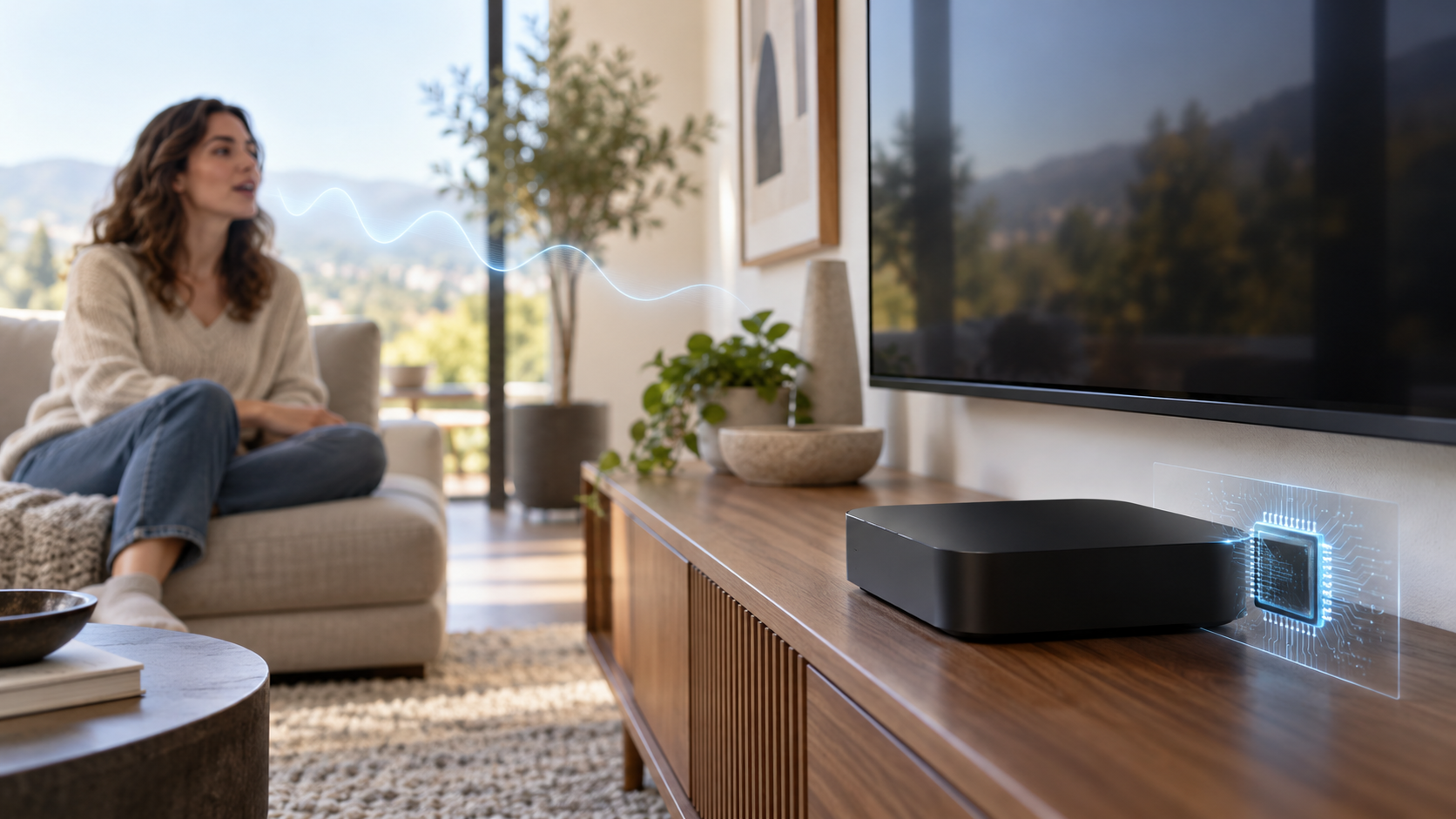
The reported addition of built-in microphones could be more important than the processor upgrade. The Verge reports that the new Apple TV 4K may allow users to speak directly to Siri without holding the Siri Remote.
Current Apple TV voice interaction generally depends on the microphone in the Siri Remote, an iPhone or iPad, or a nearby HomePod. Built-in microphones could make commands faster and more natural from across a room.
Potential uses include:
- Searching for films and television shows
- Pausing, resuming, or rewinding content
- Opening a streaming app
- Finding information about an actor
- Controlling compatible lights, thermostats, or scenes
- Adjusting playback volume
- Finding the next episode in a series
The experience will depend on microphone placement, wake-word detection, background-noise handling, and supported commands. Loud television audio, multiple speakers, or long distances could still cause recognition problems.
Privacy also becomes more important when microphones are built into a device that remains connected to a television. Apple should explain microphone controls, wake-word behavior, cloud processing, and whether the microphones can be disabled.
Streaming, Gaming, and Navigation
The Apple TV 4K is expected to remain a hub for streaming apps, Apple TV content, AirPlay, HomeKit controls, and Apple Arcade games. A new processor could improve transitions and reduce delays, but the broader experience will still depend on tvOS and third-party software.
Apple’s ecosystem remains a major advantage. AirPlay makes it easy to send video, music, or photos from an iPhone or iPad. HomeKit integrates the television into a wider smart-home setup, while Apple Arcade supports casual and controller-based gaming without a separate console.
HomePod mini 2: Potential Audio Improvements
Compact Design and Practical Placement
The HomePod mini 2 is expected to remain a compact smart speaker for bedrooms, kitchens, offices, entryways, and living rooms. Its small size makes it easy to place in multiple rooms or use as part of a stereo pair.
Compact speakers have practical limits. They can provide clear vocals and balanced music, but they usually cannot match a larger speaker’s bass extension, maximum volume, or physical soundstage. The HomePod mini 2 should therefore be compared with the original HomePod mini rather than with larger HomePod models.
Placement will influence the result. A speaker near a wall may produce stronger bass, while a corner can exaggerate low frequencies. A central position may provide a more even presentation.
What to Test
Early coverage discusses audio updates, but confirmed technical details about drivers, amplifiers, and acoustic architecture remain unavailable. The most useful evaluation should focus on audible results:
- Vocal clarity in podcasts and audiobooks
- Bass presence and control
- Treble detail without harshness
- Distortion at higher volumes
- Balance at quiet listening levels
- Instrument separation
- Soundstage from a single speaker
- Consistency across different rooms
Speech is especially important because the HomePod mini often serves as an information and control device. Siri responses should remain clear when the speaker is across a room or competing with background noise.
Music testing should include acoustic recordings, electronic tracks, podcasts, and spoken-word content. Improvements may be obvious in bass control or vocal separation, or subtle enough that existing owners notice them only during direct comparison.
Claims about spatial audio or other advanced formats require confirmation. A small speaker may create a convincing sense of space, but that does not make it equivalent to a larger stereo system or dedicated home theater.
HomePod mini 2 as an Apple TV Companion
The HomePod mini 2 could become more useful when paired with Apple TV 4K. Possible configurations include:
- One HomePod mini as the default audio output
- Two HomePod mini speakers as a stereo pair
- Multiroom playback through AirPlay
- Siri control of television playback
- Dialogue-focused listening for shows and films
Compared with basic television speakers, one HomePod mini may provide clearer dialogue and a more balanced presentation. Two speakers should create a wider stereo image and better separation. They are unlikely to deliver the low-frequency impact or surround effects of a dedicated soundbar and subwoofer.
Wireless audio also introduces practical considerations. Setup may depend on the same Apple account, network, and software requirements. Buyers should check for audio delay, format compatibility, and synchronization issues.
Siri AI: The Main Software Story
More Natural Voice Requests
Siri AI could become the most important part of both products. Hardware improvements matter, but users experience these devices through commands, questions, and follow-up requests.
Potential improvements include:
- Better understanding of natural phrasing
- Greater tolerance for incomplete commands
- More reliable follow-up questions
- Improved conversational context
- Better handling when users change topics
- More accurate completion of actions
Possible requests include “Play the next episode,” “Show me films with that actor,” and “Turn the volume down a little.” These examples illustrate potential use cases, not confirmed features. Apple must document them or testing must demonstrate reliable support.
A useful AI assistant must do more than answer general questions. It should complete actions accurately, explain when it cannot complete them, and avoid forcing users to repeat commands in rigid wording.
Siri on Apple TV 4K
Built-in microphones could make Siri easier to access while users watch television. Testing should cover quiet rooms, loud playback, background music, and conversations involving several people.
Important tests include whether Siri can find specific films, search by actor or genre, pause and rewind playback, open apps, recommend related content, control compatible smart-home devices, and understand requests from a distance.
Voice control can be more convenient than typing with the remote, especially for long titles or names. Accuracy determines whether it saves time. A misunderstood command can be slower than manual control.
Siri on HomePod mini 2
The HomePod mini 2 remains primarily a voice-first smart-home device. Siri can control music, timers, reminders, weather requests, alarms, and compatible accessories. AI improvements could make these interactions less dependent on exact phrasing.
The difference between answering and acting matters. Siri may answer a weather question but fail to complete a multi-step smart-home routine. More capable AI should improve both understanding and execution.
Useful tests include setting and cancelling timers, requesting music by mood or activity, asking follow-up questions, controlling lights and scenes, managing reminders, and switching between unrelated subjects.
Performance will depend on Apple account settings, app integrations, supported languages, and regional availability. Siri AI features may also require specific software versions or account settings.
Cross-Device Context and Handoff
The combination of Apple TV 4K and HomePod mini 2 could be more valuable than either product alone. Users might ask HomePod mini to control television playback, use the Apple TV microphone for room-wide commands, or control lights while watching a film.
Possible workflows include:
- “Pause the Apple TV.”
- “Turn off the living-room lights.”
- “Play the next episode.”
- “Set the temperature to 21 degrees.”
- “Start the movie where I left off.”
Full cross-device continuity should not be assumed. Starting a request on one device and completing it on another requires software support, account recognition, and consistent context handling.
Should Existing Owners Upgrade?
Apple TV Owners
The strongest reasons to upgrade include faster navigation, built-in microphone access, new Siri AI features, longer software support, potentially better gaming performance, and improved smart-home integration.
Waiting may be sensible if a current Apple TV 4K already feels fast, Siri AI arrives on older models, or the new features depend mainly on software. Reports indicate that some older Apple TV models may receive Siri AI capabilities, but supported models, limitations, and rollout timing remain unclear.
HomePod mini Owners
Existing owners should compare audible sound quality, Siri recognition, smart-home reliability, stereo-pair compatibility, software support, and AI feature requirements. A hardware upgrade may not be necessary if the main improvements arrive through software.
New buyers may gain the most because the HomePod mini 2 would provide the current feature set without requiring a comparison. Existing owners should upgrade only if the sound quality, Siri reliability, or compatibility improvements address a real limitation.
Privacy, Compatibility, and Availability
Built-in microphones change the privacy discussion. Buyers should ask:
- How is the wake word detected?
- What happens after activation?
- Can the microphones be disabled?
- Which requests require cloud processing?
- What controls appear in the Home app?
- Are voice recordings stored, and for how long?
These answers must come from Apple’s final hardware and software documentation.
Compatibility may depend on current tvOS and HomePod software, Siri AI or Apple Intelligence settings, supported languages, Apple account region, compatible streaming apps, HomeKit accessories, and network configuration. Features may roll out gradually, so buyers should check Apple’s official compatibility pages before purchasing.
Final Verdict
The reported Apple TV 4K and HomePod mini 2 updates could improve Apple’s home entertainment ecosystem, but their value depends on execution.
The A19 chip could make Apple TV faster and better prepared for advanced Siri features. Built-in microphones could make voice control more convenient, although they introduce important privacy questions. HomePod mini 2 audio improvements should be judged through direct listening tests rather than specifications alone.
Siri AI may become the most significant long-term change if it understands context, handles follow-up questions, and completes actions reliably. If it only provides slightly better answers, the upgrade case will be weaker.
The products appear most compelling for new Apple ecosystem buyers and users who want better voice control. Existing owners should wait for verified differences in audio quality, microphone performance, software support, pricing, and regional availability.
Frequently Asked Questions
Is the Apple TV 4K expected to include the A19 chip?
Reports indicate that the updated Apple TV 4K may use an A19 chip. Apple must confirm the final specification.
Does the new Apple TV 4K have built-in microphones?
The Verge reports that the new Apple TV 4K includes built-in microphones for direct Siri interaction. Apple still needs to confirm microphone behavior, privacy controls, and availability.
What audio improvements does the HomePod mini 2 offer?
Early coverage focuses on potential improvements to clarity and playback. A useful comparison should examine vocals, bass, detail, distortion, listening volume, and stereo-pair performance against the original HomePod mini.
Will older Apple TV models receive Siri AI features?
Some reports indicate that older Apple TV models may receive Siri AI capabilities. Supported models, feature limitations, and rollout timing remain unconfirmed.
Can the HomePod mini 2 replace a soundbar?
One HomePod mini 2 may improve dialogue and sound quality compared with basic television speakers. It may not replace a soundbar for large-room audio, deep bass, or cinema-style surround sound.
Should current Apple TV and HomePod mini owners upgrade?
Upgrade value depends on Siri AI availability, audio quality, microphone performance, compatibility, and price. Owners of recent models should compare confirmed features before replacing working devices.
Sources
Artikel Terkait
-
 Apple’s Siri-Powered Smart Home Strategy Explained
-
 GTA 6 PC Release Date Reportedly Set for Early 2027
-
 Apple Smart Home Lineup: Lock, Thermostat and Doorbell
-
 Apple HomeView: What the Home Collection Could Mean
-
 Apple HomeView: What We Know About the Siri Smart Hub
-
 Apple TV 4K 2026: Siri AI, A19 Chip, and $299 Price